2D gameSkill-based idle RPGOriginal by Games by Malcs
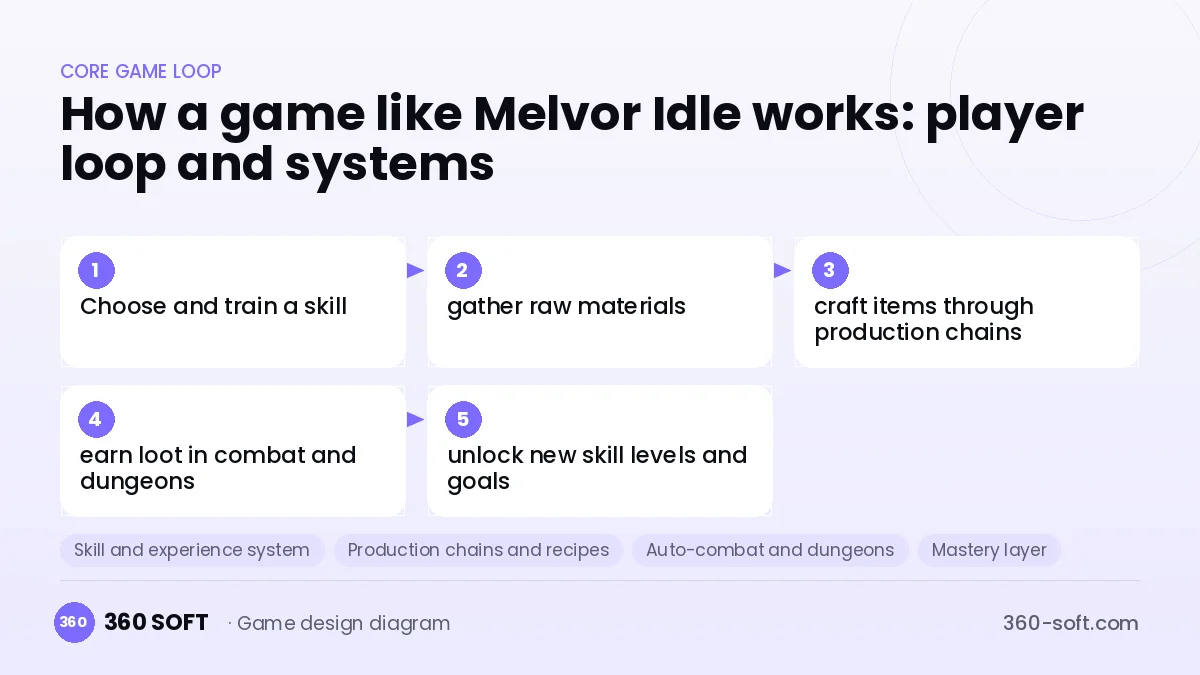
Melvor Idle distils RuneScape-style skill progression into a menu-based idle game. Skills such as woodcutting, fishing, mining, smithing and cooking feed into each other; the raw materials you gather become crafting inputs, what you craft goes into combat, and combat loot turns into new goals. Levelling up even while the game is closed and coming back to a full inventory creates a deeply satisfying loop for players who love planning.
A similar game needs interconnected skill and crafting chains, a database with hundreds of items, experience curves, auto-combat and dungeons, a second progression layer like mastery and reliable offline calculation. The visual load is low but the content and balance load is very high; a data-driven structure for items and recipes, a good interface and cloud save are the heart of the project.
Why Melvor Idle works: the core loop
Systems you need to build a game like Melvor Idle
Skill and experience system
Gathering, crafting and combat skills, each with an experience curve, level locks and efficiency bonuses.
Production chains and recipes
A recipe network running from raw materials to intermediates to equipment; a data-driven structure that is easy to extend.
Auto-combat and dungeons
Turn-based auto-combat driven by equipment, food and spell consumption; loot tables and end-of-dungeon bosses.
Mastery layer
A second progression axis for individual items and actions; long-term goals and efficiency rewards.
Offline simulation
A progression engine that deterministically calculates time away, respecting resource and inventory limits.
Inventory, bank and UI
Filtering, sorting and equipping hundreds of items; in a menu-heavy game, a readable, fast interface is essential.
What goes into the first version, what comes later
First version (soft launch)
- Six to eight skills and a core production chain
- Auto-combat and a few areas
- Offline progress and local saves
- Inventory/bank and equipment system
- Starter goals and guided tasks
Later updates
- Dungeons, bosses and the mastery layer
- Cloud save and cross-platform progress
- Expansion packs and new skills
- Community mod support
The hard parts of this genre
Content and balance volume
Hundreds of items, recipes and monsters have to feed into each other correctly; a single faulty recipe can break the economy. Database tools and testing are important.
Offline calculation accuracy
Calculating hours of offline progress quickly, correctly and in a cheat-proof way needs technical care.
Menu-heavy interface
In games played through UI rather than graphics, balancing information density against simplicity is hard, especially on a phone screen.
Team, timeline and budget
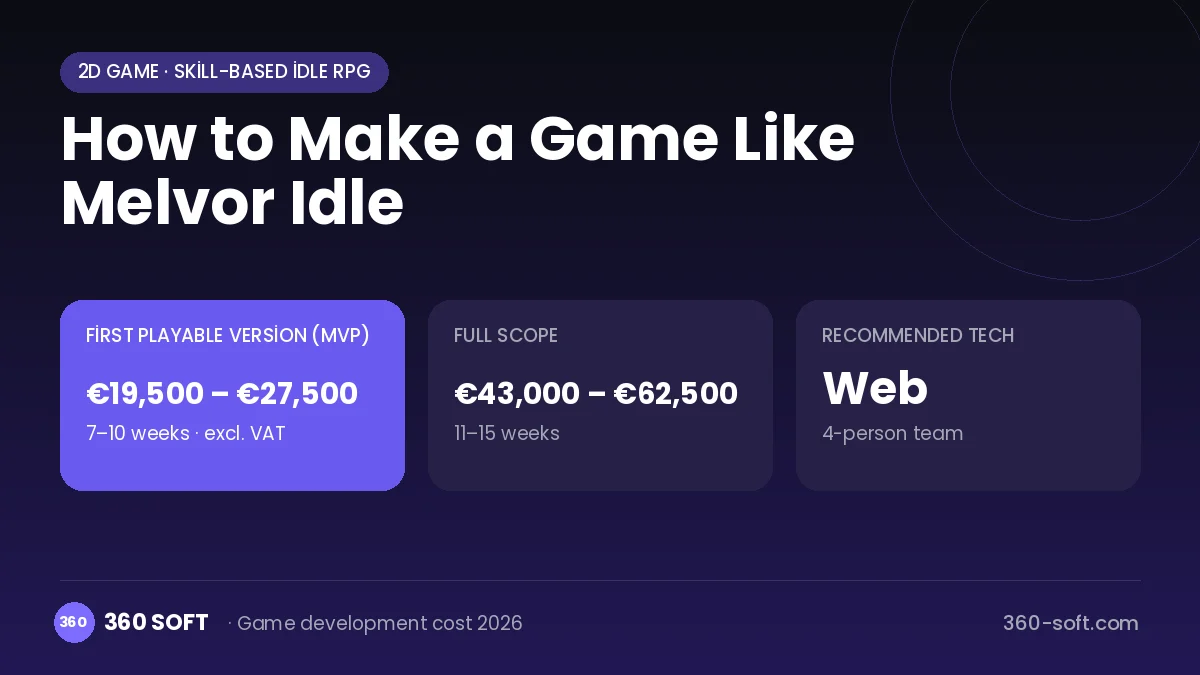
The estimate is based on the genre’s core systems, content volume, multiplayer and live-ops needs plus QA and project management: about 165 person-days for the full scope and 74 person-days for the first version. Cutting scope (fewer levels, one map, fewer characters) lowers the budget directly. Store accounts, servers, audio licences and user-acquisition budget are separate items. We send a fixed written price within 24 hours after the game design document.
Monetisation
For this genre, a premium one-off purchase or a free trial with a full-version unlock works well, followed by paid expansion packs. On mobile, an ad-free full-version bundle can be offered. The community is sensitive to paid advantages; cosmetics and content expansions are the most accepted model.
Estimate your game budget and get a fixed quote
Let us scope it together and send a fixed written quote within 24 hours. NDA on request; you own the source code.
Calculated instantly from your choices, excl. VAT. A fixed written quote follows a free scoping call within 24 hours.
Choosing a game development company for a game like Melvor Idle
Most people searching “make a game like melvor idle” are really looking for a reliable game development company. When comparing quotes, check four things:
- Can you play their released 2D games on your own phone?
- Are the source code, art files and store accounts transferred to you by contract?
- Do they build a playable prototype first and show a demo every two weeks?
- Are ads, in-app purchases and analytics set up as part of the quote?
Copyright and originality
Game mechanics on their own are generally not protected, but names, logos, characters, art, audio and level designs are. That is why we build a game “like Melvor Idle” with your own name, art and world. This is not legal advice; we recommend a trademark search before launch.
Frequently asked questions
How long does it take to make a game like Melvor Idle?
A first version with a few skills and auto-combat can be built in a few months by a small team. But the genre’s strength is content depth; a full game needs a long content and balancing process.
Will there be copyright issues?
Skill-based progression and idle crafting mechanics are generally free to use. The game’s name, item and monster art, text and names belonging to another game’s world cannot be copied. This is not legal advice.
Can I make it on my own?
Because the visual load is low, it is one of the genres a solo developer can start. Over time, though, extra help may be needed for balance, content and icon art.
Web technology or a game engine?
For menu-heavy games, web technologies speed up UI development and package easily for browser, mobile and PC. If you want more animation and effects, Godot or Unity are good choices.