3D gameProcedural space exploration and survival sandboxOriginal by Hello Games
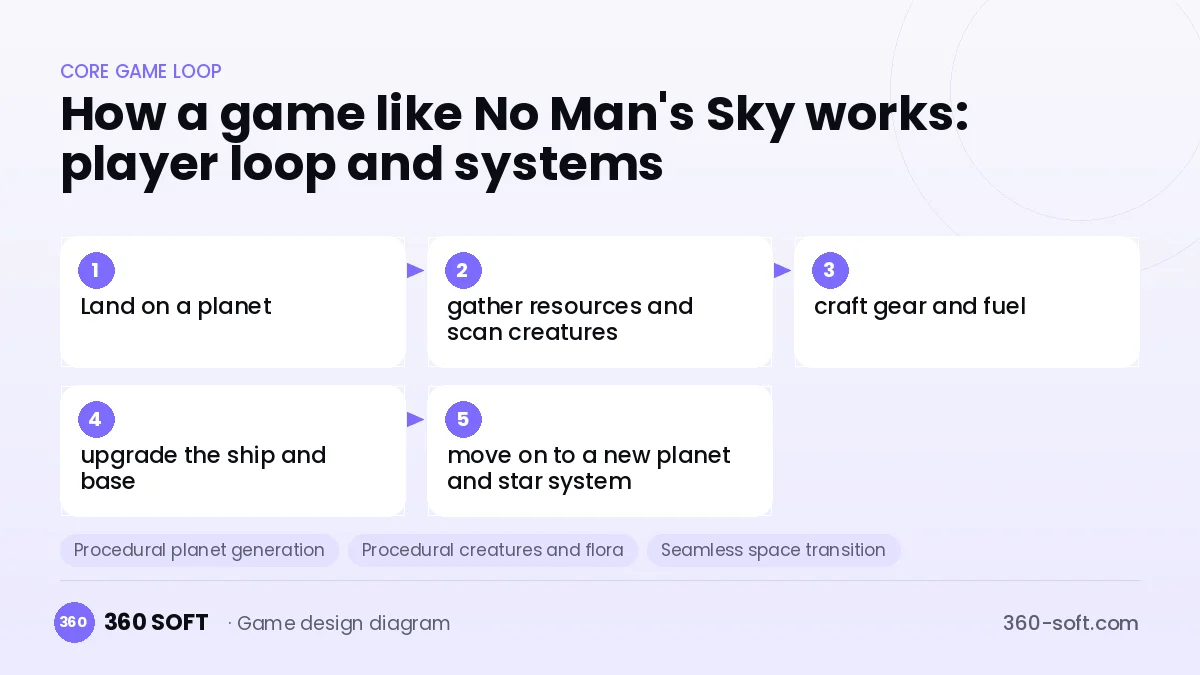
No Man's Sky gives players the feeling of discovering never-before-seen planets in a nearly infinite universe. You land on a planet, gather resources, catalogue strange creatures, upgrade your ship and jump to the next star system. Thanks to procedural generation, every planet's colours, climate and wildlife are different. With its big free updates over the years, the game has also become a well-known example of rebuilding trust with a community.
For a similar game, the heart is the procedural generation system for planets, terrain, plants and creatures, plus seamless transitions from planet surface to space, resource gathering and crafting, base building and ship systems. A realistic target for a small team is a first “No Man's Sky-style” release with one star system, three or four planet types and a core crafting loop. Procedural generation promises infinite variety, but meaningful variety is a separate design job.
Why No Man's Sky works: the core loop
Systems you need to build a game like No Man's Sky
Procedural planet generation
Terrain, biomes, colour palettes and climate generated with noise functions, with the same seed always producing the same planet.
Procedural creatures and flora
Creatures and vegetation built from part combinations, with rules that prevent nonsensical results.
Seamless space transition
Flying from the planet surface to the atmosphere and space with no loading screens, requiring large-scale coordinate and streaming management.
Resource gathering and crafting
A mining tool, element types, recipes and inventory, plus fuel and survival resources.
Ship and gear upgrades
Ship, suit and tool modules along a progression axis of range, shields and capacity.
Base building
Building modular structures on a planet's surface, a permanent home and resource production point.
What goes into the first version, what comes later
First version (soft launch)
- One star system and 3–4 planet types
- Procedural terrain, flora and simple creature generation
- Resource gathering, crafting and basic survival
- Seamless planet-to-space transition and one ship
- Single-player only, no multiplayer mode
Later updates
- Multiple star systems and a galaxy map
- Base building and fleet management
- Multiplayer exploration and shared bases
- Story missions, space stations and trading
The hard parts of this genre
Meaningful variety
Procedural generation can quickly produce planets that look alike; a blend of handcrafted elements and good rules is essential.
Huge scale and precision
Planet and space scales cause floating-point precision issues, requiring solutions such as origin shifting.
Managing expectations
Promising features in marketing that are missing from the game shakes community trust; announce features only when they are ready.
Team, timeline and budget
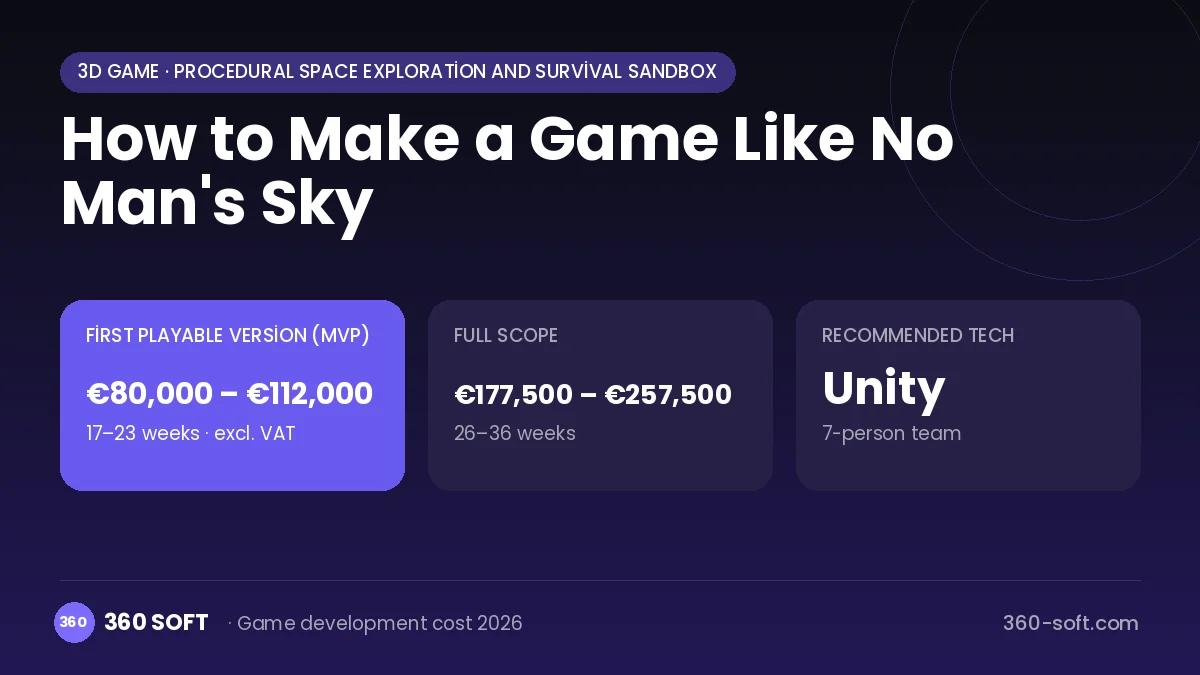
The estimate is based on the genre’s core systems, content volume, multiplayer and live-ops needs plus QA and project management: about 683 person-days for the full scope and 307 person-days for the first version. Cutting scope (fewer levels, one map, fewer characters) lowers the budget directly. Store accounts, servers, audio licences and user-acquisition budget are separate items. We send a fixed written price within 24 hours after the game design document.
Monetisation
Space exploration sandboxes usually sell as premium games; Early Access can be a good fit for developing procedural systems together with players. Big free updates can build community trust and support long-term sales. Cosmetic ship and suit packs bring extra revenue, while console versions and cross-play widen the audience.
Estimate your game budget and get a fixed quote
Let us scope it together and send a fixed written quote within 24 hours. NDA on request; you own the source code.
Calculated instantly from your choices, excl. VAT. A fixed written quote follows a free scoping call within 24 hours.
Choosing a game development company for a game like No Man's Sky
Most people searching “make a game like no mans sky” are really looking for a reliable game development company. When comparing quotes, check four things:
- Can you play their released 3D games on your own phone?
- Are the source code, art files and store accounts transferred to you by contract?
- Do they build a playable prototype first and show a demo every two weeks?
- Are multiplayer servers, anti-cheat and scaling costs written into the quote?
Copyright and originality
Game mechanics on their own are generally not protected, but names, logos, characters, art, audio and level designs are. That is why we build a game “like No Man's Sky” with your own name, art and world. This is not legal advice; we recommend a trademark search before launch.
Frequently asked questions
How long does it take to make a game like No Man's Sky?
An MVP with one star system and a few planet types can take an experienced small team about a year or slightly more. Getting variety right in procedural generation is the most time-consuming work.
Will there be copyright issues?
Procedural space exploration, crafting and base building are free to use. The No Man's Sky name, its original art direction, alien races, story and UI design cannot be copied. This is not legal advice.
Can a small team build one?
Procedural generation reduces content needs, which helps small teams. Technical topics such as seamless planet-to-space transitions, however, need an expert engine programmer.
What should I look for when choosing a studio to build a game like No Man's Sky?
Look for procedural generation, shader programming and performance optimisation experience. A prototype that generates several different planets shows the team's capability well.