3D gameFirst-person survival horror (no combat)Original by Red Barrels
Outlast takes the weapon out of the player's hands and delivers fear in its rawest form: you cannot fight, you can only hide and run. You find your way through dark corridors using a camcorder's night vision, and footsteps behind you as the battery runs low push tension through the roof. Hiding in lockers and under beds, and slamming doors behind you during chases, are some of the genre's most memorable moments.
For a similar game, you need to build embodied first-person movement, hiding, chase AI and a camera/battery mechanic. Sound and lighting design are half the success. A realistic target for a small team is a first “Outlast-style” release with one building, a few stalker enemies and a short 1–2 hour story. Because this genre works well with limited locations and content, it suits independent teams.
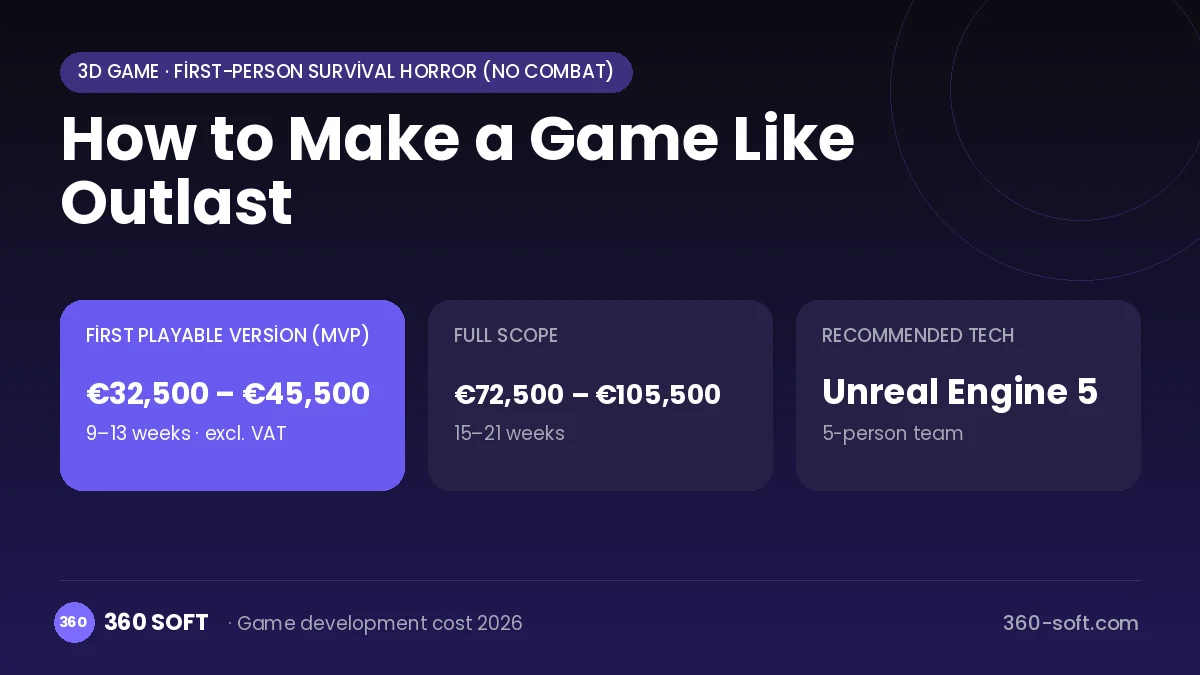
Why Outlast works: the core loop
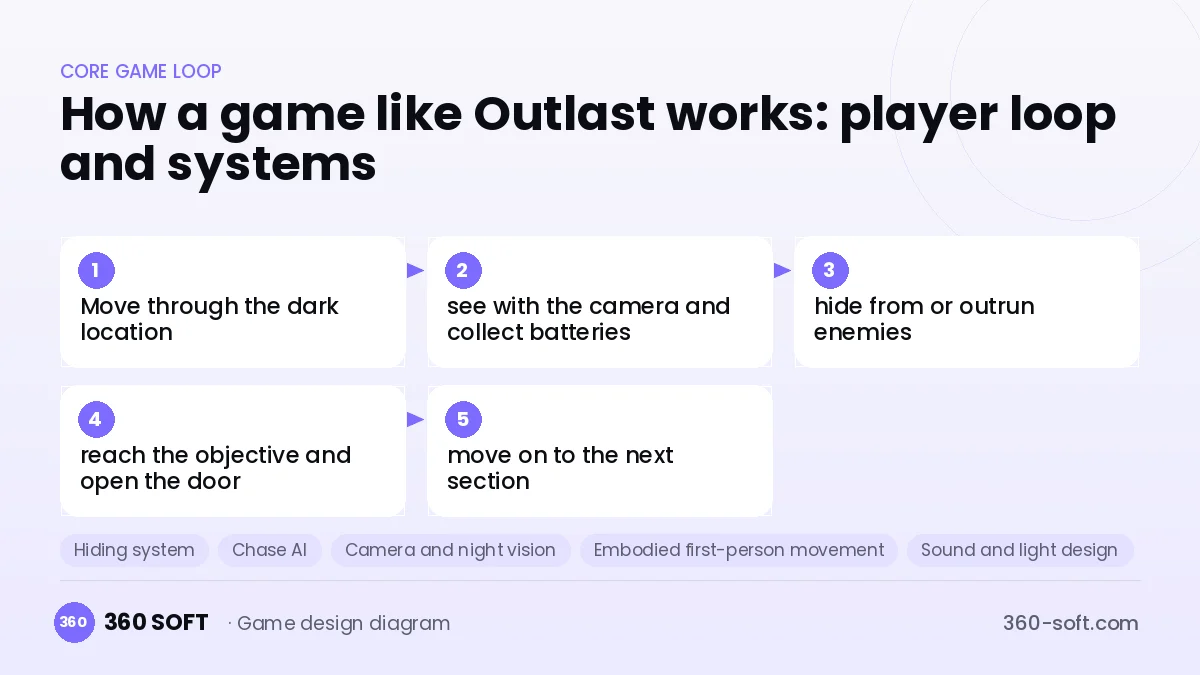
Systems you need to build a game like Outlast
Hiding system
Lockers, beds and dark corners, with breathing sounds while hidden and enemies that search for you.
Chase AI
Enemies that pursue the player on sight, break doors, lose track and search again: fair but ruthless behaviour.
Camera and night vision
Night vision that drains batteries, making constant resource management the price of seeing in the dark.
Embodied first-person movement
Crouching, peeking around corners, climbing and sliding, with camera work and animation that make you feel the character's body.
Sound and light design
Footsteps, breathing, positional audio and limited light: the most important tools for carrying fear.
Documents and recordings
Notes that tell the story and events captured on the camera, rewarding exploration.
What goes into the first version, what comes later
First version (soft launch)
- One building and a short 1–2 hour story
- Hiding, escaping and basic parkour moves
- Camera, night vision and battery system
- 2–3 stalker enemies and a few scripted chases
- Single-player only, no multiplayer mode
Later updates
- New chapters and locations
- Difficulty modes and randomised enemy placement
- An experimental co-op mode
- Accessibility and disturbing-content settings
The hard parts of this genre
Chase balance
Enemies that are too fast make the game punishing, too slow and it is not scary; the mix of scripted and systemic chases must be tuned.
Fear that survives repetition
Fear fades as players die and replay the same scene; checkpoints and enemy behaviour must be designed with this in mind.
Limits on disturbing content
The level of violence and disturbing content affects age ratings and platform approval; decide on it from the start.
Team, timeline and budget
The estimate is based on the genre’s core systems, content volume, multiplayer and live-ops needs plus QA and project management: about 278 person-days for the full scope and 125 person-days for the first version. Cutting scope (fewer levels, one map, fewer characters) lowers the budget directly. Store accounts, servers, audio licences and user-acquisition budget are separate items. We send a fixed written price within 24 hours after the game design document.
Monetisation
Survival horror games without combat sell as premium titles and are usually short but intense experiences. Content creators' reaction videos are the genre's strongest marketing channel. Story DLC can follow, and if a multiplayer mode is added, cosmetic skins bring extra revenue. A short demo also makes it easier for creators to discover the game.
Estimate your game budget and get a fixed quote
Let us scope it together and send a fixed written quote within 24 hours. NDA on request; you own the source code.
Calculated instantly from your choices, excl. VAT. A fixed written quote follows a free scoping call within 24 hours.
Choosing a game development company for a game like Outlast
Most people searching “make a game like outlast” are really looking for a reliable game development company. When comparing quotes, check four things:
- Can you play their released 3D games on your own phone?
- Are the source code, art files and store accounts transferred to you by contract?
- Do they build a playable prototype first and show a demo every two weeks?
- Are ads, in-app purchases and analytics set up as part of the quote?
Copyright and originality
Game mechanics on their own are generally not protected, but names, logos, characters, art, audio and level designs are. That is why we build a game “like Outlast” with your own name, art and world. This is not legal advice; we recommend a trademark search before launch.
Frequently asked questions
How long does it take to make a game like Outlast?
A horror MVP with one building and a short story can take an experienced small team around 6–10 months. Chase AI and audio are the most labour-intensive parts.
Will there be copyright issues?
Mechanics such as an unarmed protagonist, camcorder night vision and hiding are generally free to use. The Outlast name, characters, locations and story cannot be copied. This is not legal advice.
Can a small team build one?
Yes; this is one of the genres best suited to small teams. A limited location, few enemies and a strong atmosphere are enough.
What should I look for when choosing a studio to build a game like Outlast?
Look for first-person horror, sound design and AI experience. An early chase prototype shows the team's ability to build tension well.