3D gameCo-op kitchen chaos party gameOriginal by Ghost Town Games
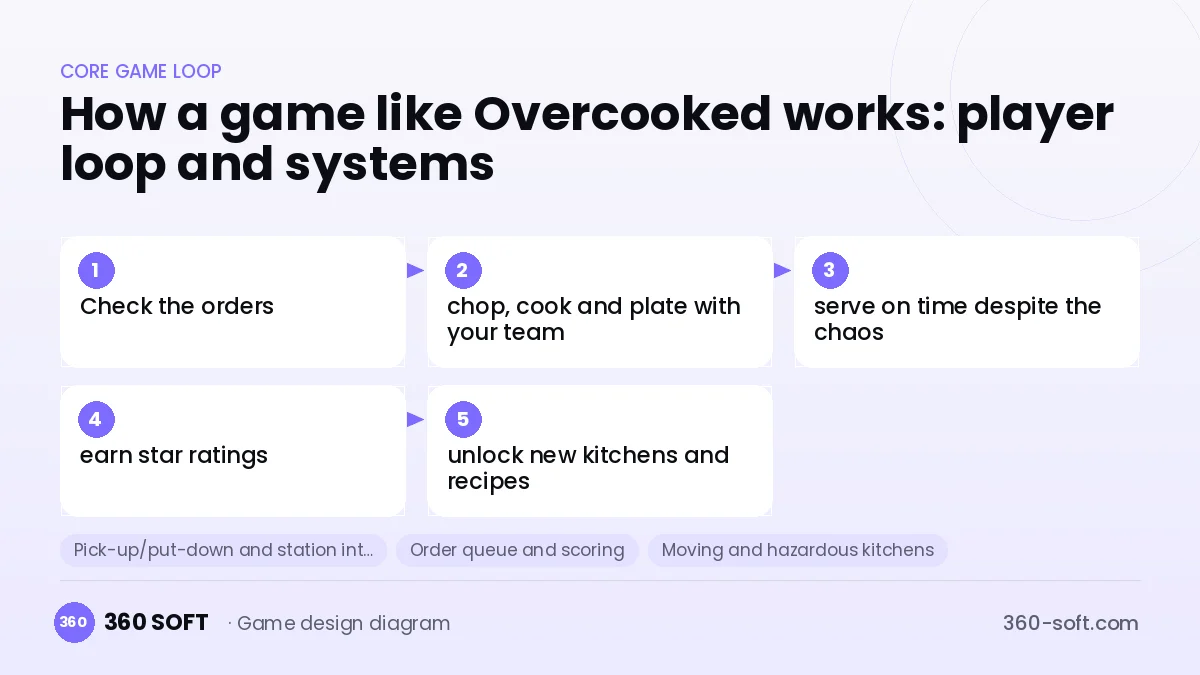
Overcooked combines simple cooking tasks with time pressure and four-player chaos to create an unforgettable party experience. Players chop ingredients, cook them, plate up and serve; but the kitchen splits in two, counters slide, fires break out and orders pile up. To win, players have to shout constantly and divide the work. That need to communicate creates a social ritual full of laughter and little arguments that people play again and again.
At the heart of a similar game sits a simple but tight interaction system: one-button pick-up/put-down, chopping and cooking stations, an order queue and scoring. The real creativity lies in level design: moving platforms, splitting kitchens and hazards. Technically you build local four-player multi-controller support, online sync and a level editor.
Why Overcooked works: the core loop
Systems you need to build a game like Overcooked
Pick-up/put-down and station interaction
One-button interaction with ingredients, plates and tools; chopping, cooking, washing and serving stations. Simple controls are the key to the party.
Order queue and scoring
Time-limited orders, tip streaks and star thresholds. Generates tension and the urge to retry at the same time.
Moving and hazardous kitchens
Sliding counters, platforms that split apart, fires and obstacles. Each level turns the same task into a different puzzle.
Recipe and ingredient database
Recipe steps, ingredient states (raw, chopped, cooked, burnt) and visual feedback kept data-driven.
Local four-player controls
Four players on one screen, a shared-controller option and character switching for solo play.
Online synchronisation
Keeping who holds which object, cooking timers and moving platforms consistent for every player.
What goes into the first version, what comes later
First version (soft launch)
- 15–20 levels and 2–3 kitchen themes
- 6–8 recipes with chopping, cooking and washing stations
- Order queue, scoring and star system
- Local four-player mode
- Basic online co-op
Later updates
- New themes, recipes and moving kitchens
- Competitive team mode
- Level editor and community sharing
- Cross-platform play and a mobile adaptation
The hard parts of this genre
Balancing chaos and fairness
Chaos is fun, but players must feel that failure was their own fault. Hazards and moving platforms have to be readable and predictable.
Online latency
Passing plates and fast interactions are very sensitive to latency. Object ownership and prediction mechanisms must be built carefully.
Solo experience
Because the game is designed for co-op, it also needs a reasonable experience for solo players (character switching, adjusted difficulty).
Team, timeline and budget
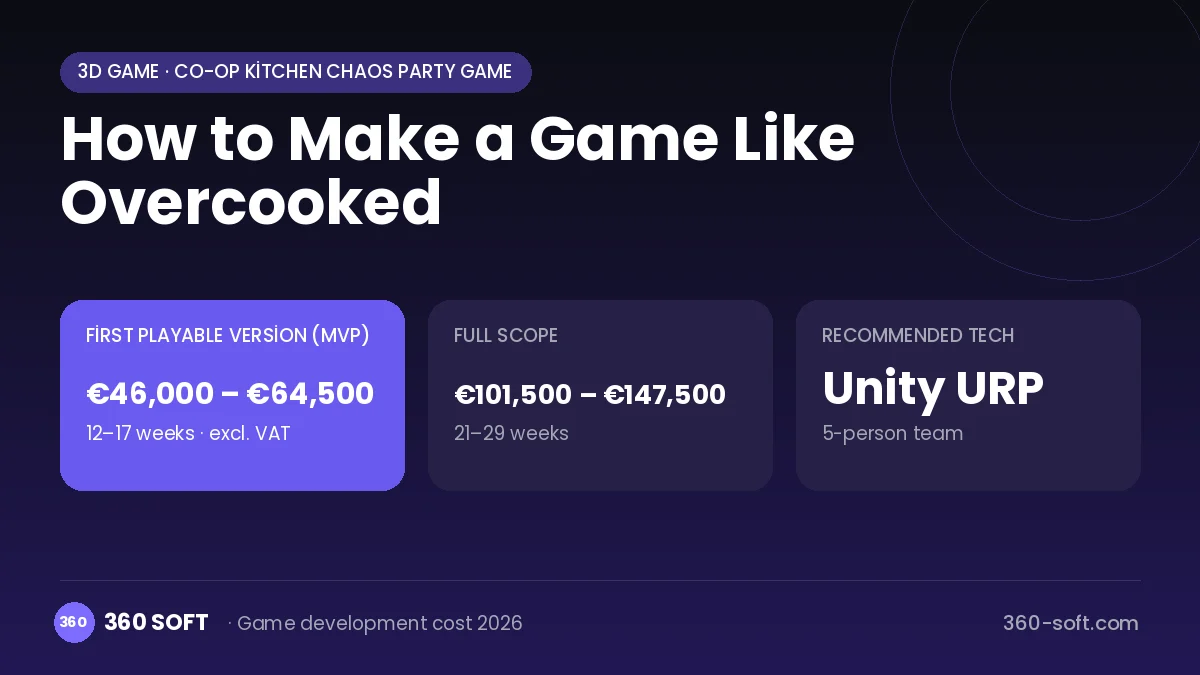
The estimate is based on the genre’s core systems, content volume, multiplayer and live-ops needs plus QA and project management: about 390 person-days for the full scope and 176 person-days for the first version. Cutting scope (fewer levels, one map, fewer characters) lowers the budget directly. Store accounts, servers, audio licences and user-acquisition budget are separate items. We send a fixed written price within 24 hours after the game design document.
Monetisation
Premium sales plus later kitchen and recipe expansion packs are the best fit for this genre. Character costumes and themed packs add revenue. In a mobile adaptation, a free-to-play model should stay focused on cosmetics and an ad-free pack; paying for power spoils the co-op fun.
Estimate your game budget and get a fixed quote
Let us scope it together and send a fixed written quote within 24 hours. NDA on request; you own the source code.
Calculated instantly from your choices, excl. VAT. A fixed written quote follows a free scoping call within 24 hours.
Choosing a game development company for a game like Overcooked
Most people searching “make a game like overcooked” are really looking for a reliable game development company. When comparing quotes, check four things:
- Can you play their released 3D games on your own phone?
- Are the source code, art files and store accounts transferred to you by contract?
- Do they build a playable prototype first and show a demo every two weeks?
- Are multiplayer servers, anti-cheat and scaling costs written into the quote?
Copyright and originality
Game mechanics on their own are generally not protected, but names, logos, characters, art, audio and level designs are. That is why we build a game “like Overcooked” with your own name, art and world. This is not legal advice; we recommend a trademark search before launch.
Frequently asked questions
How long does it take to make a game like Overcooked?
The core systems are a size small teams can manage; level design and online sync really set the timeline. Testing an early prototype with real groups of players is extremely valuable.
Will there be copyright issues?
Co-op kitchen and order management mechanics are generally free to use. Characters, kitchen designs, name, visuals and music cannot be copied. This is not legal advice.
Can a small team make it?
Yes; this genre is at a scale that suits small teams. With simple controls and stylised graphics, the real creative energy can go into level design.
What should I look for in a studio that builds party games?
Look at experience with multi-controller support, online sync and level design. Choose a studio that delivers a playable prototype early and iterates through player testing.