3D gamePhysics-based party brawlerOriginal by Recreate Games
The appeal of Party Animals comes from cute fluffy animals with wobbly, hard-to-control physics bodies trying to knock each other out of the ring. A few simple moves such as punching, headbutting and grabbing and throwing produce different, hilarious scenes every round thanks to the physics engine. Players laugh at the chaos more than they care about winning, which is why friend groups and streamers keep coming back to the game.
A similar game needs an active ragdoll character system that stays upright through bone and joint forces, grab and throw interactions, trap-filled moving maps and several game modes. The really hard part is making that physics look consistent for every player in online play. Costumes and character cosmetics, matchmaking and a private room system are also serious production items.
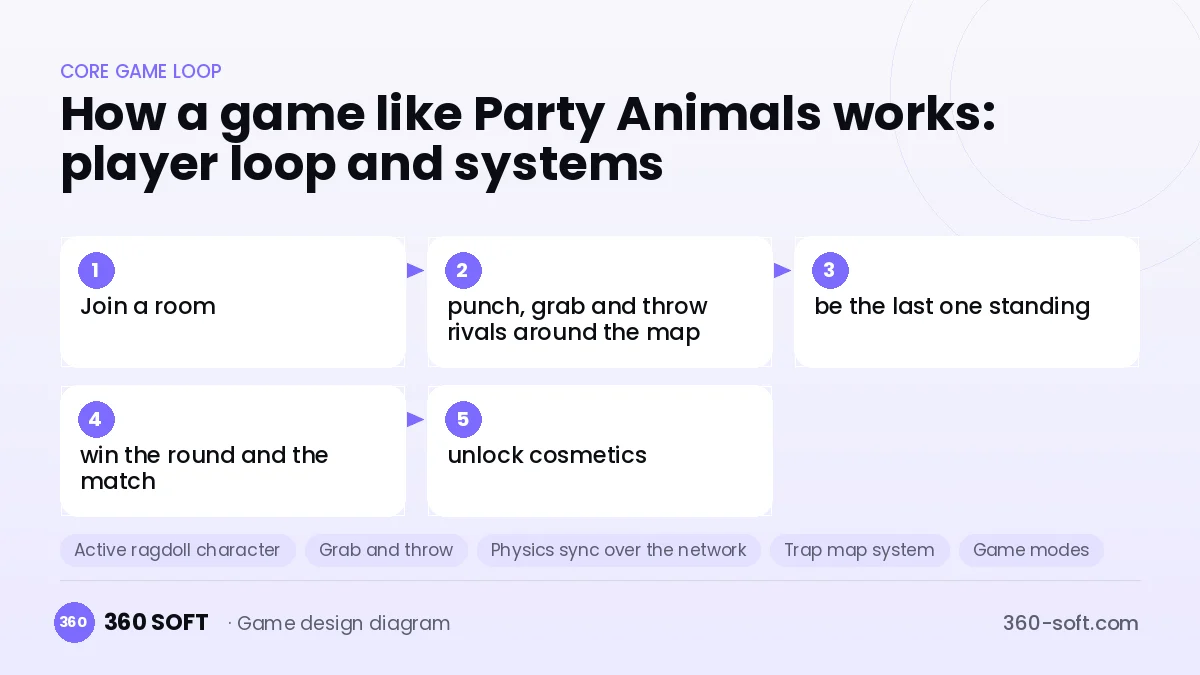
Why Party Animals works: the core loop
Systems you need to build a game like Party Animals
Active ragdoll character
A physics-based character controller that stays upright with joint motors and balance forces, and staggers or gets knocked out when hit.
Grab and throw
Physics joints that attach hands to rivals, objects or the ground; dragging, lifting and throwing-off-the-map interactions.
Physics sync over the network
Server-authoritative, lag-compensated physics replication that shows collisions and grabs consistently to every player.
Trap map system
Map-specific hazards and timed events such as spinning platforms, slippery floors, rising water or falling objects.
Game modes
A round-based mode framework running different rules, such as last one standing or team-based ball or object carrying.
Costume and character shop
Animal characters, costumes and accessories, with a modular dress-up system that does not break the fur and fabric look.
What goes into the first version, what comes later
First version (soft launch)
- Active ragdoll movement, punching, grabbing and throwing
- One game mode and 3–4 trap maps
- Online matches through a private lobby with room codes
- Local (same-screen) multiplayer support
- A few animal characters and basic costumes
Later updates
- Public matchmaking and a ranked mode
- New game modes and seasonal maps
- Cosmetic shop and season pass
- Console release and cross-platform play
The hard parts of this genre
Physics and networking
Ragdoll physics is not deterministic; for every player to see the same collision in an online match, a careful server-authoritative architecture is required.
Control feel
The character should be deliberately clumsy without frustrating the player; finding that balance takes a long prototyping and testing process.
Performance
Many jointed characters colliding at once strain the CPU; the physics budget per character must be planned from the start.
Team, timeline and budget
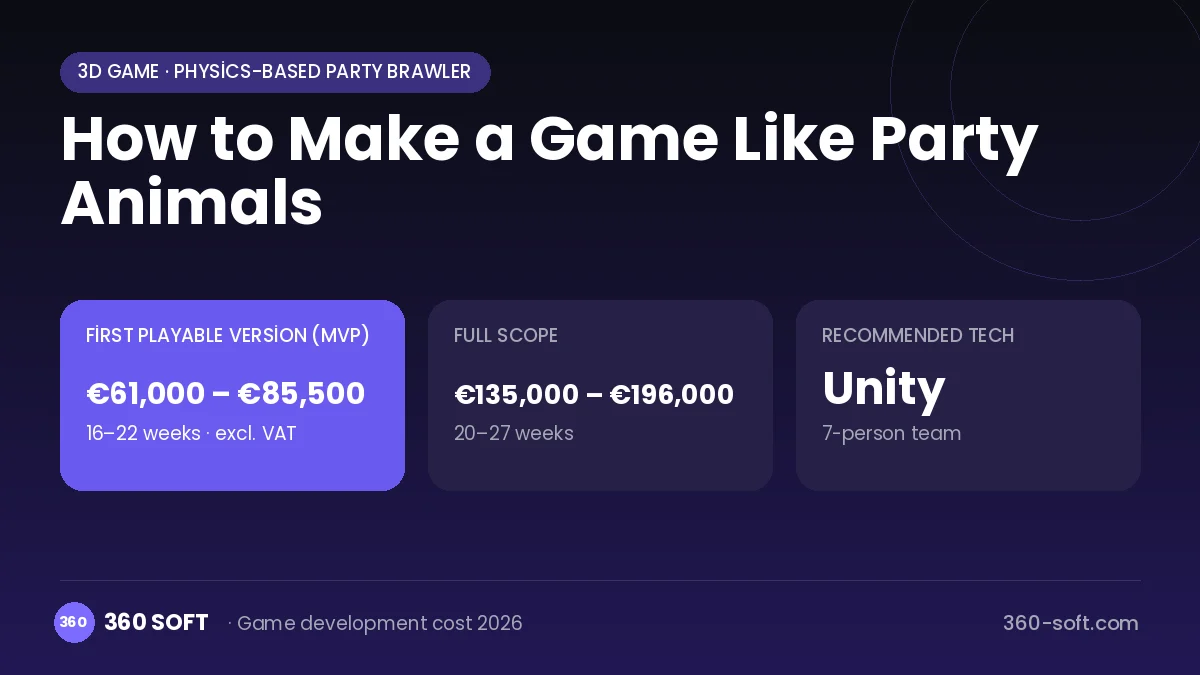
The estimate is based on the genre’s core systems, content volume, multiplayer and live-ops needs plus QA and project management: about 518 person-days for the full scope and 233 person-days for the first version. Cutting scope (fewer levels, one map, fewer characters) lowers the budget directly. Store accounts, servers, audio licences and user-acquisition budget are separate items. We send a fixed written price within 24 hours after the game design document.
Monetisation
The most common model for games like this is a one-off premium sale on PC and console together with cosmetic content: new animal characters, costumes, victory animations and seasonal packs. Selling gameplay advantages breaks the fair feel of the brawl. In a free-to-play model, a season pass and cosmetic shop become the main revenue sources.
Estimate your game budget and get a fixed quote
Let us scope it together and send a fixed written quote within 24 hours. NDA on request; you own the source code.
Calculated instantly from your choices, excl. VAT. A fixed written quote follows a free scoping call within 24 hours.
Choosing a game development company for a game like Party Animals
Most people searching “make a game like party animals” are really looking for a reliable game development company. When comparing quotes, check four things:
- Can you play their released 3D games on your own phone?
- Are the source code, art files and store accounts transferred to you by contract?
- Do they build a playable prototype first and show a demo every two weeks?
- Are multiplayer servers, anti-cheat and scaling costs written into the quote?
Copyright and originality
Game mechanics on their own are generally not protected, but names, logos, characters, art, audio and level designs are. That is why we build a game “like Party Animals” with your own name, art and world. This is not legal advice; we recommend a trademark search before launch.
Frequently asked questions
How long does it take to make a game like Party Animals?
A playable ragdoll prototype can come together quickly, but polishing online physics sync and control feel takes months. Map and costume production also directly affect the schedule.
Will there be copyright issues?
Physics-based party brawling is a genre and the mechanics are generally free to use. Character designs, the name, map layouts, visuals and sounds must be original. This is not legal advice.
Which engine is the better fit?
Unity stands out for fast prototyping and a wide choice of networking libraries; Unreal offers high visual quality and built-in networking. Team experience and target platform decide the choice.
What should I look for in a studio that builds games like Party Animals?
The studio should be able to show work on physics-based character control and online physics sync. Testing the control feel hands-on in an early prototype is the healthiest yardstick.