3D gameCalendar-based social sim and JRPGOriginal by Atlus
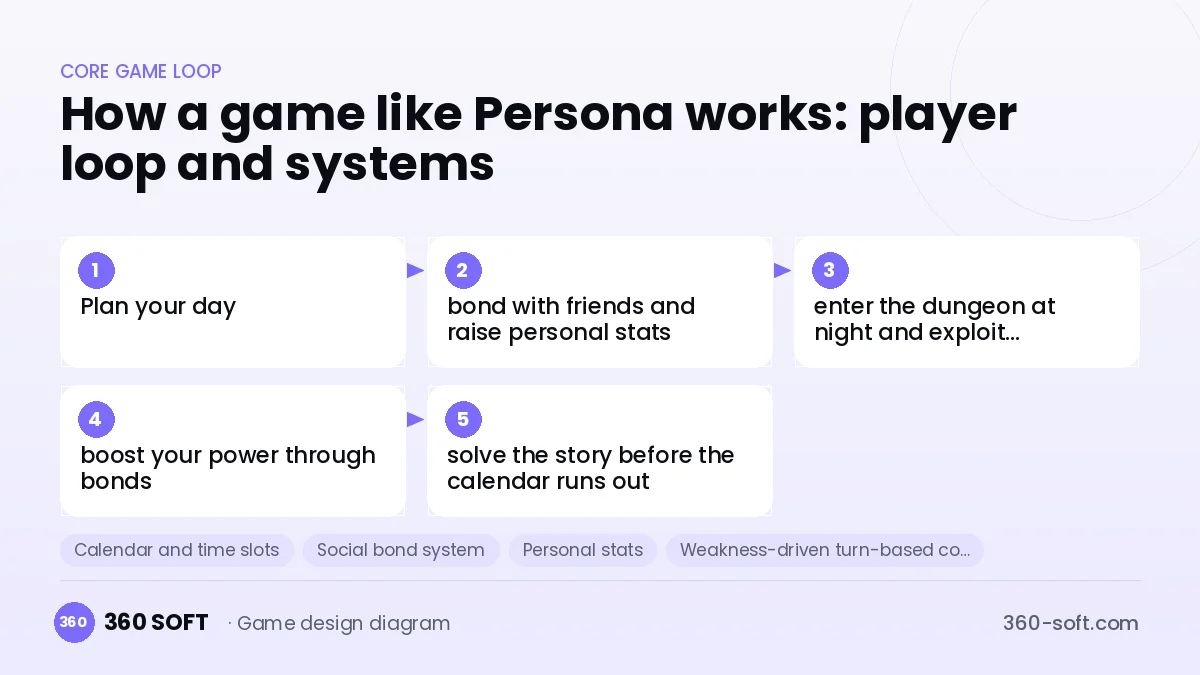
What makes the Persona series unique is that it merges two different games into a single calendar. By day the player goes to school, hangs out with friends, works part-time jobs and builds personal stats; by night they enter supernatural dungeons and fight turn-based battles. Deciding how to spend limited time makes every day meaningful, and the social bonds you form come back as real power in combat. Strong style, music and UI design are inseparable from the experience.
A similar game needs two systems built together: a calendar and social simulation (day and time slots, relationship ranks, personal stats, dialogue choices) and dungeons and combat (hitting weaknesses, extra turns, creature fusion). It also needs a data model linking the two, plus heavy writing, character portraits and a UI with real style.
Why Persona works: the core loop
Systems you need to build a game like Persona
Calendar and time slots
A calendar that splits each day into slots such as morning, afternoon and evening, with events and deadlines planned in advance. Limited time makes every decision count.
Social bond system
Ranked relationship stories, dialogue choices and unlockable rewards for every side character. Writing quality decides whether this system succeeds.
Personal stats
Values such as courage, knowledge and charm unlock specific activities and conversations. They give players long-term personal goals.
Weakness-driven turn-based combat
Pace-boosting mechanics like earning an extra turn when you hit a weakness, or knocking down every enemy for an all-out attack.
Creature fusion
Fusing spirits or creatures earned in battle into new, stronger ones, with bonuses based on bond rank. It ties the two main systems together.
Stylish UI and presentation
Menus, transitions and the battle screen are part of the game's identity. Fast, fluid UI animation needs its own design investment.
What goes into the first version, what comes later
First version (soft launch)
- A calendar slice covering one month or one term
- 4–5 social bond characters with their relationship stories
- One themed dungeon, weakness combat and a boss
- Basic creature fusion and personal stats
- Saves, settings and a UI in an original art direction
Later updates
- An extended calendar and new dungeons
- Extra social bonds, romance routes and side activities
- Voice-over, multiple languages and a hard mode
- Console releases
The hard parts of this genre
Balancing two games at once
If the reward balance between social sim and dungeon combat breaks, players see one of them as a chore. Each side has to be tuned to feed the other.
Writing volume
Every social bond means dozens of scenes and branching dialogue. Script, editing and localisation make up a large share of the budget.
Calendar design and missed content
If it is unclear what the player missed and when, frustration follows. Deadlines, warnings and time hints must be designed carefully.
Team, timeline and budget
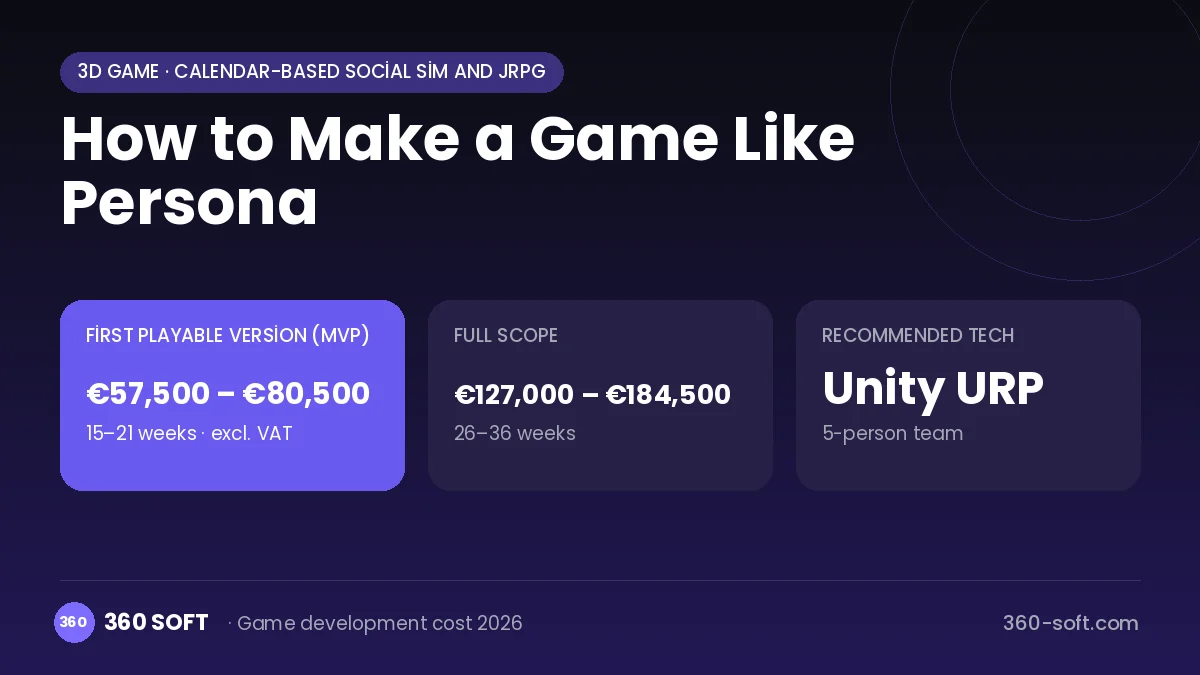
The estimate is based on the genre’s core systems, content volume, multiplayer and live-ops needs plus QA and project management: about 488 person-days for the full scope and 219 person-days for the first version. Cutting scope (fewer levels, one map, fewer characters) lowers the budget directly. Store accounts, servers, audio licences and user-acquisition budget are separate items. We send a fixed written price within 24 hours after the game design document.
Monetisation
Premium sales suit this genre best; expanded re-releases and costume or extra-scenario packs are additional revenue sources. Supporting products such as the soundtrack and a digital art book mean a lot to the community. In a mobile adaptation, a character-collecting gacha can work if the drop rates are published clearly.
Estimate your game budget and get a fixed quote
Let us scope it together and send a fixed written quote within 24 hours. NDA on request; you own the source code.
Calculated instantly from your choices, excl. VAT. A fixed written quote follows a free scoping call within 24 hours.
Choosing a game development company for a game like Persona
Most people searching “make a game like persona” are really looking for a reliable game development company. When comparing quotes, check four things:
- Can you play their released 3D games on your own phone?
- Are the source code, art files and store accounts transferred to you by contract?
- Do they build a playable prototype first and show a demo every two weeks?
- Are ads, in-app purchases and analytics set up as part of the quote?
Copyright and originality
Game mechanics on their own are generally not protected, but names, logos, characters, art, audio and level designs are. That is why we build a game “like Persona” with your own name, art and world. This is not legal advice; we recommend a trademark search before launch.
Frequently asked questions
How long does it take to make a game like Persona?
With two core systems and heavy writing, it is a long project. For small teams, a first release with a short calendar slice, a few social bonds and a single dungeon is realistic.
Will there be copyright issues?
Mechanics like calendar-based social simulation and weakness-driven combat are generally free to use. Characters, names, creature designs, UI look and music cannot be copied; you need an original style. This is not legal advice.
Can it be made in 2D instead of 3D?
Yes; visual-novel-style 2D social scenes with 2D or simple 3D dungeons cut production costs significantly. What matters is that the style is consistent and distinctive.
What should I look for in a studio that builds games like Persona?
Look for a team that is strong in narrative design, dialogue tools and UI animation. Choose a studio that clearly plans how the writing team and the engineering team will work together.