3D gamePolice patrol simulation
The appeal of police simulators is that they put the player in the role of the person who enforces the rules but also makes the call. On patrol, the player decides whether to deal with an illegally parked car, a driver who ran a red light or a call coming in over the radio. Following the right procedure on each case earns points, while being needlessly heavy-handed costs you. That “fair officer” feeling creates a calm but attention-demanding loop that is very different from an action game.
For a similar game, the biggest investment is a living city: traffic and pedestrian AI that mostly follows the rules and sometimes breaks them, plus interaction menus for ID checks, breathalyser tests, writing tickets and making arrests. Shift structure, rank progression and new districts to unlock sit on top of that. An optional co-op patrol mode requires multiplayer infrastructure, so it noticeably expands the scope.
Why Police Simulator works: the core loop
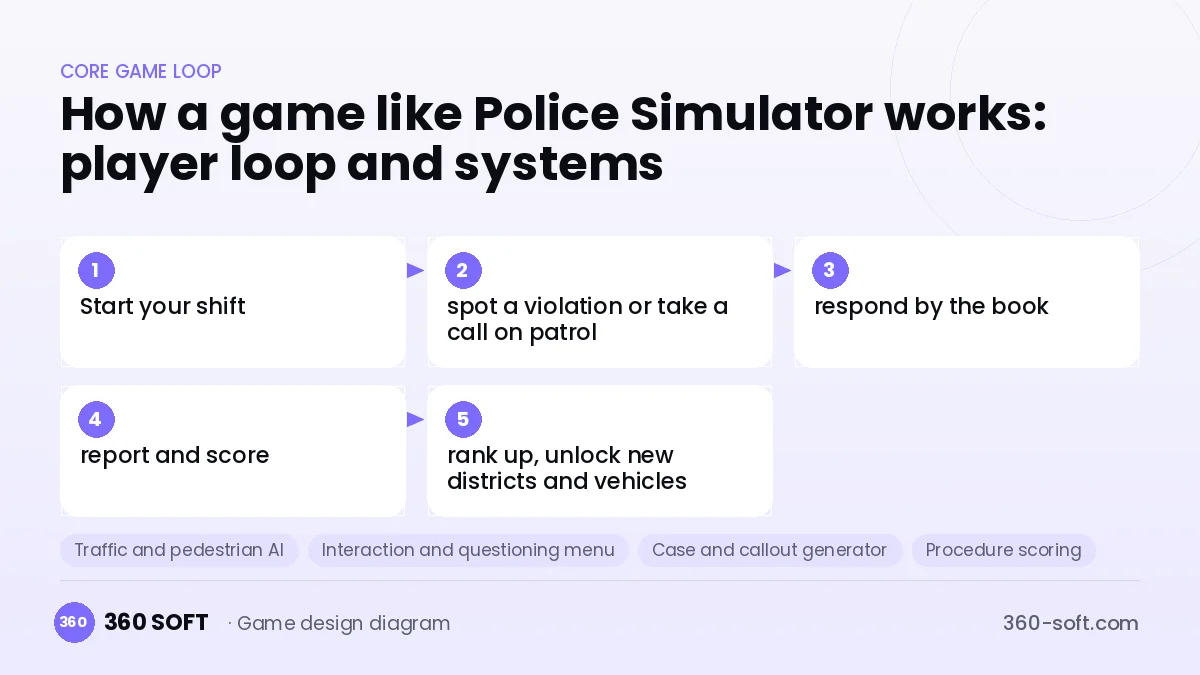
Systems you need to build a game like Police Simulator
Traffic and pedestrian AI
NPC behaviour that obeys the rules, randomly breaks them, flees or argues back; the system that decides whether the city feels believable.
Interaction and questioning menu
A contextual interface that walks through ID and licence checks, vehicle searches, breathalyser tests, issuing fines and arrests in order.
Case and callout generator
A mission system that creates radio callouts dynamically based on difficulty and time of shift.
Procedure scoring
An evaluation engine that rewards actions done in the right order and penalises unnecessary force or the wrong fine.
Shift and rank progression
Shift objectives, experience points, new powers, equipment and city districts unlocked step by step.
Driving and pursuits
Sirens and light bars, traffic reactions during a chase, roadblocks and AI for fleeing vehicles.
What goes into the first version, what comes later
First version (soft launch)
- One dense city district
- Foot patrol plus basic vehicle patrol
- Parking violations, traffic stops and simple callouts
- Procedure scoring and an end-of-shift report
- A handful of powers and items unlocked through rank progression
Later updates
- Co-op patrol mode
- Detective work and crime scene investigation missions
- New city districts, day-night cycle and weather variety
- Console release and gamepad optimisation
The hard parts of this genre
A believable city simulation
Hundreds of cars and pedestrians that follow the rules and occasionally make mistakes are hard on both AI and performance; LOD and distance-based simulation are essential.
Cases that don’t get repetitive
Handling the same violation dozens of times gets boring; case templates need variables and surprise developments to stay fresh.
Handling a sensitive theme
A police theme calls for care around violence and discrimination; making the reward system encourage proportionate, fair behaviour is central to the design.
Team, timeline and budget
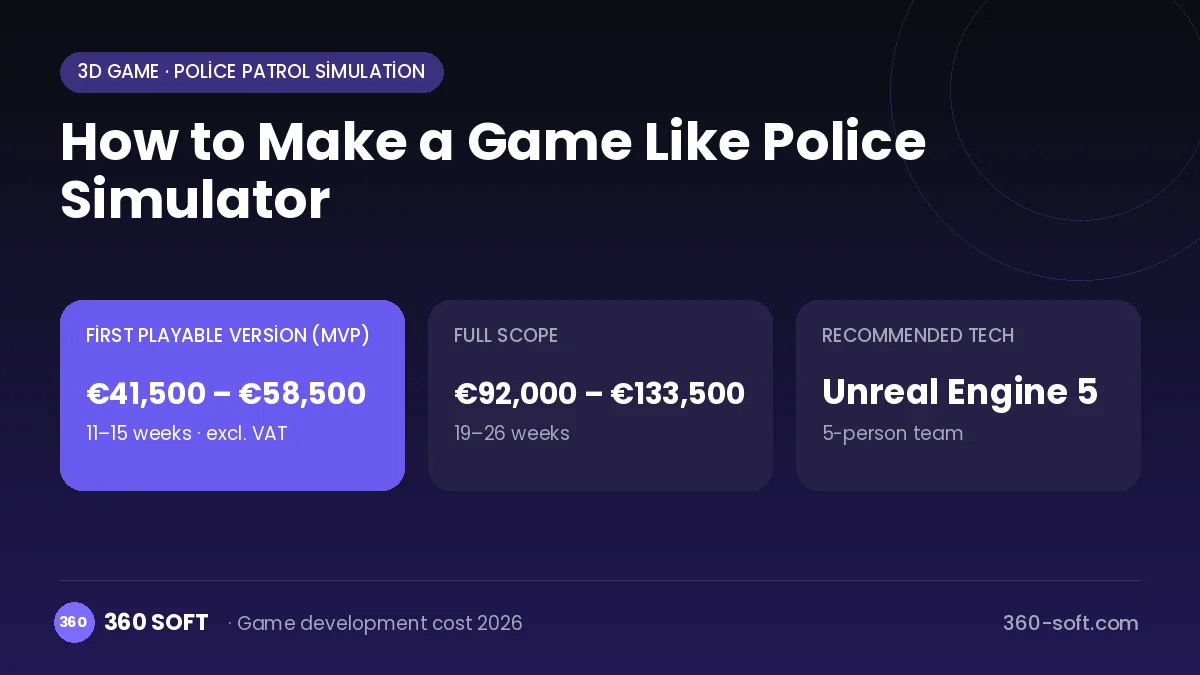
The estimate is based on the genre’s core systems, content volume, multiplayer and live-ops needs plus QA and project management: about 353 person-days for the full scope and 159 person-days for the first version. Cutting scope (fewer levels, one map, fewer characters) lowers the budget directly. Store accounts, servers, audio licences and user-acquisition budget are separate items. We send a fixed written price within 24 hours after the game design document.
Monetisation
On PC and console, a premium one-off purchase plus DLC packs with new cities, vehicles or missions is the best fit. A mobile version can use free download, rewarded ads for extra missions and cosmetic vehicle liveries. Simulation fans are used to paying for the game itself; aggressive energy systems push this audience away.
Estimate your game budget and get a fixed quote
Let us scope it together and send a fixed written quote within 24 hours. NDA on request; you own the source code.
Calculated instantly from your choices, excl. VAT. A fixed written quote follows a free scoping call within 24 hours.
Choosing a game development company for a game like Police Simulator
Most people searching “make a game like police simulator” are really looking for a reliable game development company. When comparing quotes, check four things:
- Can you play their released 3D games on your own phone?
- Are the source code, art files and store accounts transferred to you by contract?
- Do they build a playable prototype first and show a demo every two weeks?
- Are ads, in-app purchases and analytics set up as part of the quote?
Copyright and originality
Game mechanics on their own are generally not protected, but names, logos, characters, art, audio and level designs are. That is why we build a game “like Police Simulator” with your own name, art and world. This is not legal advice; we recommend a trademark search before launch.
Frequently asked questions
How long does it take to make a game like Police Simulator?
A PC version with one district and the core case types can be built by an experienced team in somewhere between a few months and a year. A large city and a co-op mode extend that timeline significantly.
Can I use real police logos and uniforms?
Official agency emblems, rank insignia and vehicle liveries may require permission, which is why many productions use a fictional city and force. Mechanics are free to use, but names and visuals cannot be copied; this is not legal advice.
Can it be made for mobile too?
Yes, but city density and graphics quality need to be reduced and the controls simplified for touch. Shorter shifts and a mission-driven structure work better on mobile.
What should I look for when choosing a simulation game developer?
Look at their performance track record in open-city scenes, examples of traffic AI and whether they deliver a playable prototype. Also ask whether they build content tools to keep case variety high.