3D gameThird-person cat exploration adventureOriginal by BlueTwelve Studio
Stray takes the player through a neon-lit, abandoned cyber city through the eyes of a stray cat. The appeal comes from the small pleasures of being a cat: knocking things off tables, scratching rugs, napping on a lap or leaping between narrow rooftops. These details bring warmth to a story set in a melancholic world full of robots. The game is built on atmosphere, exploration and environmental puzzles rather than demanding combat, and it invites players to slow down.
For a similar game the most critical investment is believable animal animation and a contextual movement system: quadruped locomotion, automatic detection of jump points and interaction animations. You also need vertically layered city design, lighting and atmosphere, environmental puzzles, short chase sequences and characters who carry the story. Keeping scope short and hand-polishing every scene is the secret to success in this genre.
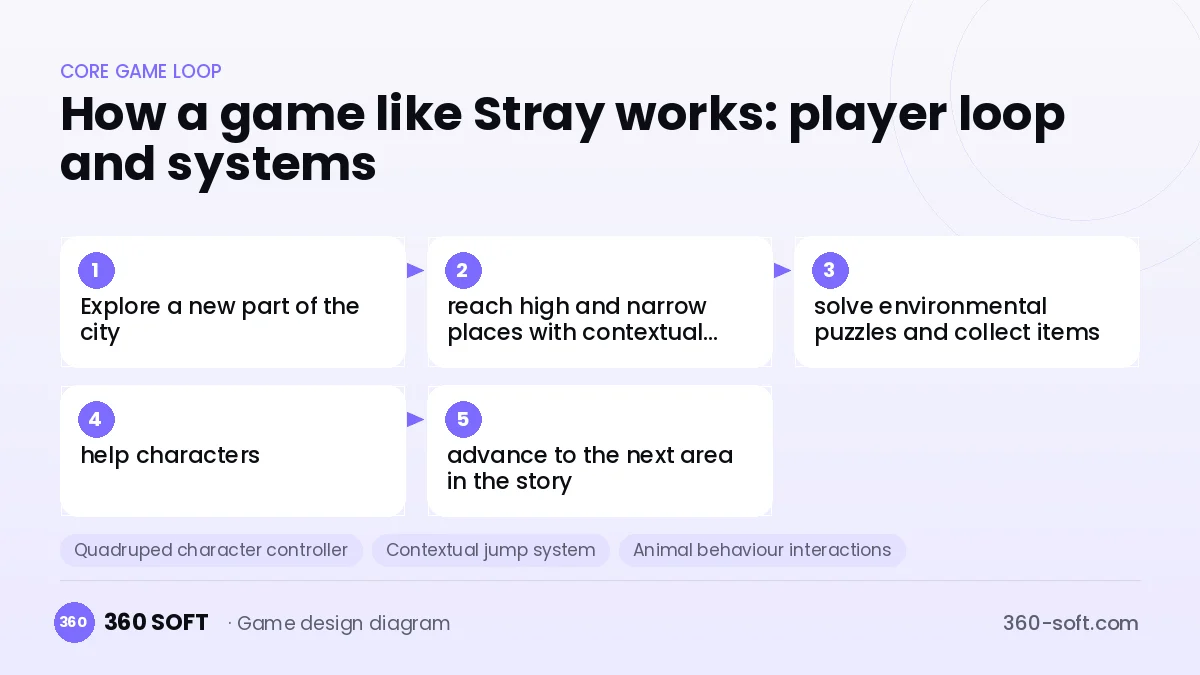
Why Stray works: the core loop
Systems you need to build a game like Stray
Quadruped character controller
Animal-specific animation and physics for walking, running, crouching and moving through tight spaces. Procedural foot placement adds realism.
Contextual jump system
Detecting jump points and making safe leaps with a single button. Keeps exploration fluid and removes the frustration of falling.
Animal behaviour interactions
Small but character-defining actions such as scratching, knocking things over, meowing and sleeping, plus how the world and characters react to them.
Vertical city and level design
Exploration spaces layered with rooftops, pipes and gaps; hidden routes and collectibles.
Environmental puzzles
Puzzles solved by pushing objects, triggering mechanisms and interacting with a helper robot.
Lighting and atmosphere
Neon lights, fog, rain and sound design. The core layer that creates the emotional tone and sense of discovery.
What goes into the first version, what comes later
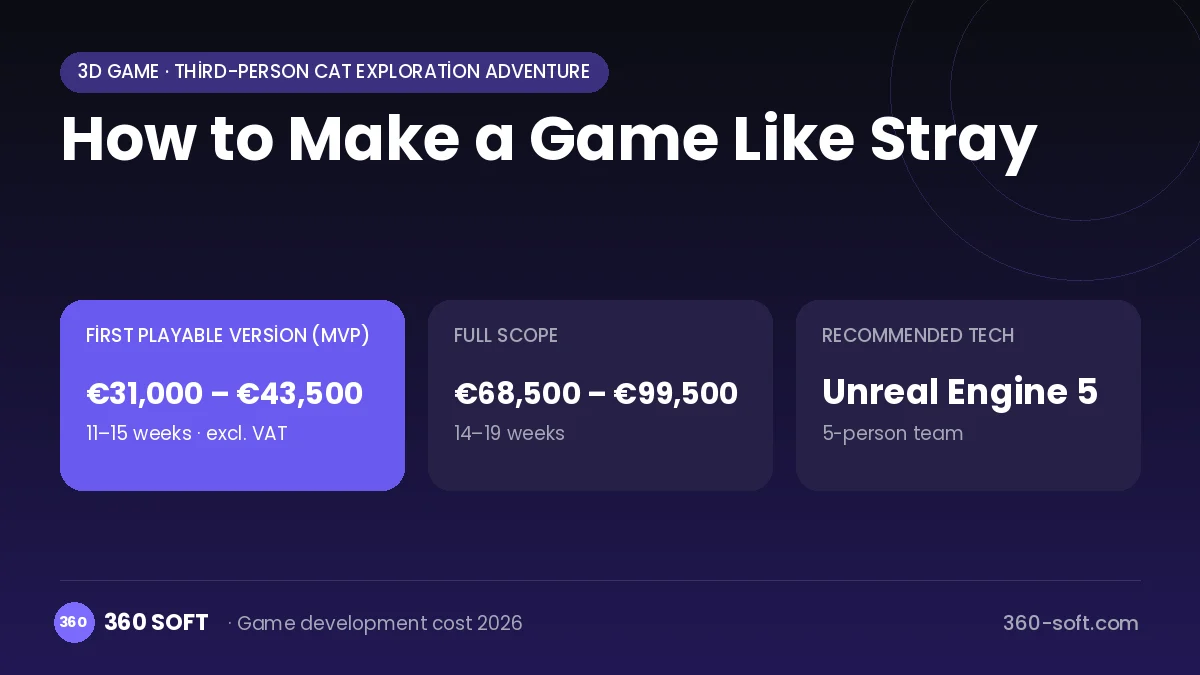
First version (soft launch)
- One city district and a 1–2 hour story
- Quadruped character controller and contextual jumping
- Basic animal interactions (scratching, knocking over, meowing)
- 3–4 environmental puzzles and one chase sequence
- Atmospheric lighting, sound and save system
Later updates
- New districts and a complete story
- Collectibles, memories and achievements
- Photo mode and accessibility settings
- Console versions and multiple languages
The hard parts of this genre
Believable animal movement
Players know cat behaviour well; unnatural movement is noticed immediately. Reference study, motion capture or intensive hand animation is needed.
Contextual movement and level fit
The jump system and level geometry have to be designed together. Otherwise players cannot tell where they can go.
High polish in a short game
Games like this need to be short but polished. Atmosphere, sound and detail consume a significant share of the budget.
Team, timeline and budget
The estimate is based on the genre’s core systems, content volume, multiplayer and live-ops needs plus QA and project management: about 263 person-days for the full scope and 118 person-days for the first version. Cutting scope (fewer levels, one map, fewer characters) lowers the budget directly. Store accounts, servers, audio licences and user-acquisition budget are separate items. We send a fixed written price within 24 hours after the game design document.
Monetisation
Premium sales are the best model for this genre; joining subscription game libraries can also bring visibility and revenue. A soundtrack and digital art book add income. Microtransactions and ads do not fit this atmospheric experience. Sale periods and bundles also play an important role in long-term revenue.
Estimate your game budget and get a fixed quote
Let us scope it together and send a fixed written quote within 24 hours. NDA on request; you own the source code.
Calculated instantly from your choices, excl. VAT. A fixed written quote follows a free scoping call within 24 hours.
Choosing a game development company for a game like Stray
Most people searching “make a game like stray” are really looking for a reliable game development company. When comparing quotes, check four things:
- Can you play their released 3D games on your own phone?
- Are the source code, art files and store accounts transferred to you by contract?
- Do they build a playable prototype first and show a demo every two weeks?
- Are ads, in-app purchases and analytics set up as part of the quote?
Copyright and originality
Game mechanics on their own are generally not protected, but names, logos, characters, art, audio and level designs are. That is why we build a game “like Stray” with your own name, art and world. This is not legal advice; we recommend a trademark search before launch.
Frequently asked questions
How long does it take to make a game like Stray?
Even though it is a short game, animal animation and atmospheric polish take time. For a small team it is realistic to start with a one-district vertical slice and then expand.
Will there be copyright issues?
The ideas of exploring as an animal character and contextual movement are generally free to use. Characters, city, story, visual design and music cannot be copied. This is not legal advice.
Can a small team make it?
Yes; this genre is one where small, focused teams can succeed. Keeping scope limited and investing in animation and atmosphere is the right strategy.
What should I look for in a studio that builds adventure games?
Look at experience with character animation, level design and lighting/atmosphere. Choose a studio that shows a movement prototype early and honestly limits scope.