2D gameTurn-based artillery combatOriginal by Team17
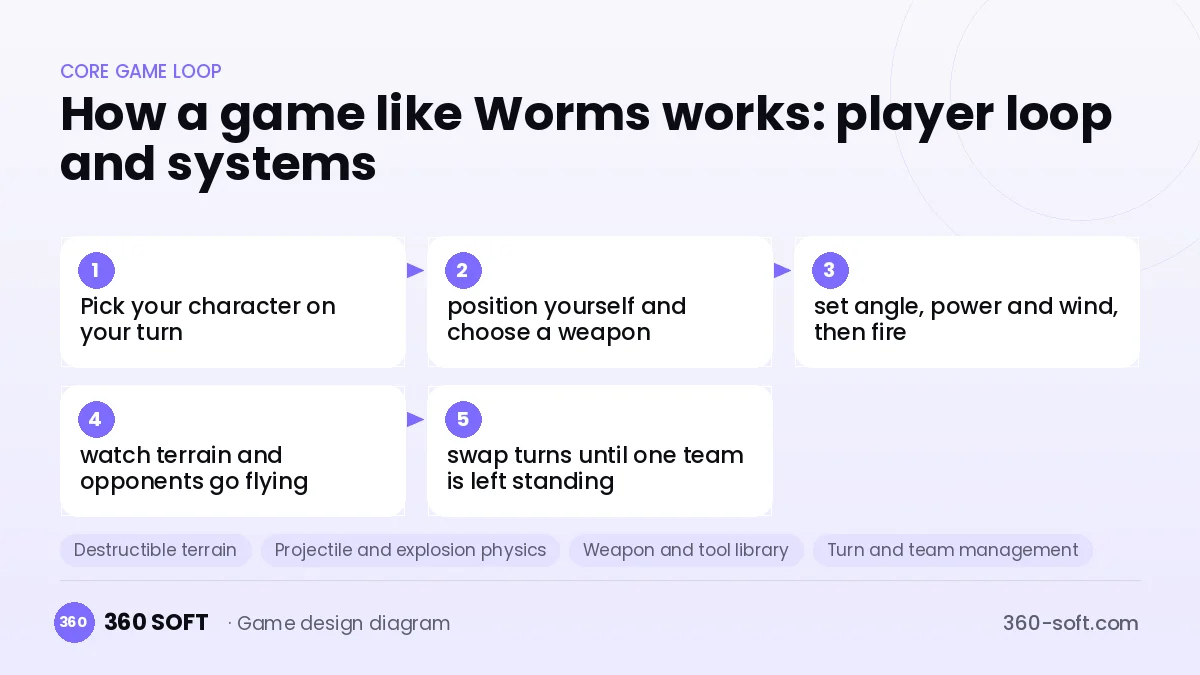
Worms turns turn-based artillery combat into chaotic comedy. Players set angle and power, fire a rocket, account for the wind and watch the exploding terrain roll an opponent into the water. Destructible terrain means every shot changes the map permanently, while absurd weapons create unexpected moments that leave friends in the same room in fits of laughter. Its strength lies in a fun mix of strategy and luck.
A similar game needs a pixel- or mask-based terrain destruction system, projectile physics affected by wind and gravity, sliding and knockback behaviour for characters, and a large weapon library. Turn management, movement tools such as the ninja rope and jetpack, team management and AI opponents are core systems. Online, the turn-based structure reduces network load, but physics results must be identical for every player.
Why Worms works: the core loop
Systems you need to build a game like Worms
Destructible terrain
A 2D map system carved at pixel level by explosions, with collision data updated instantly and permanent changes.
Projectile and explosion physics
Projectile behaviour with wind, gravity, bounce and delayed detonation, plus calculation of explosion knockback.
Weapon and tool library
A system that defines weapons such as bazookas, grenades and air strikes, and movement tools such as ropes, jetpacks and teleports, as data.
Turn and team management
A structure that runs match rules such as turn switching between teams, turn timers, sudden death and rising water.
AI opponent
A computer opponent that calculates shot angle and power through simulation and adds an error margin based on difficulty.
Online and local multiplayer
Pass-and-play on one device, plus online matchmaking with deterministic, physics-verified match infrastructure.
What goes into the first version, what comes later
First version (soft launch)
- Destructible terrain and explosion physics
- 10–15 weapons and a rope movement tool
- Local pass-and-play multiplayer and an AI opponent
- Random map generation with a few themes
- Team names and simple customisation
Later updates
- Online matchmaking and a ranked league
- A mission-based single-player campaign
- Weapon editor and custom match rules
- Cosmetic hats, gravestones and voice packs
The hard parts of this genre
Terrain destruction performance
Updating the texture and collision shape on every explosion requires careful optimisation on large maps and on mobile.
Deterministic physics
For the same shot to produce the same result on every device online, fixed-point maths or server verification may be needed.
Balancing chaos and fairness
Absurd weapons add fun, but weapon balance must be tuned well so they do not feel unfair in competitive play.
Team, timeline and budget
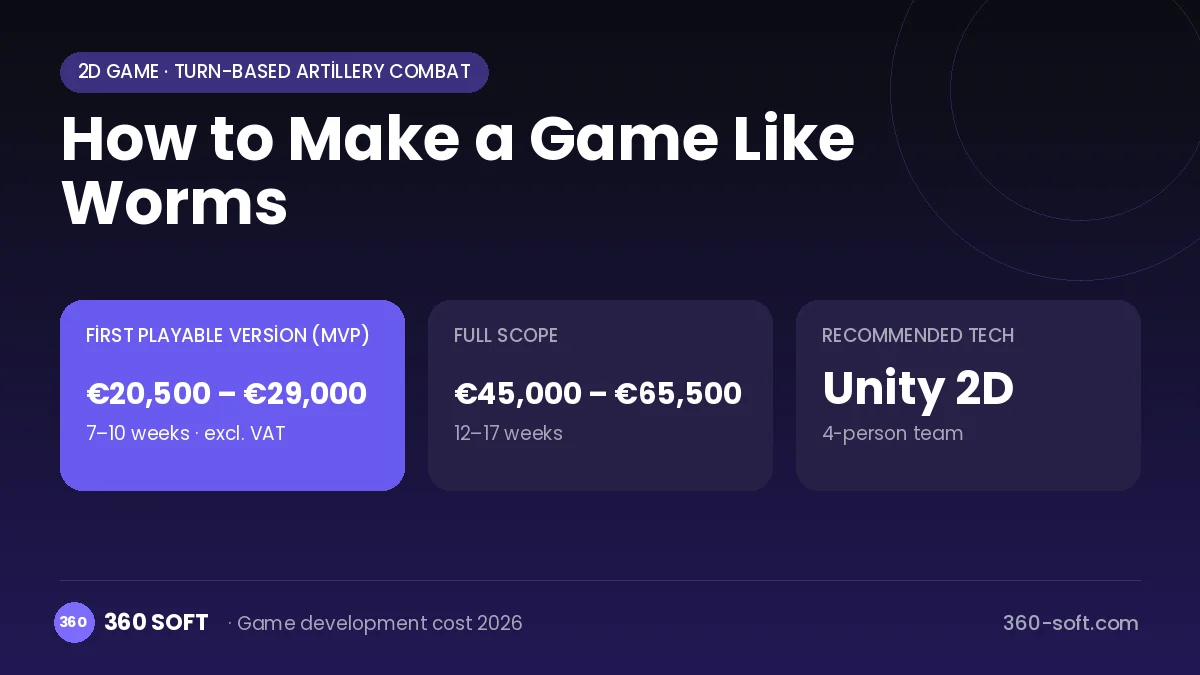
The estimate is based on the genre’s core systems, content volume, multiplayer and live-ops needs plus QA and project management: about 172 person-days for the full scope and 77 person-days for the first version. Cutting scope (fewer levels, one map, fewer characters) lowers the budget directly. Store accounts, servers, audio licences and user-acquisition budget are separate items. We send a fixed written price within 24 hours after the game design document.
Monetisation
The classic model for this genre is a premium price on PC and console with extra weapon or theme packs. On mobile, free-to-play with cosmetic outfits, voice packs and a seasonal reward track works well. Selling weapon power would break competition, so revenue should be built mainly around cosmetics.
Estimate your game budget and get a fixed quote
Let us scope it together and send a fixed written quote within 24 hours. NDA on request; you own the source code.
Calculated instantly from your choices, excl. VAT. A fixed written quote follows a free scoping call within 24 hours.
Choosing a game development company for a game like Worms
Most people searching “make a game like worms” are really looking for a reliable game development company. When comparing quotes, check four things:
- Can you play their released 2D games on your own phone?
- Are the source code, art files and store accounts transferred to you by contract?
- Do they build a playable prototype first and show a demo every two weeks?
- Are multiplayer servers, anti-cheat and scaling costs written into the quote?
Copyright and originality
Game mechanics on their own are generally not protected, but names, logos, characters, art, audio and level designs are. That is why we build a game “like Worms” with your own name, art and world. This is not legal advice; we recommend a trademark search before launch.
Frequently asked questions
How long does it take to make a game like Worms?
A locally playable prototype with destructible terrain and a few weapons can be ready within a few weeks. With online mode, a campaign and a large weapon library, the timeline stretches to months.
Does a game similar to Worms raise copyright issues?
Turn-based artillery and destructible terrain mechanics are generally free to use. The original worm character designs, the name, the presentation of specific weapons, sound and art cannot be copied. This is not legal advice.
Is online play difficult?
A turn-based structure is easier than real-time games, but keeping physics results in sync is the critical issue. Sharing the shot input and running the same simulation on every device is a common approach.
What should I look for in a studio to build a game like this?
Ask about the studio's experience with custom 2D physics and terrain destruction. If online play is planned, experience with deterministic simulation or server verification is important.