3D gameOpen-world action adventure
The magic of Zelda-style open-world adventures is that they give players tools, not rules. You can climb any wall, glide from a peak, burn grass with fire and ride the rising hot air, or solve a puzzle in a way the designer never imagined. Systemic physics and chemistry rules reward creativity. Every hill that sparks curiosity really does hide something, which keeps exploration constantly satisfying.
For a similar game the real work is not map size but building systems that interact with each other: climbing and gliding, physics objects, elemental interactions and short puzzle shrines. A realistic MVP has to reduce scope: one region, 8–10 puzzle shrines, three or four core abilities, one large dungeon and simple cooking and crafting. A stylised art direction is the smartest choice for protecting an indie budget.
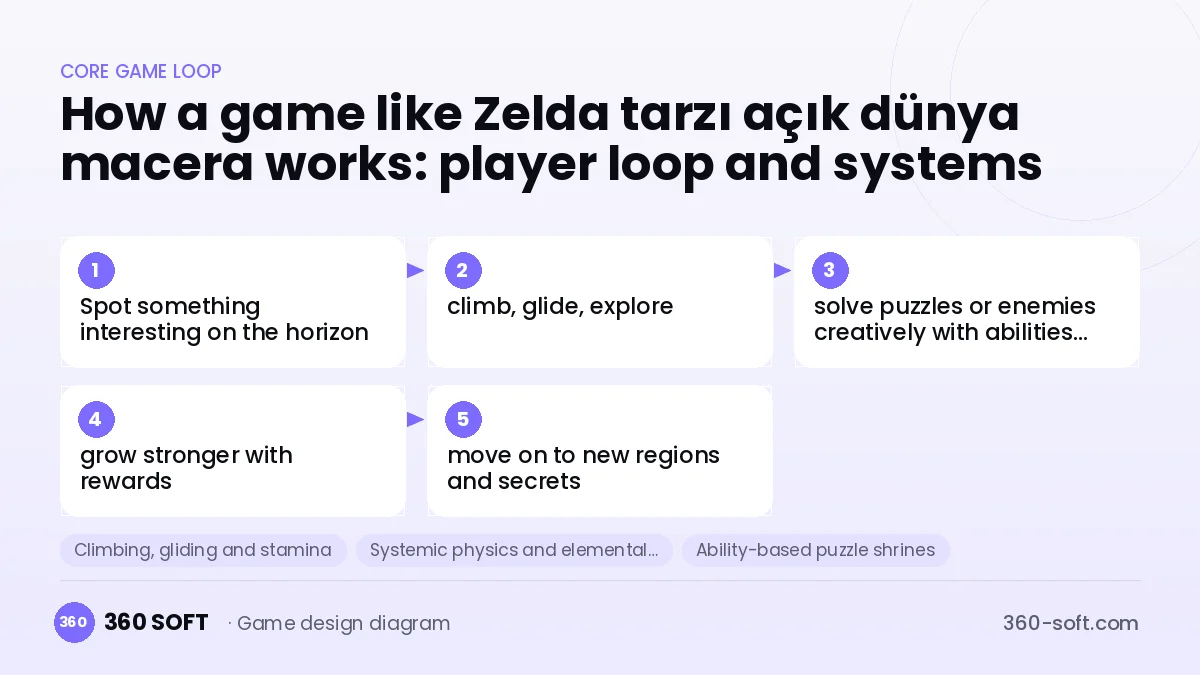
Why Zelda tarzı açık dünya macera works: the core loop
Systems you need to build a game like Zelda tarzı açık dünya macera
Climbing, gliding and stamina
Climbing almost any surface, parachute-style gliding and a limited stamina bar. This turns the whole world into a playground.
Systemic physics and elemental chemistry
Rules such as fire spreading, wind pushing objects and metal conducting electricity. They let players come up with unexpected solutions.
Ability-based puzzle shrines
Short puzzle spaces that each teach a single idea, with a reward at the end. Modular content that guides exploration and measures progress.
Breakable weapons and combat
Found weapons that wear out over time, multiple ways to approach enemy camps and turning the environment into a weapon. Pushes players to improvise.
Curiosity-driven world design
Visual landmarks such as towers, peaks and silhouettes that grab attention; natural guidance instead of quest markers.
Cooking, crafting and gathering
Cooking meals and elixirs from gathered ingredients, plus heat and cold resistance. Adds a practical purpose to exploration.
What goes into the first version, what comes later
First version (soft launch)
- One region, one village and one large dungeon
- Climbing, gliding and stamina system
- 3–4 core abilities with physics and elemental interactions
- 8–10 short puzzle shrines
- Breakable weapons, enemy camps and cooking
Later updates
- New regions, climates and large dungeons
- Creative abilities such as building and fusing objects
- Mount taming and side quest chains
- Console releases and a photo mode
The hard parts of this genre
Systems breaking each other
The more freedom physics and elemental rules give, the easier it is for players to skip puzzles or soft-lock the game. Every new interaction must be retested across all shrines.
A world that does not feel empty
Filling a large map with meaningful content is hard. A small but dense region beats a big, empty map.
Climbing and camera
Being able to climb every surface is demanding engineering for animation, collision and camera; edge cases can often make players feel stuck.
Team, timeline and budget
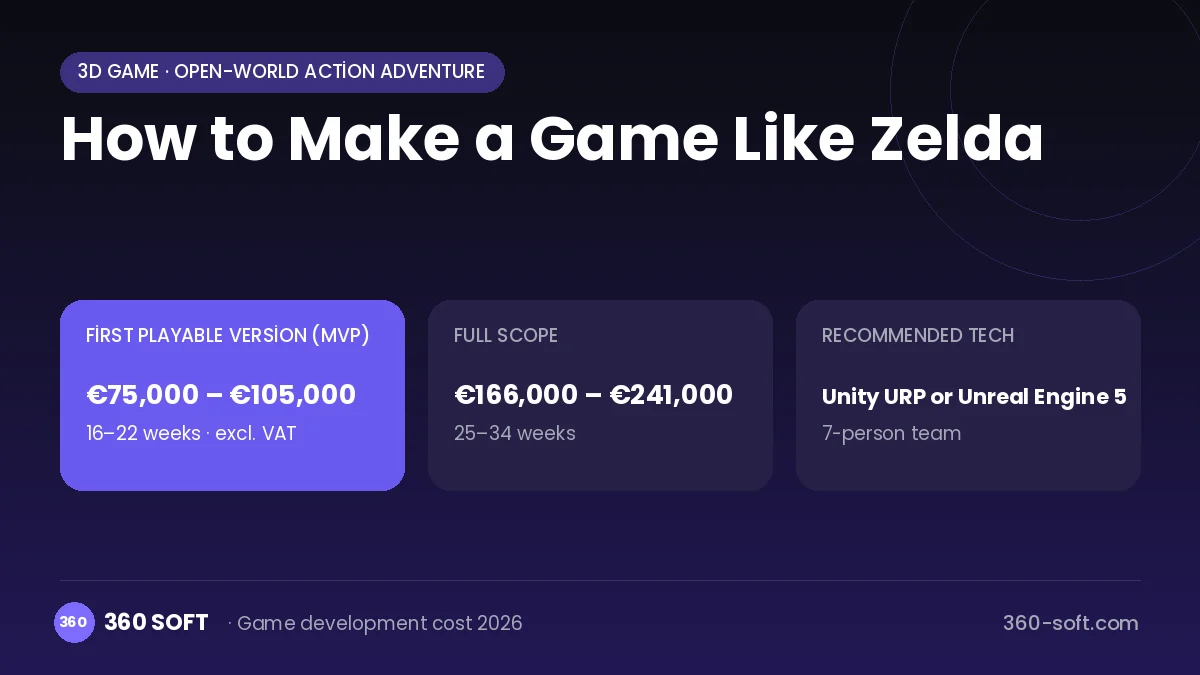
The estimate is based on the genre’s core systems, content volume, multiplayer and live-ops needs plus QA and project management: about 638 person-days for the full scope and 287 person-days for the first version. Cutting scope (fewer levels, one map, fewer characters) lowers the budget directly. Store accounts, servers, audio licences and user-acquisition budget are separate items. We send a fixed written price within 24 hours after the game design document.
Monetisation
A premium sale is the most natural model here, followed by DLC with new regions or story. High-quality single-player adventures can sell strongly on console and PC stores. Microtransactions do not fit this genre; for community support consider early access or crowdfunding.
Estimate your game budget and get a fixed quote
Let us scope it together and send a fixed written quote within 24 hours. NDA on request; you own the source code.
Calculated instantly from your choices, excl. VAT. A fixed written quote follows a free scoping call within 24 hours.
Choosing a game development company for a game like Zelda tarzı açık dünya macera
Most people searching “make a game like zelda” are really looking for a reliable game development company. When comparing quotes, check four things:
- Can you play their released 3D games on your own phone?
- Are the source code, art files and store accounts transferred to you by contract?
- Do they build a playable prototype first and show a demo every two weeks?
- Are ads, in-app purchases and analytics set up as part of the quote?
Copyright and originality
Game mechanics on their own are generally not protected, but names, logos, characters, art, audio and level designs are. That is why we build a game “like Zelda tarzı açık dünya macera” with your own name, art and world. This is not legal advice; we recommend a trademark search before launch.
Frequently asked questions
How long does it take to make a game like Zelda?
A full-scale open-world adventure needs a large team. A vertical slice with one region, a few abilities and around ten puzzle shrines is a realistic start for an independent team.
Will I run into copyright issues?
Mechanics such as climbing, gliding, puzzle shrines and systemic physics are generally free to use. Characters, names, world, music, logos and visual design absolutely cannot be copied, and this series has particularly strong trademark protection. This is not legal advice.
Which engine should I use?
Unity URP suits a stylised look with wide platform support, while Unreal Engine 5 suits richer lighting and nature. The real investment should go into physics interactions and the climbing system.
What should I look for in a studio to build an open-world adventure?
Look for a team with level design and physics experience that can show a systemic gameplay prototype. The right studio offers a playable interaction demo, not just scenery.