Mobile appE-commerce & marketplacesOriginal by A.S. Watson Group
The app of a personal care chain like Watsons carries the relationship that starts in store into the customer's pocket. With a membership card, users earn points on every purchase, see coupons tailored to them, get product recommendations for their skin type and choose between home delivery and in-store collection. For frequent repeat purchases, this personalisation is what keeps customers from drifting to a rival chain.
To build something similar you need, alongside the mobile app, web store and admin panel, a membership and points infrastructure that talks to the store POS, personalised coupon distribution, product ingredient and skin type matching data, and omnichannel order management. For international chains, multi-language support and country-specific pricing must also be planned in.
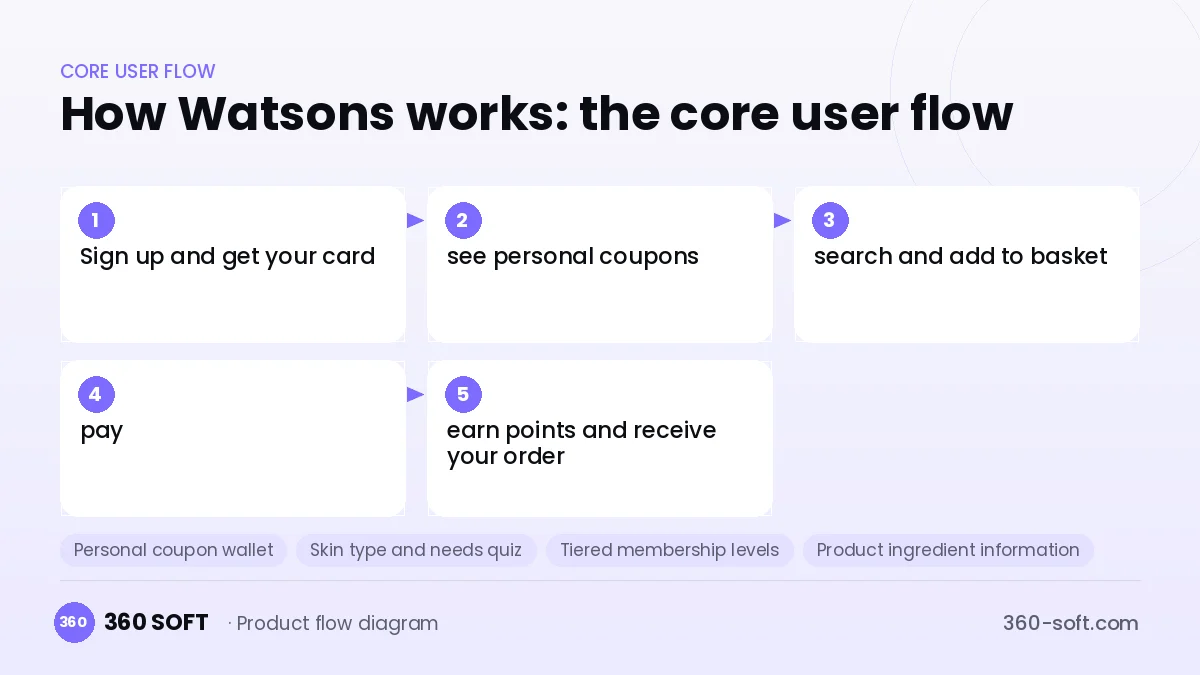
How Watsons works: the core user flow
How many apps and dashboards do you need?
Customer app
Users shop, scan their digital membership card at the till and manage coupons and points.
Store integration
Handles POS, card scanning and preparation of click-and-collect orders.
CRM and admin panel
Segmentation, coupon distribution, catalogue and campaign reports are managed.
Critical features of a product like Watsons
Personal coupon wallet
Each member gets different coupons based on purchase history; a coupon is redeemed at the till or in the online basket with a single tap.
Skin type and needs quiz
A short quiz recommends products with suitable ingredients and a care routine.
Tiered membership levels
Members move up levels based on spend; higher tiers unlock bonus points and exclusive campaigns.
Product ingredient information
Ingredients, directions and warnings are stored as structured data, enabling ingredient-based filtering.
Omnichannel orders
Home delivery, click and collect and, where needed, express delivery are handled in the same order flow.
Campaign performance reports
Coupon redemption rates and revenue impact by segment are measured in the panel.
What goes into the first version, what comes later
First version (MVP)
- Catalogue, search, basket and payments
- Digital membership card and points balance
- Coupon wallet and basic campaigns
- Carrier integration and order tracking
- Push notification infrastructure
Later releases
- Skin type quiz and recommendation engine
- Tiered membership levels
- Click and collect and in-store stock lookup
- Multi-country and multi-language support
Modules and how the budget is calculated
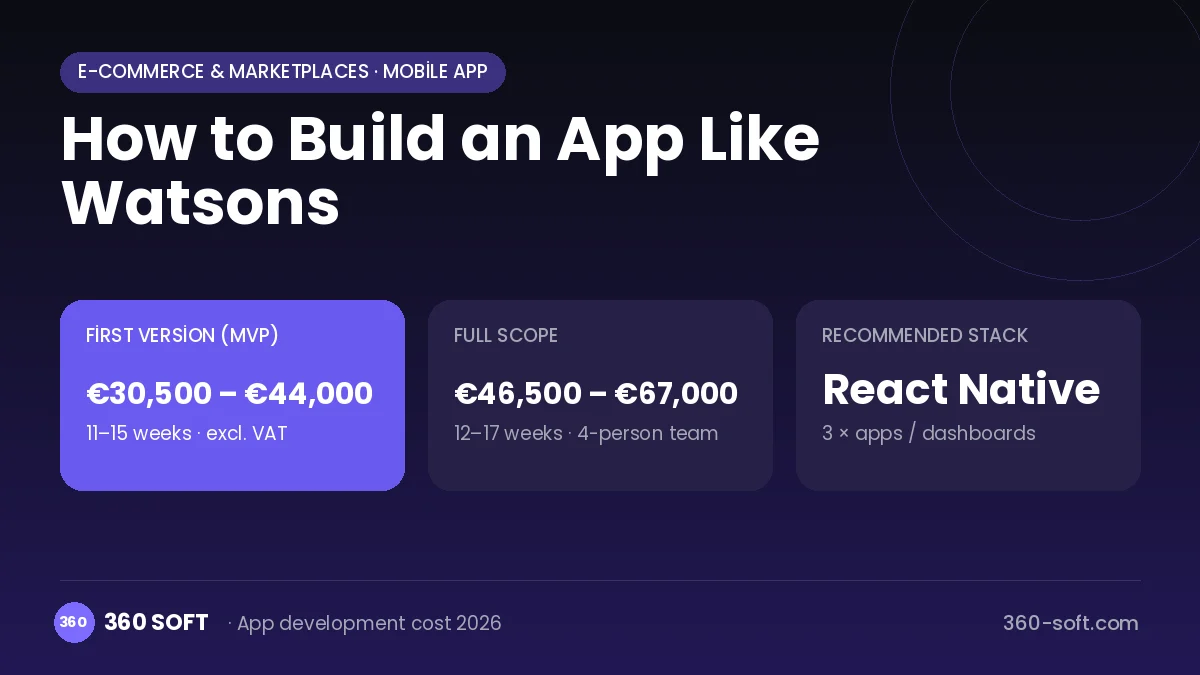
The budget is calculated with 360 SOFT’s pricing model from the modules below, about 30 screens and the project’s complexity: roughly 177 person-days for the full scope and 116 person-days for the first version. Every module you drop lowers the budget directly.
| Module | Phase |
|---|---|
| Sign-up, login, social login | First version |
| User profile and settings | First version |
| Admin dashboard | First version |
| Product / content catalogue | First version |
| Cart and checkout | First version |
| Online payments (Stripe / PSP) | First version |
| Advanced search and filters | First version |
| Push notifications | First version |
| Email / SMS notifications | First version |
| Barcode / RFID / handheld | Later release |
| ERP / accounting integration | Later release |
| Reporting and analytics | First version |
| Multi-language | First version |
| GDPR and security hardening | First version |
Hosting, SMS, map APIs, app store accounts and payment-provider fees are separate items. Maintenance and improvements (optional): €600 / month. We send a fixed written price within 24 hours after a free discovery call.
The hard parts
Single customer identity
Merging in-store and online purchases into one person requires clean matching of phone numbers, cards and accounts.
GDPR and marketing consent
Data collected for personalisation must be managed in line with explicit consent and marketing opt-in requirements under GDPR and ePrivacy rules.
Coupon abuse
Device- and account-level checks are needed to prevent abuse such as multiple accounts or coupon sharing.
Business model
The app's main return is product sales and the higher purchase frequency that loyalty brings. Sponsored product placements for brands, targeted coupon campaigns and in-app ad space create additional revenue streams. The shopping data collected also significantly strengthens the chain's negotiating power in joint marketing deals with suppliers.
Get a free quote for your project
Let us scope it together and send a fixed written quote within 24 hours. NDA on request; you own the source code.
Choosing a company to build an app like Watsons
Most people searching “build an app like watsons” are really looking for a reliable app development company. When comparing quotes, check four things:
- Can you try similar products they have shipped, in the stores or live?
- Are the source code, design files, servers and store accounts transferred to you by contract?
- Do they show a working demo every two weeks, with written scope and acceptance criteria?
- Are maintenance, scaling and GDPR/security costs written into the quote?
Copyright and trademarks
A business model and features are generally not protected on their own, but the Watsons name, logo, interface design, content and source code are. That is why we build a product with similar functionality but your own brand, design and code. This is not legal advice; we recommend a trademark search before launch.
Frequently asked questions
How long does it take to build an app like Watsons?
A first version with shopping, payments and a membership card is ready within a few months. Store POS and CRM integration is the main item that determines the timeline.
How do we connect our loyalty programme to the app?
If you already have a card programme, it is integrated via API; if not, points and tier rules are built from scratch. Either way, the store till must be able to read the card in the app.
Are there copyright or trademark issues?
The retail and loyalty business model is free to use; names, logos, design, content and code cannot be copied. This is not legal advice.
What should I look for in an app development company?
Experience with retail integration, CRM and campaign design is the most important criterion. Also ask how they handle GDPR-compliant data management.