Mobile appE-commerce & marketplacesOriginal by LVMH
What sets the Sephora app apart is how it turns shopping into a beauty experience. Users try a lipstick or foundation shade on their own face through the camera, find products that suit their skin tone, browse real customer reviews and photos, and then complete their purchase with loyalty points. Bringing premium brands under one roof and offering rich content makes the app not just a store but a discovery tool.
To build something similar you need, on top of a standard e-commerce platform, augmented reality virtual try-on, shade and skin type matching, a photo review system, a content and video module and a tiered loyalty programme. A supplier portal where brands upload product data and visuals, plus an admin panel for catalogue, campaigns and moderation, are also built.
How Sephora works: the core user flow

How many apps and dashboards do you need?
Customer app
Users discover products, try them on virtually, write reviews and shop.
Brand / supplier portal
Brands upload product information, shade palettes and visual content.
Admin panel
Catalogue, campaigns, loyalty rules and review moderation are managed.
Critical features of a product like Sephora
Virtual make-up try-on
Face tracking applies lipstick, eyeshadow and foundation shades to the live camera feed, with instant switching between products.
Shade and skin matching
A photo or a short set of questions estimates the user's skin tone and lists matching shades across brands.
Photo reviews
Reviews include skin type and shade information, so users can filter opinions from people with a similar profile.
Tiered loyalty programme
Spend levels unlock point multipliers, birthday gifts and access to exclusive events.
Beauty content and videos
Tutorials and product videos are presented with direct shopping links.
Samples and gift selection
At checkout, users can choose trial-size products or gifts with their points.
What goes into the first version, what comes later
First version (MVP)
- Catalogue, filtering, basket and payments
- Photo review and rating system
- Basic loyalty points
- Shade selector and product variant management
- Order tracking and push notifications
Later releases
- AR virtual try-on
- AI skin tone analysis
- Video content and live shopping streams
- Tiered membership and event booking
Modules and how the budget is calculated
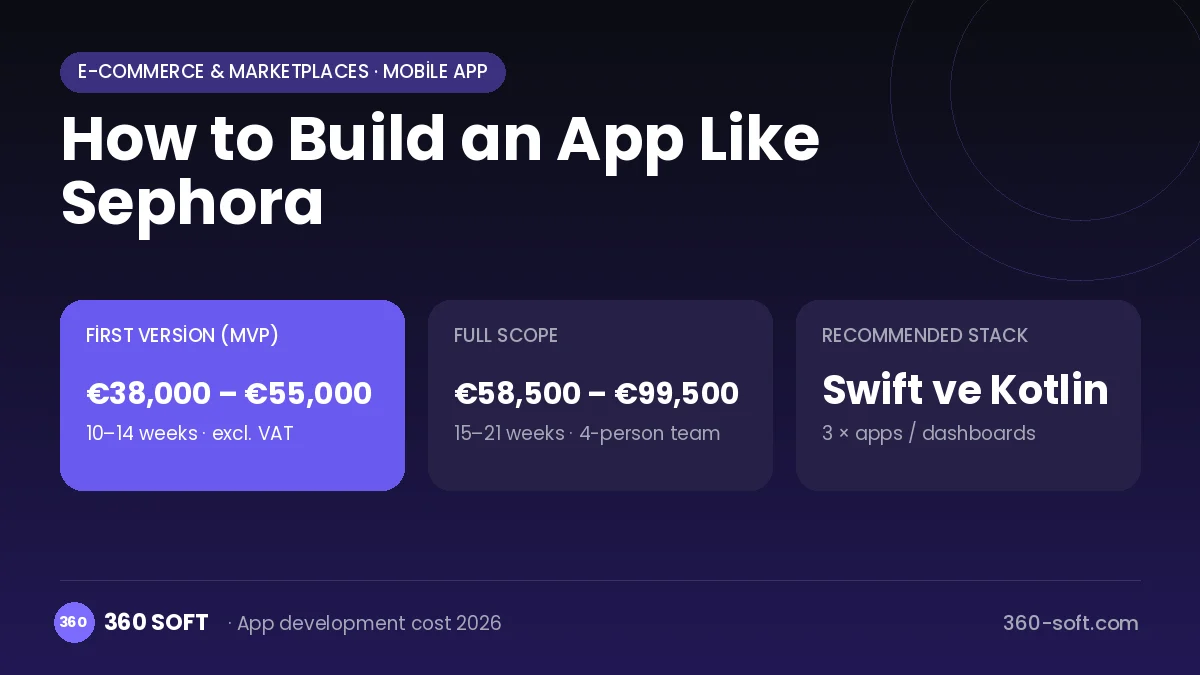
The budget is calculated with 360 SOFT’s pricing model from the modules below, about 32 screens and the project’s complexity: roughly 225 person-days for the full scope and 146 person-days for the first version. Every module you drop lowers the budget directly.
| Module | Phase |
|---|---|
| Sign-up, login, social login | First version |
| User profile and settings | First version |
| Admin dashboard | First version |
| Roles and permissions | First version |
| Product / content catalogue | First version |
| Cart and checkout | First version |
| Online payments (Stripe / PSP) | First version |
| Advanced search and filters | First version |
| Ratings and reviews | First version |
| File, photo, video upload | First version |
| Video / voice calls | First version |
| AI features (LLM, RAG, recommendations) | Later release |
| Push notifications | First version |
| Reporting and analytics | First version |
Hosting, SMS, map APIs, app store accounts and payment-provider fees are separate items. Maintenance and improvements (optional): €750 / month. We send a fixed written price within 24 hours after a free discovery call.
The hard parts
Realistic virtual try-on
Showing colour accurately across different lighting and skin tones is hard, and wrong results increase returns. Off-the-shelf AR SDKs can reduce cost and risk.
Biometric data and GDPR
Facial images may count as sensitive data; processing should happen on the device wherever possible and explicit consent must be obtained.
Variant complexity
A single product can have dozens of shades, sizes and stock levels; the catalogue model must handle this structure correctly from the start.
Business model
The main revenue comes directly from product sales, and margins on premium brands are high. Sponsored product placements for brands, featured launch slots and joint campaigns bring additional revenue. A paid top tier of the loyalty programme or a beauty box subscription can also be considered to create recurring revenue.
Get a free quote for your project
Let us scope it together and send a fixed written quote within 24 hours. NDA on request; you own the source code.
Choosing a company to build an app like Sephora
Most people searching “build an app like sephora” are really looking for a reliable app development company. When comparing quotes, check four things:
- Can you try similar products they have shipped, in the stores or live?
- Are the source code, design files, servers and store accounts transferred to you by contract?
- Do they show a working demo every two weeks, with written scope and acceptance criteria?
- Are maintenance, scaling and GDPR/security costs written into the quote?
Copyright and trademarks
A business model and features are generally not protected on their own, but the Sephora name, logo, interface design, content and source code are. That is why we build a product with similar functionality but your own brand, design and code. This is not legal advice; we recommend a trademark search before launch.
Frequently asked questions
How long does it take to build an app like Sephora?
A first version with e-commerce, reviews and loyalty can go live in a few months. Risk is reduced if AR features such as virtual try-on are planned as a separate phase.
Does virtual make-up try-on have to be built from scratch?
Usually not; off-the-shelf AR SDKs are used for face tracking, and the colour application layer is developed specifically for the project. This approach cuts both time and budget considerably.
Are there copyright or trademark issues?
Beauty e-commerce and the idea of virtual try-on are free to use; names, logos, design, content and code cannot be copied. You need permission for the images of the brands you sell. This is not legal advice.
What should I look for in an app development company?
Look for experience with AR, image processing and high-visual-quality e-commerce. Ask for performance tests and try-on results on a range of devices.