Mobile appE-commerce & marketplacesOriginal by ContextLogic
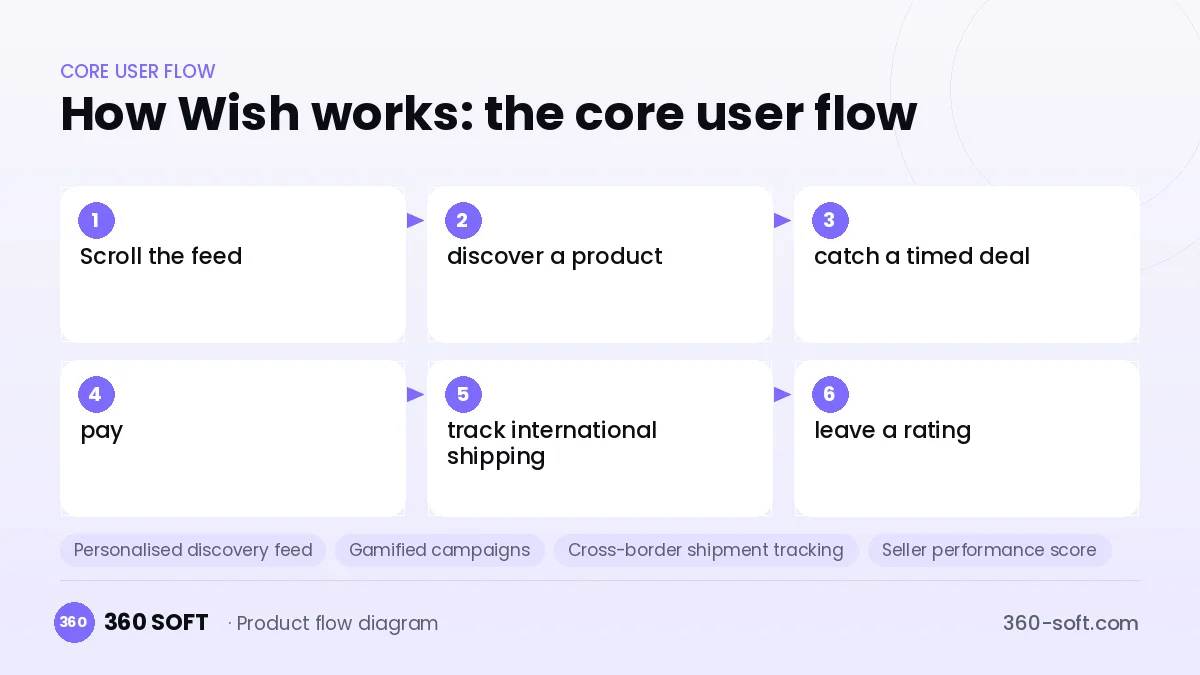
Wish is known as one of the first major marketplaces to base shopping on a discovery feed rather than search. Users scroll without knowing what they are looking for, come across very cheap products and buy on impulse. A personalised feed, timed discounts and gamified campaigns bring the app closer to entertainment, while most products ship directly from overseas manufacturers.
To build something similar you need an endless feed powered by a recommendation algorithm, a marketplace portal where many sellers upload products, cross-border shipping and customs tracking, a seller performance and quality control system, and refund and dispute management. It is a three-sided structure: a customer app, a seller portal and an admin panel that monitors fraud and product quality.
How Wish works: the core user flow
How many apps and dashboards do you need?
Customer app
Users discover products in a personal feed, buy them and track international shipments.
Seller portal
Manufacturers and sellers upload products, ship orders and monitor their performance score.
Admin and trust panel
Product review, counterfeit detection, refund disputes and payouts are managed.
Critical features of a product like Wish
Personalised discovery feed
A recommendation engine that learns from clicks, scrolling and purchases gives each user a different product feed.
Gamified campaigns
Daily login rewards, spin-the-wheel coupons and time-limited flash sales bring users back to the app.
Cross-border shipment tracking
Tracking data from carriers in different countries is merged into a single timeline.
Seller performance score
Sellers are scored on late shipments, returns and complaint rates; low scorers get less visibility.
Product quality screening
Image and title analysis flags prohibited or counterfeit products before they go live.
Refunds and disputes
Refund requests are opened for undelivered or faulty items, and responsibility between seller and platform is determined by the rules.
What goes into the first version, what comes later
First version (MVP)
- Seller portal and product upload
- Discovery feed based on category and popularity
- Basket, payments and seller payout tracking
- Shipment tracking integration
- Ratings and refund requests
Later releases
- Machine-learning personal feed
- Gamification and daily rewards
- Automated counterfeit detection
- Local warehouse and fast delivery programme
Modules and how the budget is calculated
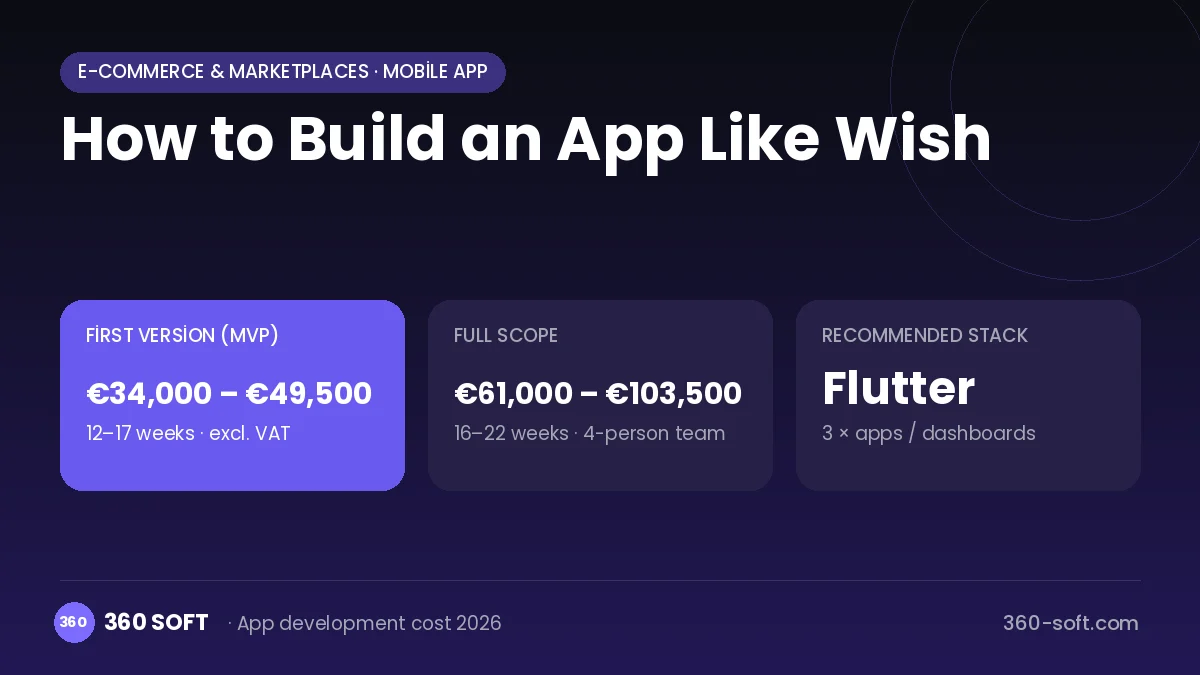
The budget is calculated with 360 SOFT’s pricing model from the modules below, about 36 screens and the project’s complexity: roughly 234 person-days for the full scope and 130 person-days for the first version. Every module you drop lowers the budget directly.
| Module | Phase |
|---|---|
| Sign-up, login, social login | First version |
| User profile and settings | First version |
| Admin dashboard | First version |
| Roles and permissions | First version |
| Product / content catalogue | First version |
| Cart and checkout | First version |
| Online payments (Stripe / PSP) | First version |
| Advanced search and filters | First version |
| Marketplace integration (Amazon, etc.) | Later release |
| Ratings and reviews | First version |
| Push notifications | First version |
| AI features (LLM, RAG, recommendations) | Later release |
| Multi-language | First version |
| GDPR and security hardening | First version |
| Reporting and analytics | Later release |
Hosting, SMS, map APIs, app store accounts and payment-provider fees are separate items. Maintenance and improvements (optional): €800 / month. We send a fixed written price within 24 hours after a free discovery call.
The hard parts
Product quality and trust
Very cheap, unvetted products drive up complaint and return rates; seller oversight determines the platform's reputation.
Long delivery times
Delays and losses are common with cross-border shipments; transparent tracking and expectation management are essential.
Payment and customs rules
Seller payouts must run through a licensed payment institution or a ready-made marketplace payments platform such as Stripe Connect, and customs and tax rules must be taken into account.
Business model
The platform's core revenue is the commission taken on every sale. Sellers are sold advertising and sponsored product campaigns to stand out in the feed, which is a major revenue line in a discovery-led model. Fast shipping programmes, warehousing services and seller subscription packages can bring extra revenue. Seller payouts should run on licensed payment institution infrastructure.
Get a free quote for your project
Let us scope it together and send a fixed written quote within 24 hours. NDA on request; you own the source code.
Choosing a company to build an app like Wish
Most people searching “build an app like wish” are really looking for a reliable app development company. When comparing quotes, check four things:
- Can you try similar products they have shipped, in the stores or live?
- Are the source code, design files, servers and store accounts transferred to you by contract?
- Do they show a working demo every two weeks, with written scope and acceptance criteria?
- Are maintenance, scaling and GDPR/security costs written into the quote?
Copyright and trademarks
A business model and features are generally not protected on their own, but the Wish name, logo, interface design, content and source code are. That is why we build a product with similar functionality but your own brand, design and code. This is not legal advice; we recommend a trademark search before launch.
Frequently asked questions
How long does it take to build an app like Wish?
A first version with a seller portal, discovery feed, payments and shipment tracking can be ready within a few months. The recommendation algorithm needs real user data to mature.
How many separate apps are needed?
A customer mobile app, a web-based seller portal and an admin panel form the core structure. A mobile order app for sellers can also be added.
Are there copyright or trademark issues?
The discovery-led marketplace model is free to use; names, logos, design, content and code cannot be copied. Counterfeit products sold on the platform can also create liability, so moderation is essential. This is not legal advice.
Is an off-the-shelf marketplace script enough?
Ready-made scripts can be used for an experimental start. For a marketplace that needs a personal feed, seller scoring and scale, custom software is the sounder choice.