2D gameMatch-3 puzzle with home decorationOriginal by Playrix
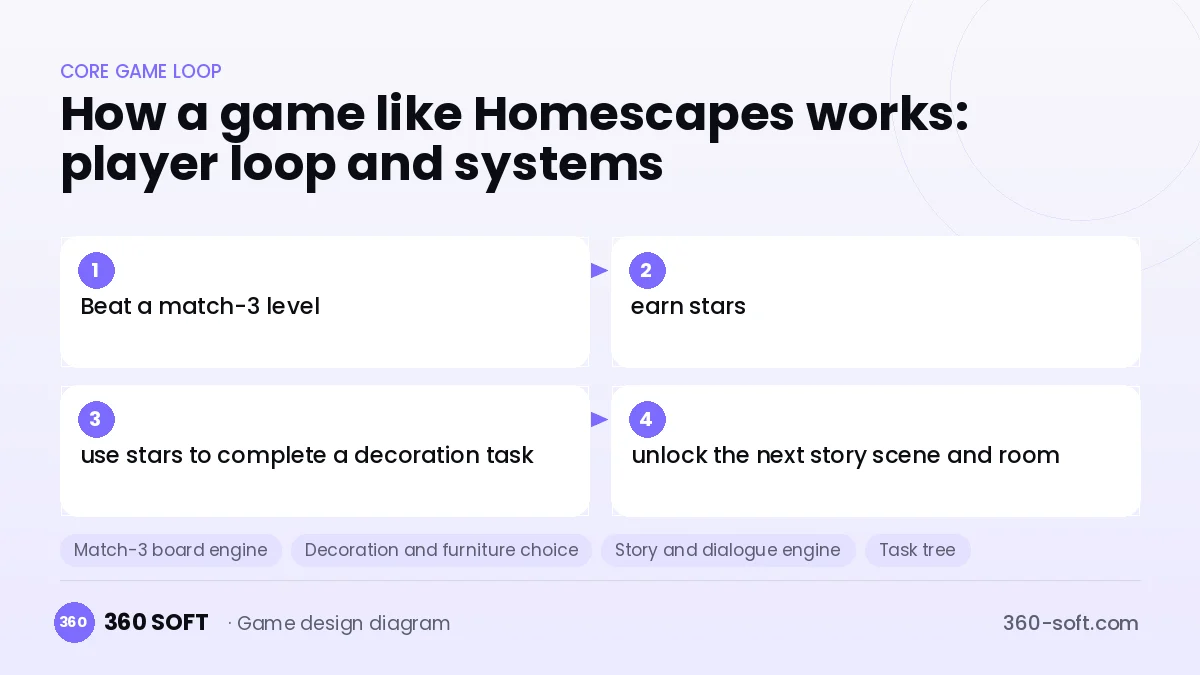
Homescapes ties short match-3 levels to the story of rebuilding a family home, giving players two separate kinds of satisfaction: the instant pleasure of beating a level and watching the house visibly become more beautiful. Each star completes a task, and each task unlocks a new room, a furniture choice or a character dialogue. While solving puzzles, players are really waiting for the next episode of the story, as if watching a series.
A similar game requires building two separate products in one package. On one side sits the board engine that handles cascades and booster combinations, along with a level editor; on the other, a decoration scene with animated characters, dialogue flow, furniture options and room transitions. The task system that connects them, cloud saves, an events calendar and an art pipeline that keeps producing new rooms are also part of the project.
Why Homescapes works: the core loop
Systems you need to build a game like Homescapes
Match-3 board engine
The core puzzle logic in which boosters such as rockets, bombs and paper planes combine and obstacles break layer by layer.
Decoration and furniture choice
A system that offers players several design options for each task, places the choice permanently in the room and allows it to be changed later.
Story and dialogue engine
A scripting tool, ready for localization, that links character animations, speech bubbles and cutscenes to task progress.
Task tree
A data-driven progression structure, managed by designers, that defines how many stars each task needs and which task unlocks after which.
Room and area management
A content delivery layer for downloading new areas as separate bundles, scene transitions and keeping old rooms visitable.
Events and team modules
LiveOps components such as timed competitions, collection events and life-sharing within teams that encourage regular returns.
What goes into the first version, what comes later
First version (soft launch)
- A complete match-3 board with booster combinations
- A two- or three-room decoration flow and the first story chapter
- Task tree, star economy and lives system
- A first level pack built with the level editor
- Cloud saves, basic analytics and initial store offers
Later updates
- New rooms, outdoor areas such as a garden, and seasonal decor
- Team system, team chat and team tournaments
- Collection albums and timed event reward tracks
- Extra personalization layers such as pets and outfits
The hard parts of this genre
Balancing two economies
Level difficulty and the star cost of decoration tasks must be tuned together; if either breaks, the story either runs out too fast or players get bored.
Art production load
Every new room needs many furniture variants, character animations and scene illustrations; without a planned art pipeline, the update schedule slips.
App size
As rooms pile up, the package grows; on-demand content downloads and safely unloading old assets from memory must be well designed.
Team, timeline and budget
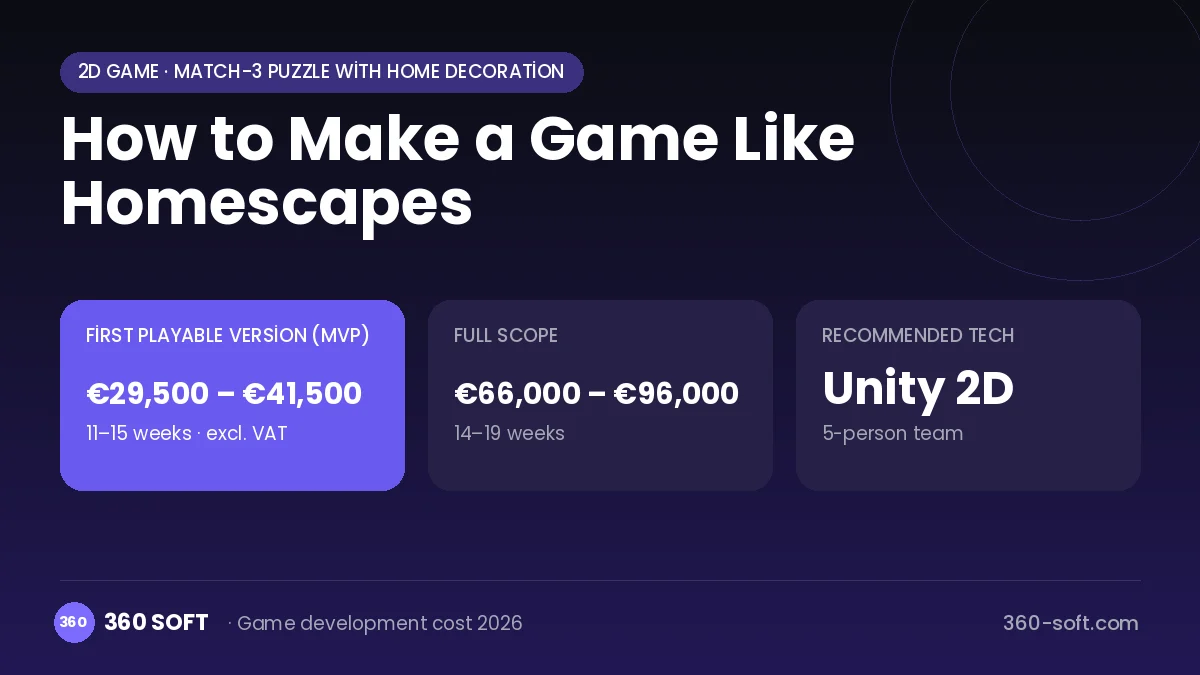
The estimate is based on the genre’s core systems, content volume, multiplayer and live-ops needs plus QA and project management: about 252 person-days for the full scope and 113 person-days for the first version. Cutting scope (fewer levels, one map, fewer characters) lowers the budget directly. Store accounts, servers, audio licences and user-acquisition budget are separate items. We send a fixed written price within 24 hours after the game design document.
Monetisation
Revenue comes mostly from in-app purchases: extra moves, unlimited lives for a set time, boosters and coin packs. Rather than selling directly, the decoration side drives indirect spending by encouraging level play. Seasonal reward tracks and rewarded ads deliver steady revenue even from non-paying players.
Estimate your game budget and get a fixed quote
Let us scope it together and send a fixed written quote within 24 hours. NDA on request; you own the source code.
Calculated instantly from your choices, excl. VAT. A fixed written quote follows a free scoping call within 24 hours.
Choosing a game development company for a game like Homescapes
Most people searching “make a game like homescapes” are really looking for a reliable game development company. When comparing quotes, check four things:
- Can you play their released 2D games on your own phone?
- Are the source code, art files and store accounts transferred to you by contract?
- Do they build a playable prototype first and show a demo every two weeks?
- Are multiplayer servers, anti-cheat and scaling costs written into the quote?
Copyright and originality
Game mechanics on their own are generally not protected, but names, logos, characters, art, audio and level designs are. That is why we build a game “like Homescapes” with your own name, art and world. This is not legal advice; we recommend a trademark search before launch.
Frequently asked questions
How long does it take to make a game like Homescapes?
A match-3 board and a single-room decoration prototype can be built in a few months. A version with story, enough levels and room content to soft launch takes considerably longer; art and level volume determine most of the timeline.
Does making a game similar to Homescapes cause copyright issues?
Combining match-3 with decoration is a genre formula and generally free to use. However, characters, story, names, house designs, interface and sounds cannot be copied; you need to build your own world and characters. This is not legal advice.
Can a small team build it?
The core mechanic can be built by a small team, but producing rooms and story regularly needs a serious art team. Small teams can reduce risk by narrowing the scope and starting with a single location and short chapters.
What should I look for in a studio that makes games like Homescapes?
The studio should have experience in both puzzle mechanics and character animation and narrative design. Be sure to ask about their approach to the level editor, content bundling and post-launch event management.