2D gameStory-driven matching and decorationOriginal by Tactile Games
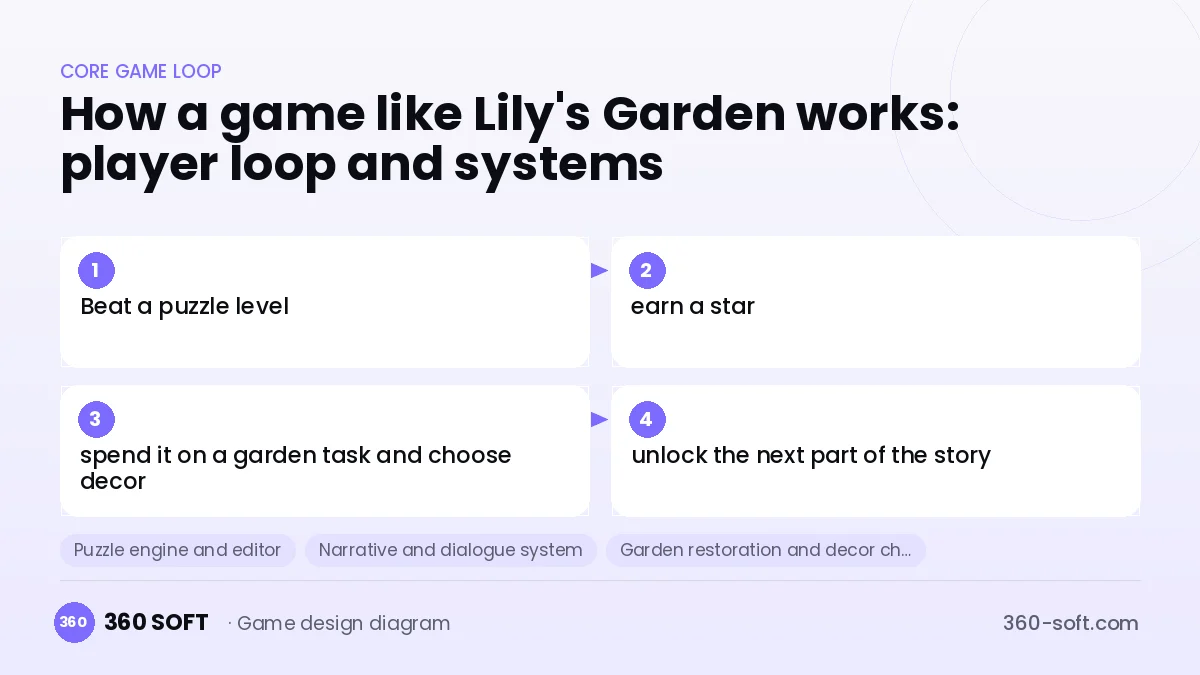
Lily's Garden combines matching puzzles with a story that unfolds like a TV series. Players earn stars by beating levels, use those stars to restore an abandoned garden step by step and unlock the next part of the characters' drama-filled story. The puzzles deliver short-term mental satisfaction while the story fuels the "what happens next" curiosity; this dual structure hooks players both daily and over the long term.
A similar game requires two separate production pipelines: a mature puzzle engine and level editor with boosters and obstacles, and a narrative system that manages dialogue, character animation and decoration choices. Restoring garden areas piece by piece, player style choices, a lives and booster economy, events, cloud saves and regular story chapter updates sit at the heart of the scope.
Why Lily's Garden works: the core loop
Systems you need to build a game like Lily's Garden
Puzzle engine and editor
Board handling tile matching, booster combos and obstacles, plus the level tool designers use to build levels.
Narrative and dialogue system
Story engine that plays character dialogue, emotional expressions and scene transitions from data files.
Garden restoration and decor choice
Meta layer with areas unlocked by tasks, several style options for each object and animated renovations.
Task and star economy
Core loop where stars earned in levels are spent on story tasks, setting the pace of progress.
Lives and boosters
Resource balance built on lives that refill over time, pre-level boosters and extra-move offers.
Events and teams
LiveOps features that build social bonds through limited-time competitions, team chat and life sharing.
What goes into the first version, what comes later
First version (soft launch)
- Puzzle engine with finished boosters and obstacles
- First story chapters and dialogue system
- First garden areas and decor style choices
- Lives, booster and extra-move economy
- IAP, cloud saves and analytics
Later updates
- Regular new story chapters and areas
- Teams, chat and team competitions
- Seasonal events and reward tracks
- New obstacle families and level types
The hard parts of this genre
Two production pipelines
Producing puzzle levels and story and art content at the same pace requires a large, well-coordinated team.
Story and economy alignment
Story pace depends on the star economy; progress that is too slow bores players, while too fast burns through content.
Art quality
Characters and garden areas are the game's shop window; consistent, high-quality 2D illustration and animation are needed.
Team, timeline and budget
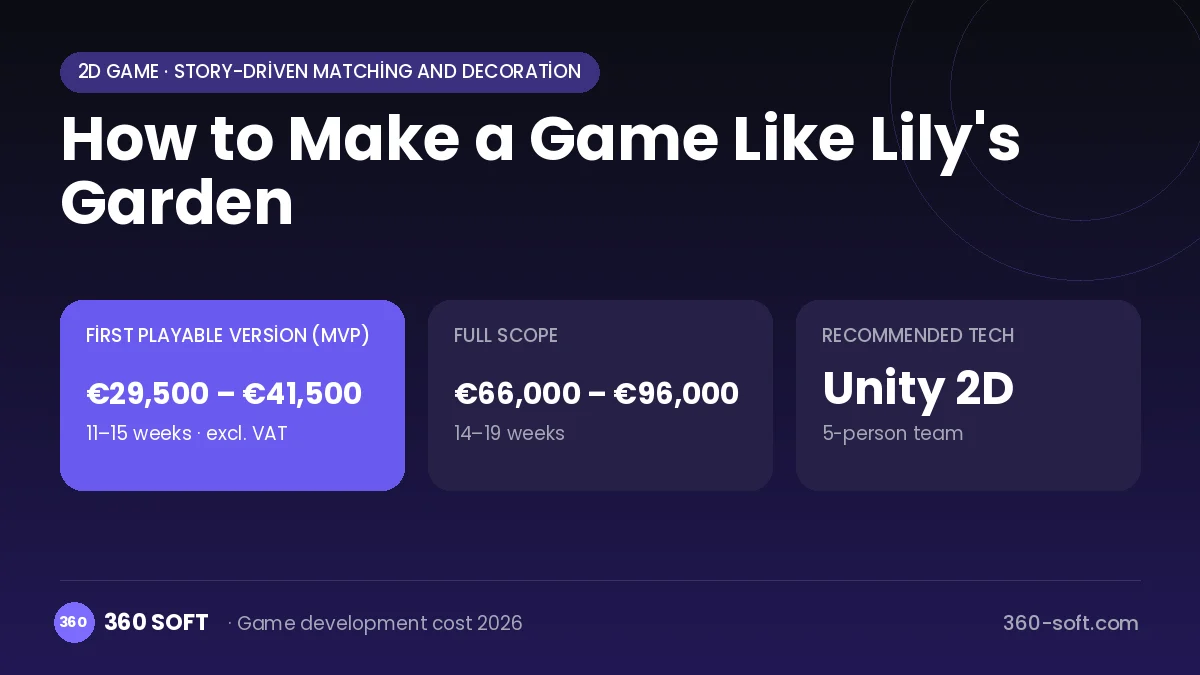
The estimate is based on the genre’s core systems, content volume, multiplayer and live-ops needs plus QA and project management: about 252 person-days for the full scope and 113 person-days for the first version. Cutting scope (fewer levels, one map, fewer characters) lowers the budget directly. Store accounts, servers, audio licences and user-acquisition budget are separate items. We send a fixed written price within 24 hours after the game design document.
Monetisation
Story-driven match games earn largely from in-app purchases: extra moves, life refills, booster packs and special offers. A player's curiosity about the story naturally supports spending to progress. Rewarded ads and season passes add revenue; the economy should still allow progress without paying.
Estimate your game budget and get a fixed quote
Let us scope it together and send a fixed written quote within 24 hours. NDA on request; you own the source code.
Calculated instantly from your choices, excl. VAT. A fixed written quote follows a free scoping call within 24 hours.
Choosing a game development company for a game like Lily's Garden
Most people searching “make a game like lily's garden” are really looking for a reliable game development company. When comparing quotes, check four things:
- Can you play their released 2D games on your own phone?
- Are the source code, art files and store accounts transferred to you by contract?
- Do they build a playable prototype first and show a demo every two weeks?
- Are multiplayer servers, anti-cheat and scaling costs written into the quote?
Copyright and originality
Game mechanics on their own are generally not protected, but names, logos, characters, art, audio and level designs are. That is why we build a game “like Lily's Garden” with your own name, art and world. This is not legal advice; we recommend a trademark search before launch.
Frequently asked questions
How long does it take to make a game like Lily's Garden?
Because the puzzle engine, narrative system, art content and meta layer must be developed together, a soft-launch-ready version usually takes months. Regular story and level production after launch must be planned separately.
Will there be copyright problems?
Matching mechanics and the story-driven decoration formula are generally free to use. The Lily's Garden name, characters, story, visuals and sounds cannot be copied; you need an original narrative and art direction. This is not legal advice.
What does the story writing require?
You need a script split into chapters, each ending on a cliffhanger, plus dialogue tools to bring it into the game. It is important for the writer and game designer to work in step with the economy.
What should I look for when choosing a studio to make a game like Lily's Garden?
Look for a studio with experience in match-3 engines, level editors and narrative systems and strong 2D character animation skills. It should offer a sustainable plan for post-launch content production and LiveOps.