2D gameMatching and style/decorationOriginal by Magic Tavern
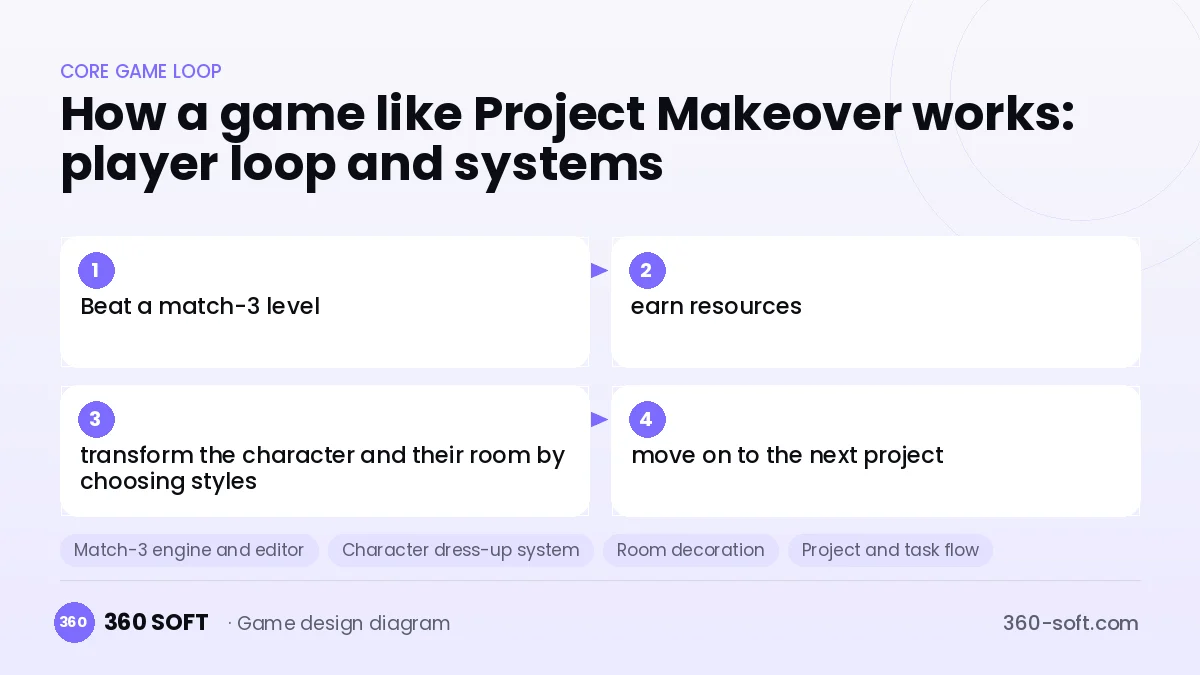
Project Makeover combines match-3 levels with the fantasy of transforming characters and spaces. Using resources earned from puzzles, players redesign a character's hair, make-up and outfit, and then the room they live in. The before-and-after comparison at the end of each makeover project is a powerful moment of satisfaction, while humorous characters and short stories make players curious about the next transformation.
A similar game needs a mature match-3 engine with boosters and obstacles, a dress-up system that changes a character's look layer by layer, and a placement layer that manages room decoration. Because separate illustrations are produced for every option, the art pipeline is huge. You also need a lives and booster economy, story dialogue, events and a LiveOps backend that delivers regular new makeover projects.
Why Project Makeover works: the core loop
Systems you need to build a game like Project Makeover
Match-3 engine and editor
Board handling matches, cascades, booster combos and obstacles, plus a level production tool.
Character dress-up system
Appearance framework that combines hair, make-up, outfits and accessories in layers and shows choices with animation.
Room decoration
Space system where furniture, colours and decor items are placed from options, offering a before-and-after view.
Project and task flow
Structure that splits each makeover project into tasks, ties earned resources to steps and moves the story forward.
Narrative and dialogue
Story engine that gives each project context through humorous character dialogue and short scenes.
Economy and events
Lives, boosters and extra-move offers, plus limited-time events and reward tracks.
What goes into the first version, what comes later
First version (soft launch)
- Match-3 engine with finished boosters and first levels
- Layered character dress-up system
- First makeover projects and room decoration
- Lives, booster and extra-move economy
- IAP, cloud saves and analytics
Later updates
- Regular new character and location projects
- Team features and social competitions
- Seasonal events and reward tracks
- New puzzle mechanics and obstacles
The hard parts of this genre
Art volume
Several options must be drawn for every character and room; art production is the project's biggest cost and time item.
Layer compatibility
For hair, outfits and accessories to look right in every combination, layer order and overlaps must be managed carefully.
Economy balance
The balance between puzzle progress and project cost determines whether players advance without getting bored or feeling forced to pay.
Team, timeline and budget
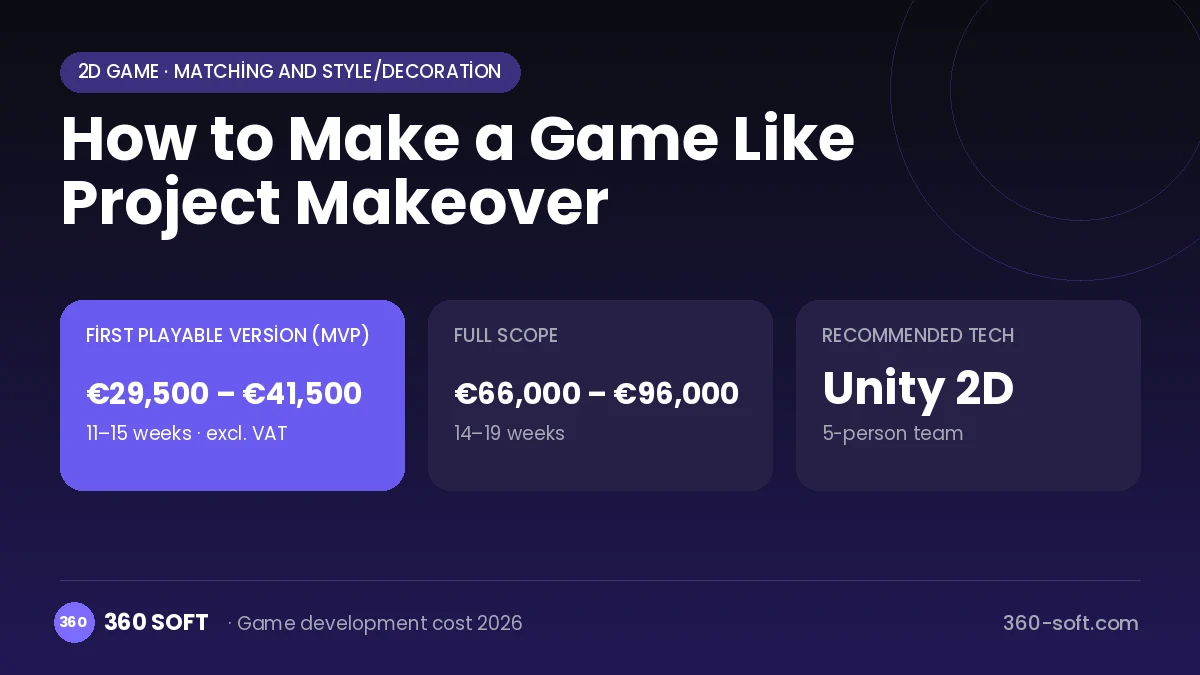
The estimate is based on the genre’s core systems, content volume, multiplayer and live-ops needs plus QA and project management: about 252 person-days for the full scope and 113 person-days for the first version. Cutting scope (fewer levels, one map, fewer characters) lowers the budget directly. Store accounts, servers, audio licences and user-acquisition budget are separate items. We send a fixed written price within 24 hours after the game design document.
Monetisation
Revenue in this formula relies heavily on in-app purchases: extra moves, lives, booster packs and offers that speed up makeover projects. Rewarded ads support non-paying players, while event reward tracks and season passes deliver regular revenue. Special outfit and decor sets also create cosmetic sales opportunities.
Estimate your game budget and get a fixed quote
Let us scope it together and send a fixed written quote within 24 hours. NDA on request; you own the source code.
Calculated instantly from your choices, excl. VAT. A fixed written quote follows a free scoping call within 24 hours.
Choosing a game development company for a game like Project Makeover
Most people searching “make a game like project makeover” are really looking for a reliable game development company. When comparing quotes, check four things:
- Can you play their released 2D games on your own phone?
- Are the source code, art files and store accounts transferred to you by contract?
- Do they build a playable prototype first and show a demo every two weeks?
- Are multiplayer servers, anti-cheat and scaling costs written into the quote?
Copyright and originality
Game mechanics on their own are generally not protected, but names, logos, characters, art, audio and level designs are. That is why we build a game “like Project Makeover” with your own name, art and world. This is not legal advice; we recommend a trademark search before launch.
Frequently asked questions
How long does it take to make a game like Project Makeover?
Because the match-3 engine, dress-up and decor systems and a large art pipeline must all be built together, a soft-launch version takes months. The volume of art content is the biggest factor in the timeline.
Will there be copyright problems?
The matching plus makeover/decor formula is generally free to use. The Project Makeover name, characters, visuals, story and interface cannot be copied; you should create your own characters and style. This is not legal advice.
Which engine should I use?
Unity 2D is a mature choice for match-3 logic and Spine-based character animation. For the layered dress-up system, good sprite and atlas management should be planned.
What should I look for when choosing a studio to make a game like Project Makeover?
Beyond match-3 experience, look for a strong 2D art team and character animation skills. Ask how they will sustain new project and event production after launch.