3D gameTeam-based hero shooterOriginal by Blizzard Entertainment
Overwatch succeeded by building the shooter genre around hero identity and role synergy. Tank, damage and support roles complement each other, and you can switch heroes mid-match to counter the enemy line-up. Every character has a clear silhouette, voice and gameplay fantasy. Thanks to objective-based modes, it is not just kill count that wins but using the right ability at the right time, which satisfies players with very different skill profiles in the same match.
Making a similar game is less about modelling a few guns and more about producing heroes each designed like a mini-game of their own. A first release needs only a few maps, a few heroes per role and a single objective mode. Underneath sit server-authoritative netcode that fairly handles projectile and hitscan weapons, shields, healing and movement abilities, role-queue matchmaking and post-match stats screens.
Why Overwatch 2 works: the core loop
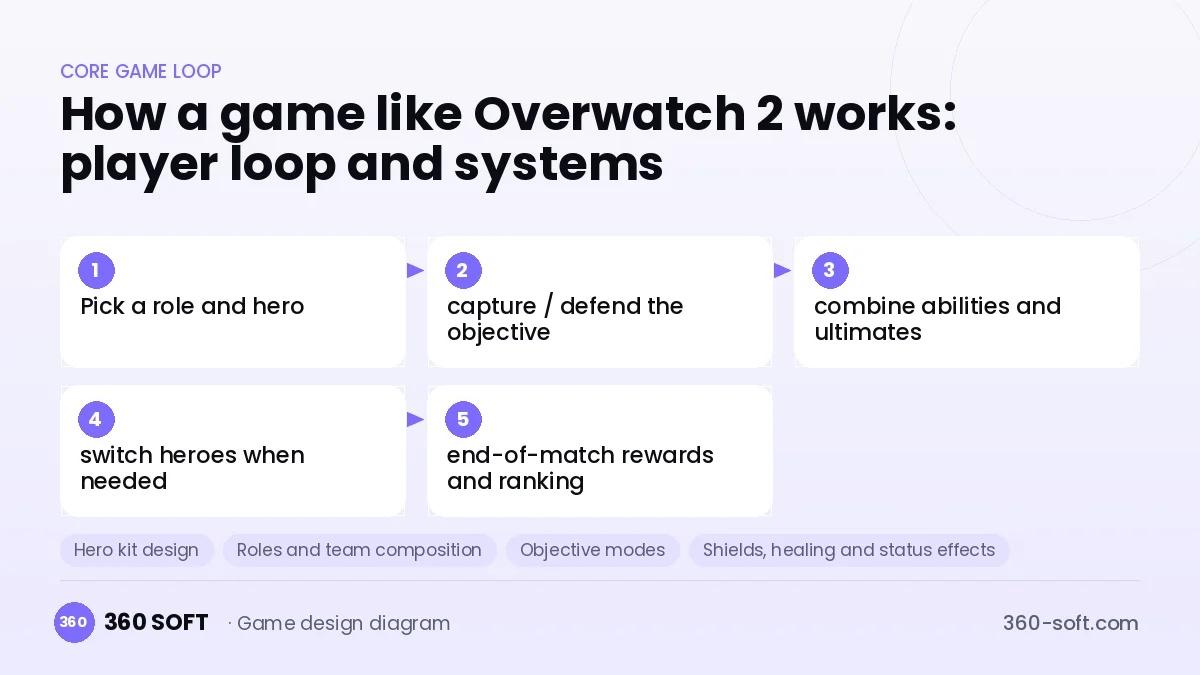
Systems you need to build a game like Overwatch 2
Hero kit design
Primary fire, secondary abilities and ultimate charge; every hero needs a limited, readable toolkit.
Roles and team composition
Tank, damage and support roles; role queue, rules for duplicate heroes on a team and role-based stats.
Objective modes
Control points, payload escort and push modes; phases, overtime and respawn waves.
Shields, healing and status effects
Consistent, readable server-side handling of damage blocking, healing, stuns and slows.
Readability and feedback
Hero silhouettes, ultimate voice callouts and hit effects; a visual language that shows what is happening even in chaotic fights.
Role-queue matchmaking and ranked
Role-based skill rating, group rules and a seasonal ranking system.
What goes into the first version, what comes later
First version (soft launch)
- 2–3 heroes per role (6–9 heroes in total)
- 2–3 maps and a single objective mode
- Quick play matchmaking with role queue
- Post-match stats and a play-of-the-game replay
- A basic cosmetic store and player profile
Later updates
- New heroes and map types
- Ranked seasons and a battle pass
- Story / PvE missions and a custom game browser
- Console support and cross-progression
The hard parts of this genre
Hero variety and balance
Every hero interacts with every other; balance issues appear even with a small roster, and the testing load grows exponentially with each new hero.
Ability network sync
Making shields, teleports and area effects look fair to players on different latencies is a hard networking problem.
Art and character production
Players bond with heroes in this genre; strong character design, animation and voice acting consume a large share of the budget.
Team, timeline and budget
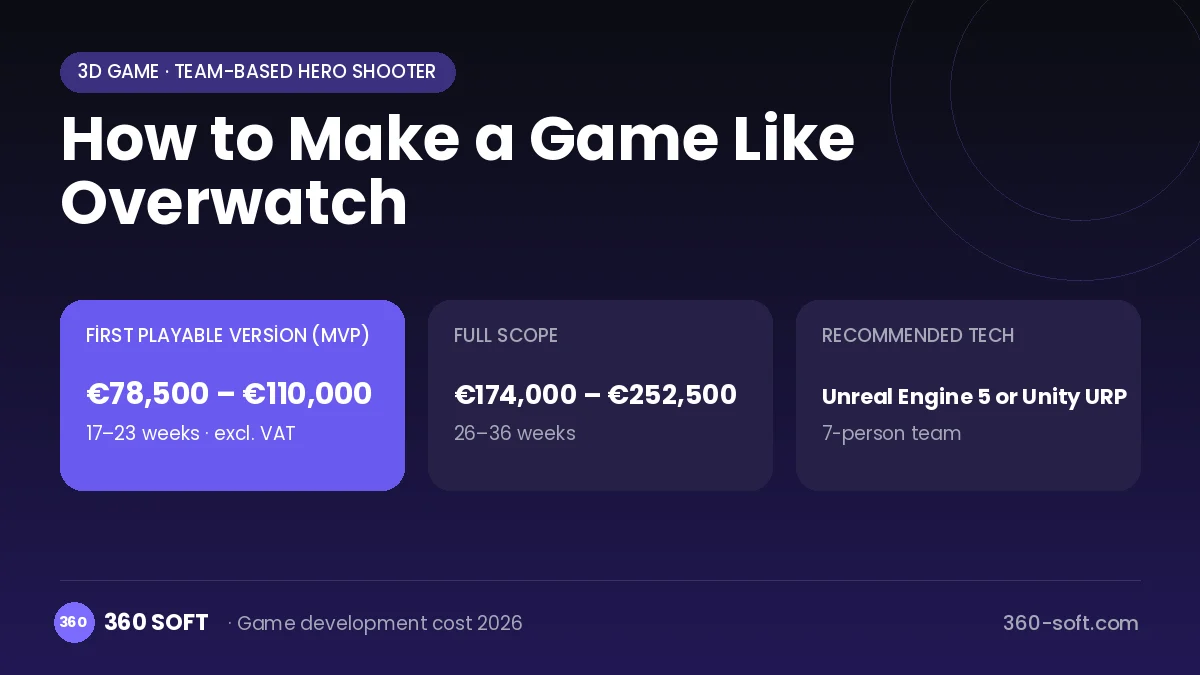
The estimate is based on the genre’s core systems, content volume, multiplayer and live-ops needs plus QA and project management: about 668 person-days for the full scope and 300 person-days for the first version. Cutting scope (fewer levels, one map, fewer characters) lowers the budget directly. Store accounts, servers, audio licences and user-acquisition budget are separate items. We send a fixed written price within 24 hours after the game design document.
Monetisation
Within a free-to-play structure, the seasonal battle pass, hero skins, victory poses, voice lines and limited-time event cosmetics are the core revenue sources. Allowing new heroes to be unlocked for free protects competitive fairness. Avoiding pay-to-win is essential to keeping trust in a competitive community.
Estimate your game budget and get a fixed quote
Let us scope it together and send a fixed written quote within 24 hours. NDA on request; you own the source code.
Calculated instantly from your choices, excl. VAT. A fixed written quote follows a free scoping call within 24 hours.
Choosing a game development company for a game like Overwatch 2
Most people searching “make a game like overwatch” are really looking for a reliable game development company. When comparing quotes, check four things:
- Can you play their released 3D games on your own phone?
- Are the source code, art files and store accounts transferred to you by contract?
- Do they build a playable prototype first and show a demo every two weeks?
- Are multiplayer servers, anti-cheat and scaling costs written into the quote?
Copyright and originality
Game mechanics on their own are generally not protected, but names, logos, characters, art, audio and level designs are. That is why we build a game “like Overwatch 2” with your own name, art and world. This is not legal advice; we recommend a trademark search before launch.
Frequently asked questions
How long does it take to make a game like Overwatch?
A playable MVP of a hero shooter (a few maps, 6–9 heroes) can take an experienced team around a year. As the hero count grows, design, animation and balance time grows exponentially, not linearly.
Will there be copyright issues?
Mechanics such as role-based team shooters and payload modes are generally free to use. Hero names, character designs, maps, visual style and sounds cannot be copied. This is general information, not legal advice.
Can it be built with a small team?
A version with few heroes and one mode is possible with a small but experienced team. Without a character artist, animator and network programmer, however, reaching the genre's quality bar is very hard.
What should I look for in a company that makes games like Overwatch?
Look at the company's experience with ability systems and real-time networking, its character design portfolio and how it manages balance with data. Ask for a playable prototype with a few heroes.