Web platformE-commerce & marketplaces
Cimri is Turkey's best-known price comparison site, comparable to PriceRunner or Google Shopping. Its value lies in answering the one question shoppers have before they buy: where is this product cheapest? By gathering prices from hundreds of stores on one screen and adding a price history chart and price-drop alerts, it lets users buy with confidence. Because retailers value that traffic too, the platform becomes an intermediary that serves both sides at once.
To build something similar, the real work happens behind the visible pages: a data collection pipeline that manages store XML/JSON feeds and, where needed, crawlers; a matching engine that recognises the same product across different stores; a price history store and fast search infrastructure. On top of that come a merchant portal, click-based billing and an admin panel for content management.
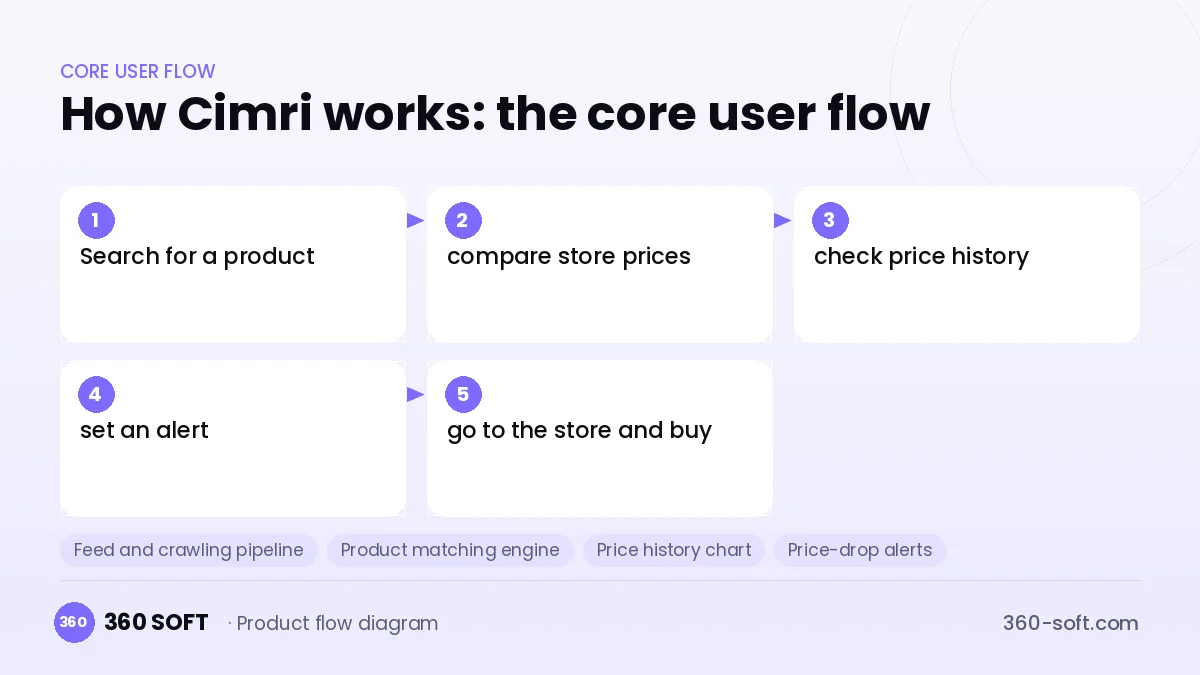
How Cimri works: the core user flow
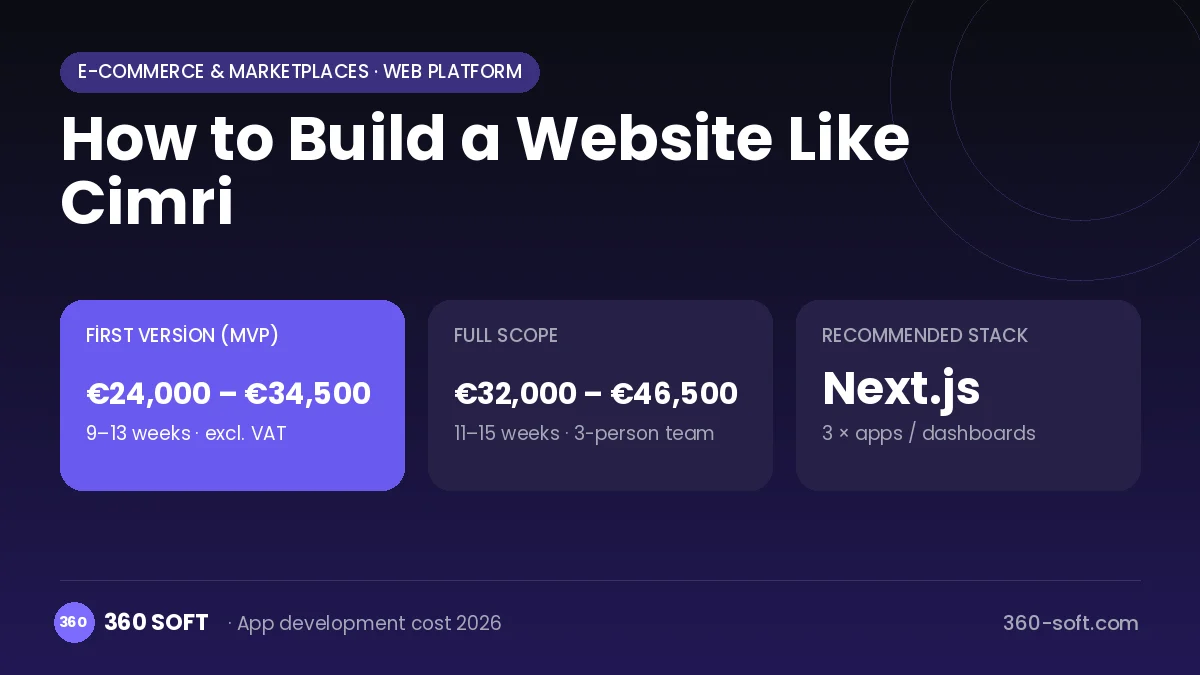
How many apps and dashboards do you need?
Visitor website and mobile web
Shoppers search for products, compare prices, set price alerts and click through to stores.
Merchant portal
Retailers connect their product feed, monitor click reports and manage their budget.
Admin panel
The team manages the category tree, matching errors, feeds and ad placements.
Critical features of a product like Cimri
Feed and crawling pipeline
Store XML/JSON feeds are pulled at set intervals, broken or incomplete records are filtered out, and controlled crawling is used for stores without a feed.
Product matching engine
Barcodes, model numbers and title similarity merge the same product from different stores into a single card; uncertain matches go to a manual review queue.
Price history chart
Each product's price changes are stored per store, so users can see from the chart whether a discount is genuine.
Price-drop alerts
Users set a target price and are notified by email or push notification when the price falls.
Filterable category pages
Dynamic filters based on technical specs (storage, screen size, clothing size, etc.) and SEO-friendly category URLs are generated.
Click tracking and billing
Every click sent to a store is logged, fraudulent clicks are filtered out and stores are billed on a cost-per-click basis.
What goes into the first version, what comes later
First version (MVP)
- Store feed integration for a handful of selected categories
- Basic product matching by barcode and model number
- Search, filters and a store price list page
- Price history chart and email price alerts
- Click tracking and a simple merchant report
Later releases
- Mobile app with push notification alerts
- AI-assisted title matching
- User reviews and expert review content
- Self-service merchant portal and automated billing
Modules and how the budget is calculated
The budget is calculated with 360 SOFT’s pricing model from the modules below, about 24 screens and the project’s complexity: roughly 123 person-days for the full scope and 91 person-days for the first version. Every module you drop lowers the budget directly.
| Module | Phase |
|---|---|
| Sign-up, login, social login | First version |
| User profile and settings | First version |
| Admin dashboard | First version |
| Product / content catalogue | First version |
| Advanced search and filters | First version |
| Email / SMS notifications | First version |
| Push notifications | First version |
| Reporting and analytics | Later release |
| Third-party API integration | First version |
| Content management / blog | First version |
| Ratings and reviews | First version |
| GDPR and security hardening | First version |
Hosting, SMS, map APIs, app store accounts and payment-provider fees are separate items. Maintenance and improvements (optional): €400 / month. We send a fixed written price within 24 hours after a free discovery call.
The hard parts
Matching accuracy
Stores list the same product under different names; a wrong match can instantly damage user trust, so automated and manual checks must be designed to work together.
Data freshness and scale
Prices and stock change constantly; refreshing millions of records frequently requires a queue system, incremental updates and solid indexing.
Crawling and legal limits
Crawling stores that do not provide a feed can run into technical barriers and terms-of-service restrictions; agreed feeds should be preferred wherever possible.
Business model
The core revenue of a price comparison site is the cost-per-click fee charged for traffic sent to stores, or a commission on traffic that converts into sales. On top of that you can add featured store listings on category pages, brand campaign placements and banner advertising. The shopper side should stay free; otherwise traffic drops, and merchant interest drops with it.
Get a free quote for your project
Let us scope it together and send a fixed written quote within 24 hours. NDA on request; you own the source code.
Choosing a company to build an app like Cimri
Most people searching “website like cimri” are really looking for a reliable app development company. When comparing quotes, check four things:
- Can you try similar products they have shipped, in the stores or live?
- Are the source code, design files, servers and store accounts transferred to you by contract?
- Do they show a working demo every two weeks, with written scope and acceptance criteria?
- Are maintenance, scaling and GDPR/security costs written into the quote?
Copyright and trademarks
A business model and features are generally not protected on their own, but the Cimri name, logo, interface design, content and source code are. That is why we build a product with similar functionality but your own brand, design and code. This is not legal advice; we recommend a trademark search before launch.
Frequently asked questions
How long does it take to build a website like Cimri?
A first version starting with a few categories, including feed integration and price alerts, usually goes live within a few months. The matching engine then matures over time as it works with live data.
How are store prices collected?
The most reliable route is the product feeds that stores provide. Controlled crawling can be used where no feed exists, but it is more fragile, and an agreement with the store should always be the first choice.
Are there copyright or trademark issues?
The price comparison business model and its features are generally free to use. However, names, logos, design, content and code cannot be copied, and you need the store's permission to use product images. This is not legal advice.
What should I look for in a company that builds price comparison sites?
The team should have experience with data collection, queue management and search engines. Ask about previous projects that handled large product catalogues and about their knowledge of SEO-friendly architecture.