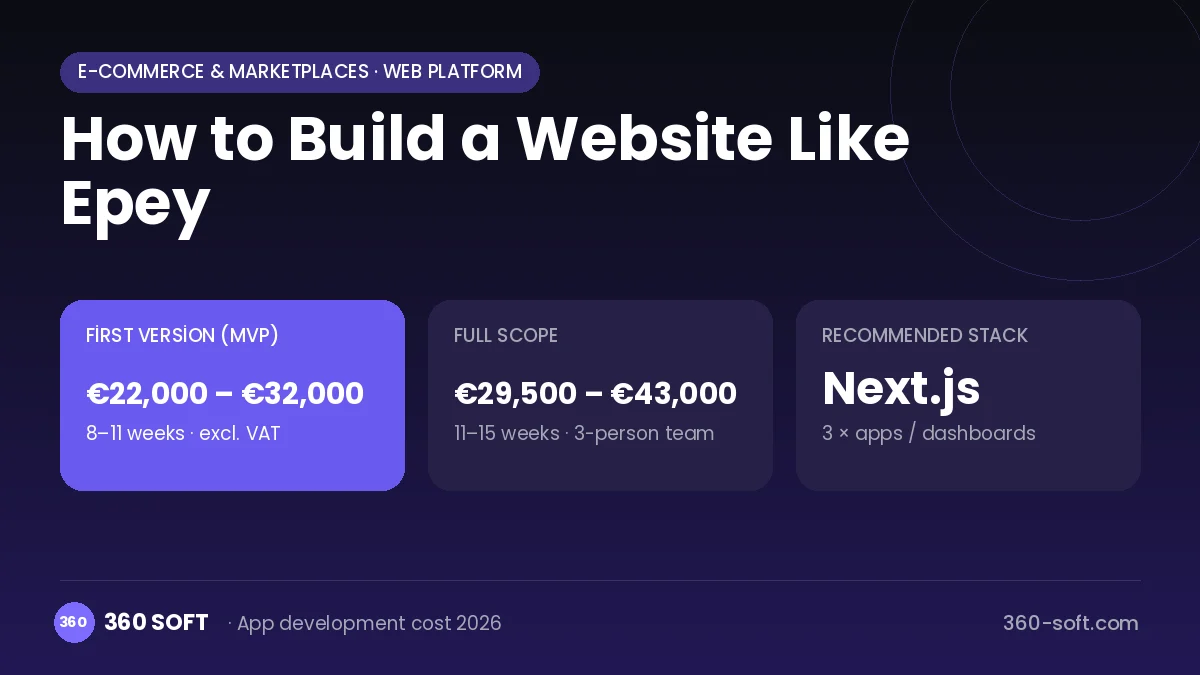
Web platformE-commerce & marketplaces
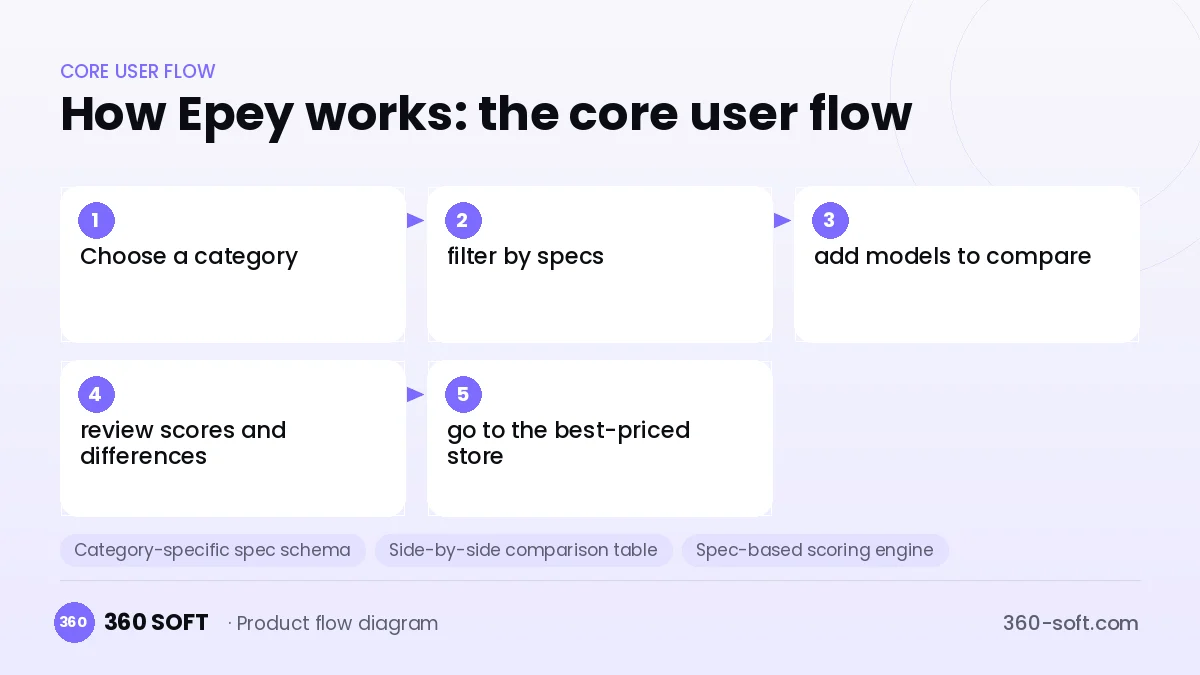
Epey is a popular Turkish product comparison site, similar in spirit to GSMArena or Versus. Its strength lies less in price and more in technical spec comparison. Someone buying a phone, laptop or home appliance can put two or three models side by side, see hundreds of specs such as processor, battery and display in one table, and reach the product score and the best price from the same page. That depth makes it a go-to destination for users in the research phase and gives it strong search engine visibility.
To build something similar you need a flexible, category-based spec schema, a clean product database populated according to that schema, a scoring engine that turns specs into ratings and a feed layer that connects store prices. An editorial panel for data entry, a fast front end that generates comparison pages and an admin panel for store reports are also part of the project.
How Epey works: the core user flow
How many apps and dashboards do you need?
Visitor website
Users filter products, compare them side by side and see scores and prices.
Editorial / data panel
The content team enters and verifies new models and technical specs according to the schema.
Admin panel
Category schemas, score weightings, store feeds and ad placements are managed.
Critical features of a product like Epey
Category-specific spec schema
Fields, units and comparison direction (higher is better / lower is better) are defined per category; new categories are added without writing code.
Side-by-side comparison table
Rows where the selected models differ are highlighted, the winning value is marked and a shareable comparison URL is created.
Spec-based scoring engine
Sub-areas such as performance, display and camera are scored with a weighted formula; weightings are adjusted from the panel.
Multi-filter and sorting
Instant filtering by price range, brand and technical values; results are sorted by score or value for money.
Store price links
Prices from store feeds are attached to the product card and the best offer is highlighted.
SEO-driven page generation
“X vs Y” comparison pages, spec-based lists and structured data are generated automatically.
What goes into the first version, what comes later
First version (MVP)
- Spec schema for one or two categories (e.g. phones)
- Product and spec entry through the editorial panel
- Filterable listing and product detail pages
- Side-by-side comparison table and basic scoring
- Price feeds from a few stores
Later releases
- User reviews and real user ratings
- Price history and price alerts
- Mobile app and barcode product lookup
- AI-powered spec data extraction
Modules and how the budget is calculated
The budget is calculated with 360 SOFT’s pricing model from the modules below, about 22 screens and the project’s complexity: roughly 113 person-days for the full scope and 84 person-days for the first version. Every module you drop lowers the budget directly.
| Module | Phase |
|---|---|
| Sign-up, login, social login | First version |
| Admin dashboard | First version |
| Roles and permissions | First version |
| Product / content catalogue | First version |
| Advanced search and filters | First version |
| Content management / blog | First version |
| Ratings and reviews | First version |
| Reporting and analytics | Later release |
| Third-party API integration | First version |
| Email / SMS notifications | First version |
Hosting, SMS, map APIs, app store accounts and payment-provider fees are separate items. Maintenance and improvements (optional): €400 / month. We send a fixed written price within 24 hours after a free discovery call.
The hard parts
Data entry and accuracy
Collecting accurate and consistent specs for every model takes effort; a single wrong value undermines the credibility of the comparison.
Flexible schema design
Categories differ enormously; the database must be designed to be both flexible and fast to filter.
Fair scoring
A weighted scoring formula is open to debate; the method must be explained transparently and applied consistently.
Business model
Product comparison sites earn most of their revenue from traffic sent to stores: cost-per-click fees or sales commission (affiliate). Alongside this you can add sponsored comparison slots for brands launching new models, display advertising on category pages and featured store listings. Editorial neutrality must be protected and sponsored content clearly labelled.
Get a free quote for your project
Let us scope it together and send a fixed written quote within 24 hours. NDA on request; you own the source code.
Choosing a company to build an app like Epey
Most people searching “website like epey” are really looking for a reliable app development company. When comparing quotes, check four things:
- Can you try similar products they have shipped, in the stores or live?
- Are the source code, design files, servers and store accounts transferred to you by contract?
- Do they show a working demo every two weeks, with written scope and acceptance criteria?
- Are maintenance, scaling and GDPR/security costs written into the quote?
Copyright and trademarks
A business model and features are generally not protected on their own, but the Epey name, logo, interface design, content and source code are. That is why we build a product with similar functionality but your own brand, design and code. This is not legal advice; we recommend a trademark search before launch.
Frequently asked questions
How long does it take to build a website like Epey?
A first version starting with one or two categories, including comparison and scoring, can be ready in a few months. The part that really takes time is collecting and verifying product data.
Where does the technical spec data come from?
Manufacturer pages, store feeds and editorial input are used together. Automatically collected data should always pass an editorial check.
Are there copyright or trademark issues?
The comparison business model and its features are generally free to use; names, logos, design, content and code cannot be copied. Bulk-copying other sites' spec tables can also cause problems. This is not legal advice.
Off-the-shelf script or custom software?
Ready-made comparison scripts usually fall short on flexible spec schemas and scoring engines. For a project that needs to scale, custom software is the sounder choice.