Mobile appE-commerce & marketplacesOriginal by Boyner
Boyner, a Turkish department store chain, brings the experience of a multi-brand fashion store that offers many brands under one roof into the digital world. Users can combine products from different brands in a single cart, see stock in physical stores and earn rewards on every purchase through a loyalty programme. A seamless transition between online and in-store, such as buying online and returning in store, is the core promise of this model.
A similar app needs multi-brand catalogue management, real-time visibility of store stock and click-and-collect and ship-from-store flows. A loyalty card and points infrastructure, brand-specific campaigns, a store app in which staff prepare orders and two-way integration with the retail ERP form the backbone of the system. Infrastructure that scales to handle traffic spikes during campaigns must also be planned from the start.
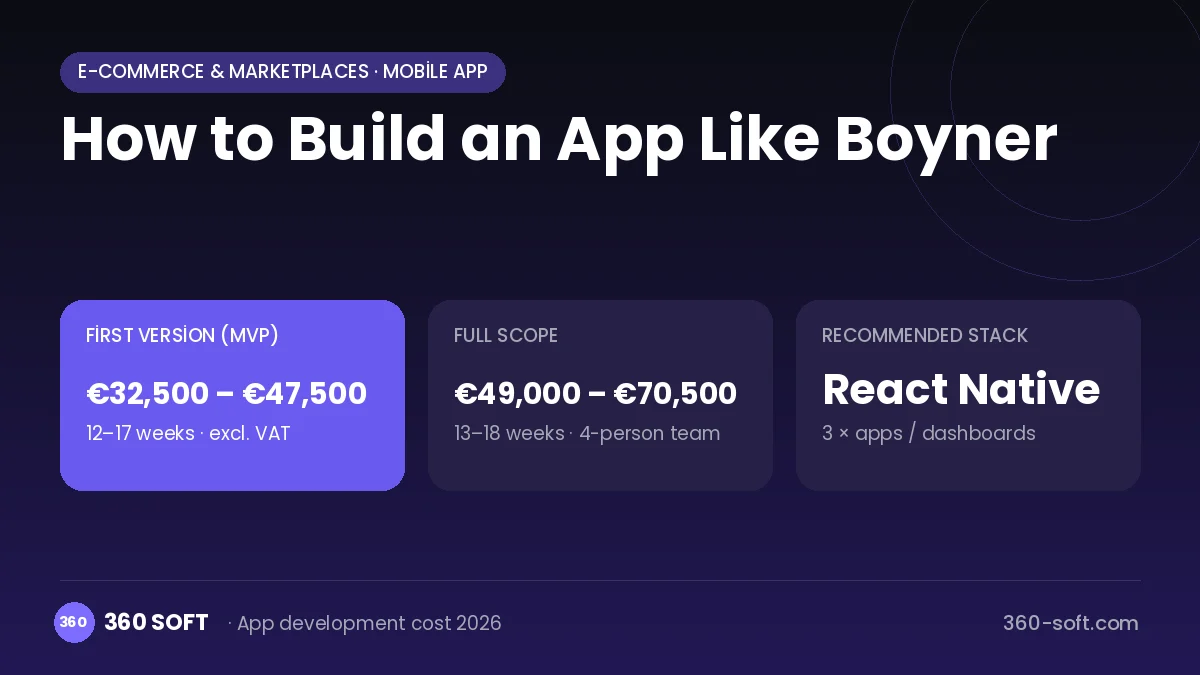
How Boyner works: the core user flow
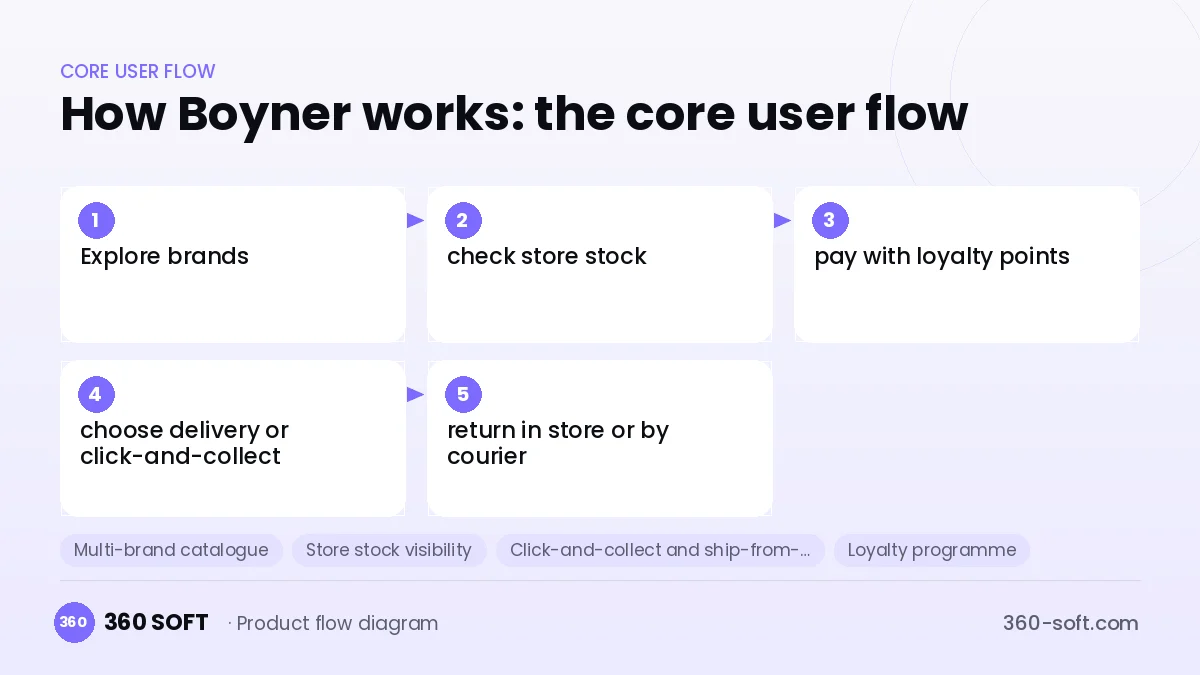
How many apps and dashboards do you need?
Customer app
Shoppers browse across brands, see nearby store stock, redeem points and choose a delivery method.
Store staff app
Store employees pick online orders from the shelves, pack them, hand them over to customers and process returns.
Admin panel
The head office team manages the brand catalogue, campaigns, loyalty rules and store orders.
Critical features of a product like Boyner
Multi-brand catalogue
Sizes, colours and category structures from different brands are mapped to a shared model; brand pages work like separate storefronts.
Store stock visibility
The product page shows in real time which store has which size.
Click-and-collect and ship-from-store
Orders are prepared at the nearest store; customers can pick them up there or have them shipped from store stock.
Loyalty programme
Shared points are earned on online and in-store purchases; tier-based discounts and early access are offered.
Cross-channel returns
Items bought online can be returned in store; the return is recorded instantly through the store app.
Retail ERP integration
Product, price, stock and sales data are synchronised both ways with the retail ERP and POS systems.
What goes into the first version, what comes later
First version (MVP)
- Multi-brand catalogue, search, filters and brand pages
- Cart, checkout and courier delivery
- Loyalty card and points balance
- Store stock visibility
- Product, price and stock synchronisation with the ERP
Later releases
- Click-and-collect and ship-from-store flows
- Store staff app
- Cross-channel returns
- Personalised recommendations and a style assistant
Modules and how the budget is calculated
The budget is calculated with 360 SOFT’s pricing model from the modules below, about 30 screens and the project’s complexity: roughly 187 person-days for the full scope and 125 person-days for the first version. Every module you drop lowers the budget directly.
| Module | Phase |
|---|---|
| Sign-up, login, social login | First version |
| User profile and settings | First version |
| Roles and permissions | First version |
| Admin dashboard | First version |
| Online payments (Stripe / PSP) | First version |
| Product / content catalogue | First version |
| Cart and checkout | First version |
| Advanced search and filters | First version |
| Push notifications | First version |
| Maps, location, routing | First version |
| Barcode / RFID / handheld | Later release |
| Reporting and analytics | First version |
| ERP / accounting integration | Later release |
| E-invoicing | First version |
Hosting, SMS, map APIs, app store accounts and payment-provider fees are separate items. Maintenance and improvements (optional): €650 / month. We send a fixed written price within 24 hours after a free discovery call.
The hard parts
Stock accuracy
Store stock changes with every sale; if an item ordered online has already been sold in store, the customer experience suffers.
Integration with legacy systems
Retail ERP and POS systems are often old; reliable data flow must be ensured with middleware services.
Standardising brand data
Every brand names sizes and colours differently; mapping rules are needed for shared filtering.
Business model
Revenue comes from product sales margins; in a multi-brand model, consignment or commission agreements with brands are also possible. The loyalty programme does not generate revenue directly but increases repeat purchase frequency. In-app promotion and campaign placement for brands, paid express delivery and gift card sales are additional revenue items.
Get a free quote for your project
Let us scope it together and send a fixed written quote within 24 hours. NDA on request; you own the source code.
Choosing a company to build an app like Boyner
Most people searching “build an app like boyner” are really looking for a reliable app development company. When comparing quotes, check four things:
- Can you try similar products they have shipped, in the stores or live?
- Are the source code, design files, servers and store accounts transferred to you by contract?
- Do they show a working demo every two weeks, with written scope and acceptance criteria?
- Are maintenance, scaling and GDPR/security costs written into the quote?
Copyright and trademarks
A business model and features are generally not protected on their own, but the Boyner name, logo, interface design, content and source code are. That is why we build a product with similar functionality but your own brand, design and code. This is not legal advice; we recommend a trademark search before launch.
Frequently asked questions
How long does it take to build an app like Boyner?
A first version with a catalogue, checkout, loyalty and ERP integration can be ready in a few months. Click-and-collect and the store staff app are introduced in the second phase.
Is integration with physical stores mandatory?
Not for online-only sales. But for a retailer with a store network, stock visibility and in-store returns are among the features customers expect most.
How many separate applications are needed?
You need a customer mobile app, a website, a separate app for store staff and an admin panel. All of them run on a shared backend and ERP integration.
What should I look for in a company that builds an app like Boyner?
Choose a team with retail ERP and POS integration experience that has built omnichannel inventory management before. Integration testing and a go-live plan should be clearly included in the proposal.