2D gameOnline carrom board gameOriginal by Miniclip
Carrom Pool turns carrom, the tabletop game hugely popular across South Asia, into a mobile multiplayer experience. The player positions the striker on the baseline, sets angle and power and tries to pocket their own coloured pieces in the corner pockets; capturing and covering the queen adds extra strategy. Short matches, a turn-based structure and familiar rules appeal to a broad audience, including the large South Asian diaspora in the UK, US and Gulf.
Building a similar game requires consistent piece physics, aim assistance, turn-based online sync and an arena/entry fee economy. Alongside classic carrom rules, faster “disc pool” style modes, cosmetic strikers and boards, chat emotes and play-with-friends features boost engagement. Currency and match results must be kept on the server.
Why Carrom Pool works: the core loop
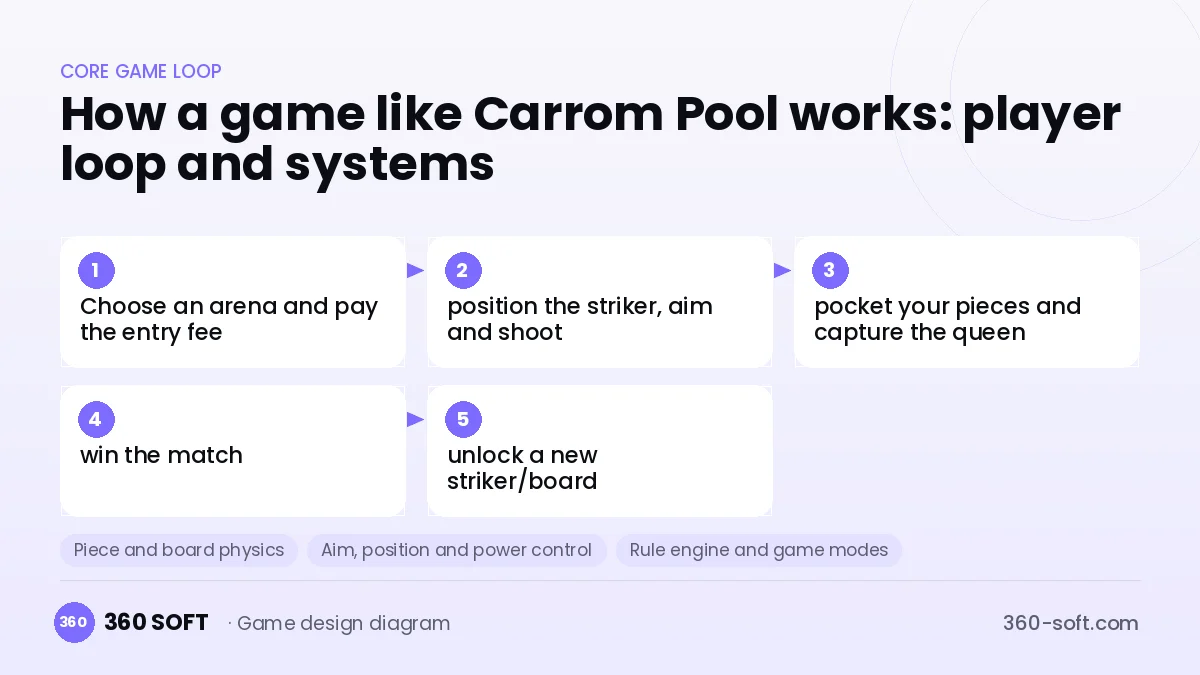
Systems you need to build a game like Carrom Pool
Piece and board physics
Collisions between pieces, friction, cushion rebounds and pocketing rules. Fixed-step, reproducible calculation is essential for online play.
Aim, position and power control
Sliding the striker along the baseline, an aiming guide line and pull-and-release power. Guide line length can be tied to progression.
Rule engine and game modes
Classic carrom, queen rules, fouls and penalties, plus faster alternative modes. Keeping rules in a separate module makes adding new modes easy.
Turn-based online match
Shot data sent and the same simulation played on both sides, with turn timers and disconnection rules.
Arena economy
Entry-fee tables, winning prizes, daily rewards and currency sinks. Inflation control is part of the economy design.
Cosmetics and social features
Striker, board and effect collections; friend lists, private rooms and quick in-match emotes.
What goes into the first version, what comes later
First version (soft launch)
- Classic carrom rules and deterministic physics
- Online 1v1 matchmaking and a vs-computer mode
- Several arenas with an entry fee/prize economy
- A basic striker collection and shop
- Analytics, Remote Config and a foundation for cheat detection
Later updates
- Alternative fast modes and tournaments
- Private rooms with friends and in-match chat emotes
- Season pass and limited-time cosmetics
- Club/team leagues and rankings
The hard parts of this genre
Multi-piece collisions
A single shot sets dozens of pieces colliding; tiny differences change the outcome. Sync requires a single authoritative simulation on the server or fixed-point maths.
Regional rule differences
Local carrom rules vary from country to country. The default rule set should be chosen according to the target market.
Cheats and auto-aim tools
Popular board games attract aim-helper apps and modded clients. Plan server validation and anomaly analysis from the start.
Team, timeline and budget
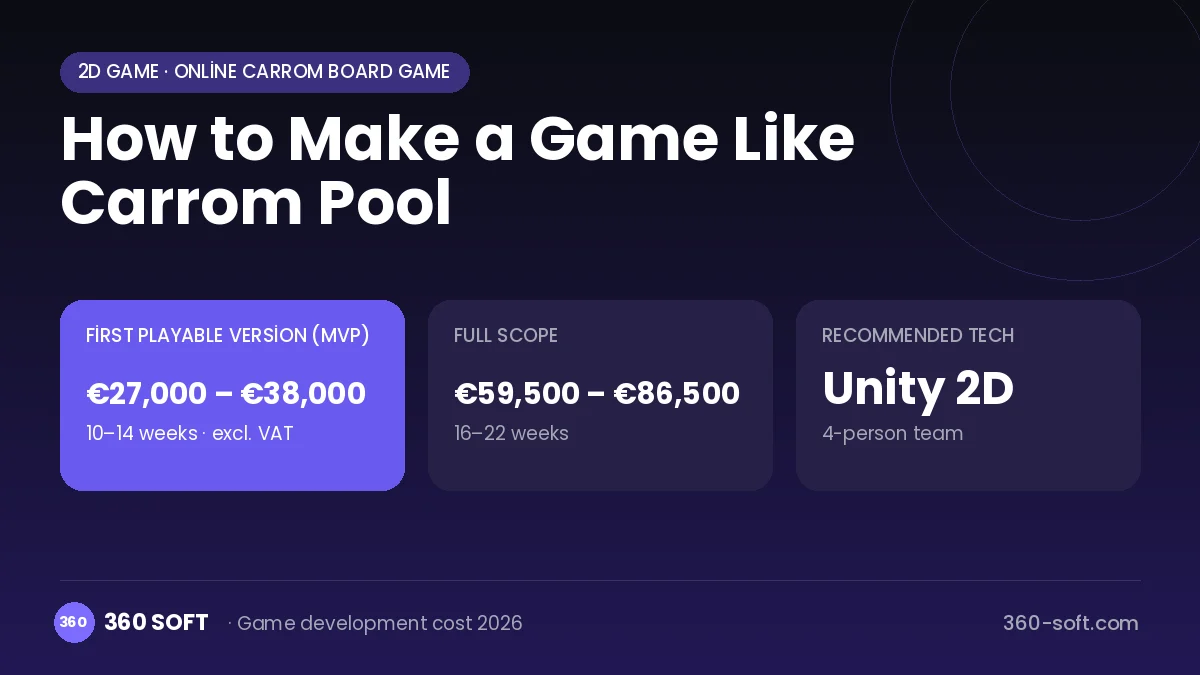
The estimate is based on the genre’s core systems, content volume, multiplayer and live-ops needs plus QA and project management: about 228 person-days for the full scope and 103 person-days for the first version. Cutting scope (fewer levels, one map, fewer characters) lowers the budget directly. Store accounts, servers, audio licences and user-acquisition budget are separate items. We send a fixed written price within 24 hours after the game design document.
Monetisation
Revenue in this genre comes from in-game currency bundles, striker and board cosmetics and VIP membership. A season pass rewards regular play, while rewarded ads are used for free currency and opening chests. Payment habits differ across target markets, so small, affordable bundles matter alongside regionally adjusted pricing.
Estimate your game budget and get a fixed quote
Let us scope it together and send a fixed written quote within 24 hours. NDA on request; you own the source code.
Calculated instantly from your choices, excl. VAT. A fixed written quote follows a free scoping call within 24 hours.
Choosing a game development company for a game like Carrom Pool
Most people searching “make a game like carrom pool” are really looking for a reliable game development company. When comparing quotes, check four things:
- Can you play their released 2D games on your own phone?
- Are the source code, art files and store accounts transferred to you by contract?
- Do they build a playable prototype first and show a demo every two weeks?
- Are multiplayer servers, anti-cheat and scaling costs written into the quote?
Copyright and originality
Game mechanics on their own are generally not protected, but names, logos, characters, art, audio and level designs are. That is why we build a game “like Carrom Pool” with your own name, art and world. This is not legal advice; we recommend a trademark search before launch.
Frequently asked questions
How long does it take to make a game like Carrom Pool?
With limited visual content, the timeline is driven by physics sync, online infrastructure and the economy. A soft launch with one mode and a few arenas can be done relatively quickly.
Are there copyright issues?
Carrom is a traditional board game and its rules are free to use. However, the Carrom Pool name, UI, visuals and original mode designs cannot be copied; this is not legal advice.
Which engine is right?
Unity 2D is a common choice; for deterministic physics you may need a custom solution rather than the built-in physics engine. For a lightweight build, Godot 4 or Cocos Creator can also be used.
What should I look for in a company to build a board game?
Choose a team with experience of a live online board game, a server-authoritative economy and anti-cheat. Discuss the scaling and maintenance plan up front.