In the cold chain, a deviation of a few hours can mean destroying a warehouse of goods or having a pharmaceutical batch returned. Reading a thermometer and writing it in a logbook will not catch a compressor failure at night, and it cannot produce the continuous record auditors ask for. In the system we build, sensors placed in cold rooms, cabinets and refrigerated vehicles record temperature and humidity every minute. When a threshold is crossed, the person on call receives an SMS, a phone call and an app notification, and each shipment’s temperature curve is attached to the delivery note and shared with the customer.
Problems we see in the cold chain
- Failures at night and weekends noticed too late
- Handwritten temperature logs falling short at audits
- No proof of a temperature deviation in transit
- Short events such as a door left open going unnoticed
Modules
Sensor management
Sensors defined per room, cabinet and vehicle, with battery and connection status.
Thresholds and alarms
Upper and lower limits by product group, delayed alarms and escalating notification chains.
Gap-free logging
Data buffered on the device is back-filled automatically when the connection returns.
Shipment history
In-transit temperature curve matched to vehicle position.
Incidents and actions
A record of who closed each alarm, when and with what corrective action.
Audit report
Daily, monthly and batch-level temperature reports with signed PDF output.
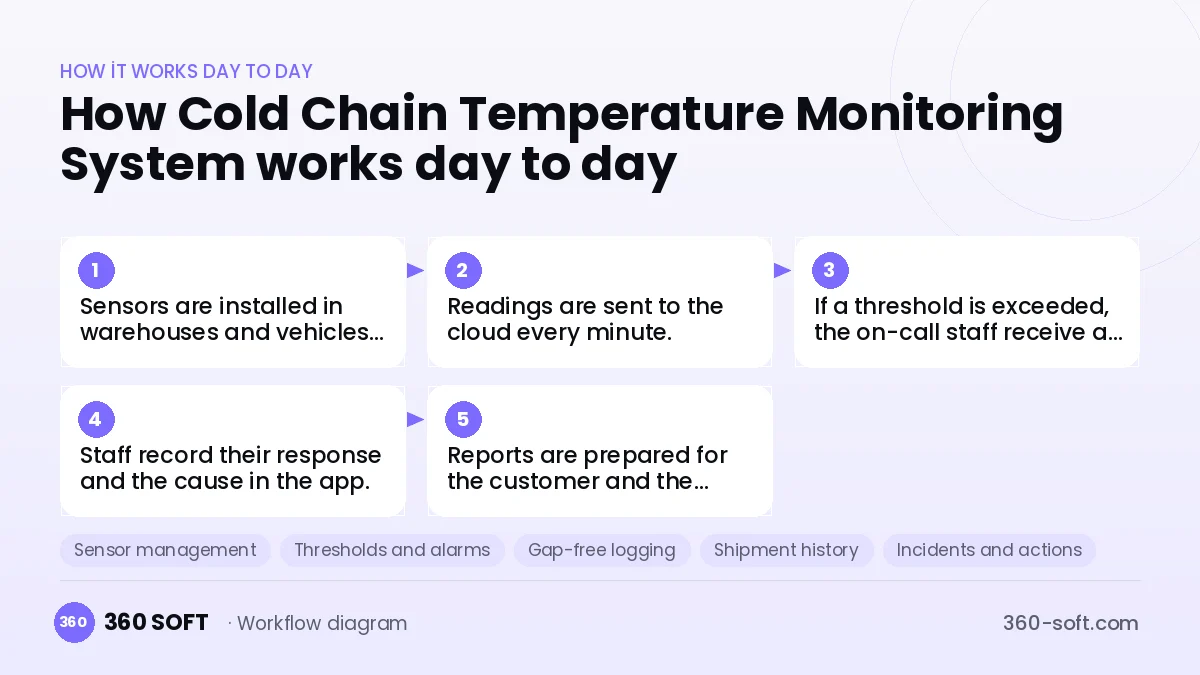
How it works day to day
- 1
Sensors are installed in warehouses and vehicles and thresholds are set on the dashboard.
- 2
Readings are sent to the cloud every minute.
- 3
If a threshold is exceeded, the on-call staff receive a notification and a voice call.
- 4
Staff record their response and the cause in the app.
- 5
Reports are prepared for the customer and the auditor per shipment and per period.
Integrations
Off-the-shelf software or custom-built?
When off-the-shelf is enough
For a business with one cold room, the ready-made cloud dashboard from the device maker is usually enough.
When custom software pays off
For companies that monitor several warehouses, different sensor brands and a vehicle fleet together, and must give customers shipment-level reports, a custom system provides a single screen and a single alarm chain.
How the budget is built
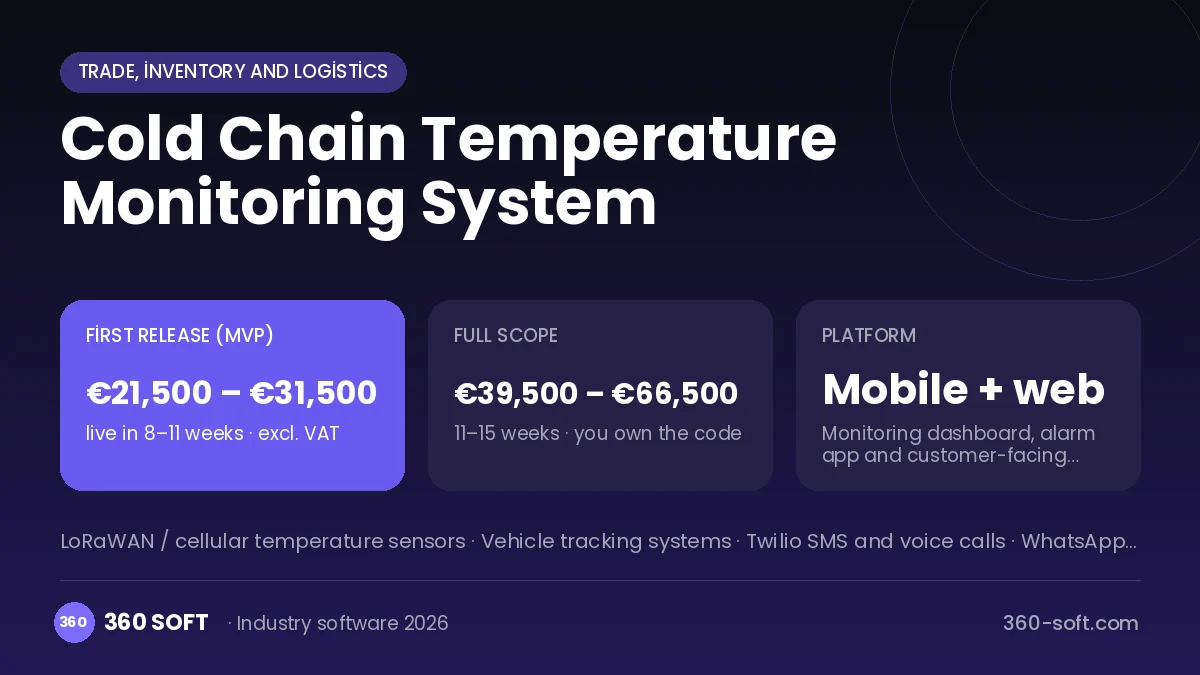
We launch the workflow that saves you the most time first, then add modules based on real usage. The full scope below is calculated with 18 screens and 9 modules; the final price follows a free discovery call and a written scope.
Maintenance and improvements (optional): €500 / month. Hosting, SMS, WhatsApp and app store fees are listed separately.
Frequently asked questions
Which sensors does it work with?
With LoRaWAN, cellular and Wi-Fi sensors that provide data transfer; your existing devices are assessed during discovery.
Is data lost if the internet goes down?
Sensors and gateways keep readings in memory and the gap is filled automatically once the connection returns.
Are the reports accepted in pharma and food audits?
Records are timestamped and tamper-proof, and reports can be produced in the format the auditor needs.
Can our customers see the temperature data?
Yes. Customers get access only to the area or shipments that hold their own goods.