Mobile appVideo, music & mediaOriginal by Spotify
Spotify's success comes from opening a huge music catalogue to everyone through a free tier while creating the real value in personalised discovery. Weekly discovery playlists, mood-based lists and year-end wrap-ups give users the feeling that "it knows me". Playlist sharing, collaborative lists and podcasts spread the app across every moment of the day.
Building something similar takes mobile, desktop and web players, a delivery stack that streams audio with low latency and a recommendation engine that processes listening data. Importing catalogue data from labels, royalty reporting based on play counts, a freemium ad tier, offline downloads and an artist analytics panel run as separate services on the backend.
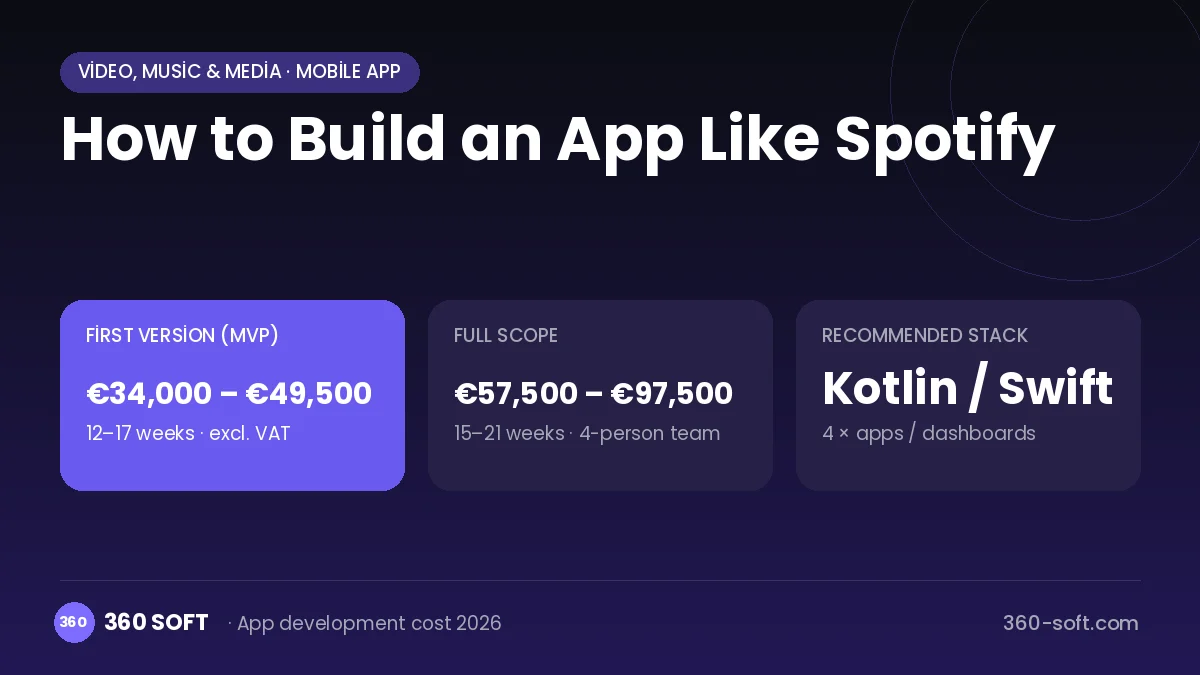
How Spotify works: the core user flow
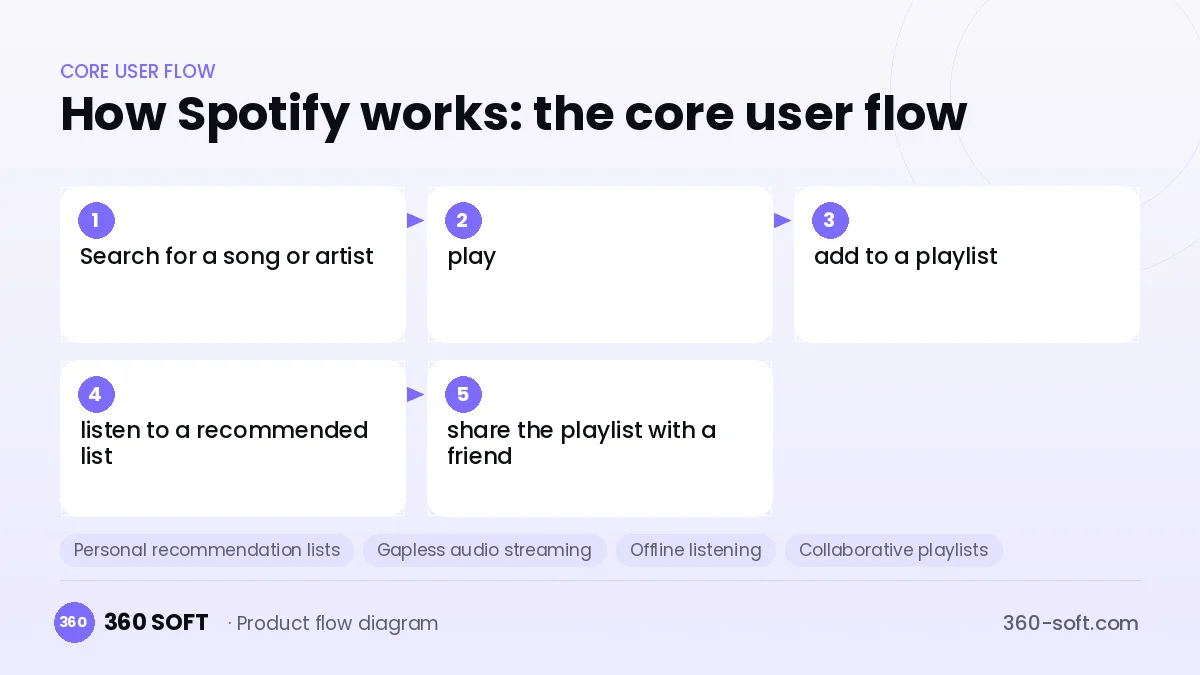
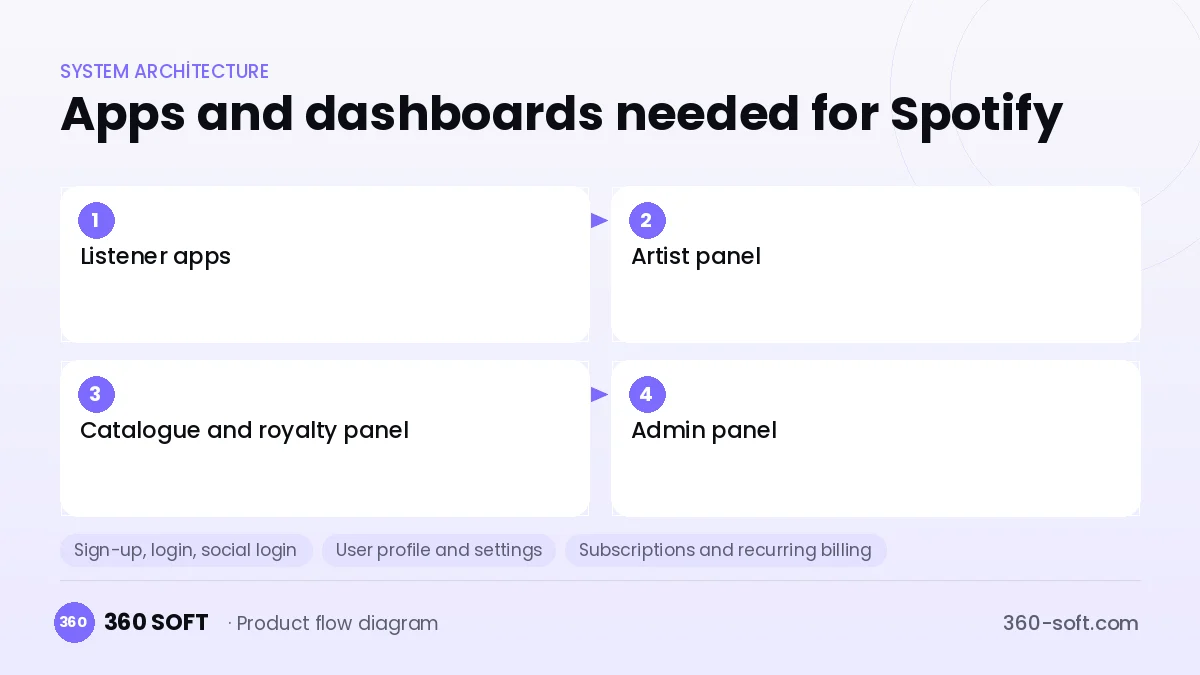
How many apps and dashboards do you need?
Listener apps
Users who listen to music and podcasts and build lists on mobile, desktop, web and in-car systems.
Artist panel
The panel where artists and managers manage listening statistics, profile details and new releases.
Catalogue and royalty panel
An operations panel that ingests songs from distributors and produces royalty reports for rights holders.
Admin panel
An internal panel for managing subscriptions, ad campaigns, editorial playlists and user support.
Critical features of a product like Spotify
Personal recommendation lists
New personalised playlists are generated every week from listening history and the behaviour of similar users.
Gapless audio streaming
Tracks are pre-buffered so there are no gaps between songs, and audio quality adapts to connection speed.
Offline listening
Premium users download lists in encrypted form to the device, and the licence period is verified at regular intervals.
Collaborative playlists
Several users can add songs to the same list, and lists are shared by link.
Cross-device control
Music started on a phone can be moved to a speaker or computer, and playback control is synced across all devices.
Play-based royalty reporting
Every play record is grouped by rights holder and turned into periodic royalty reports.
What goes into the first version, what comes later
First version (MVP)
- iOS and Android music player
- Catalogue, search and artist pages
- Playlist creation and sharing
- Freemium model: ad-supported free tier and premium subscription
- Play logging and basic royalty reporting
Later releases
- AI-powered personal recommendation lists
- Offline downloads and a desktop app
- A podcast and audiobook section
- An artist panel and year-end summary
Modules and how the budget is calculated
The budget is calculated with 360 SOFT’s pricing model from the modules below, about 34 screens and the project’s complexity: roughly 220 person-days for the full scope and 130 person-days for the first version. Every module you drop lowers the budget directly.
| Module | Phase |
|---|---|
| Sign-up, login, social login | First version |
| User profile and settings | First version |
| Subscriptions and recurring billing | First version |
| Online payments (Stripe / PSP) | First version |
| Product / content catalogue | First version |
| Advanced search and filters | First version |
| File, photo, video upload | First version |
| Offline mode and sync | First version |
| AI features (LLM, RAG, recommendations) | Later release |
| Push notifications | First version |
| Reporting and analytics | Later release |
| Roles and permissions | First version |
| Admin dashboard | First version |
| GDPR and security hardening | First version |
Hosting, SMS, map APIs, app store accounts and payment-provider fees are separate items. Maintenance and improvements (optional): €750 / month. We send a fixed written price within 24 hours after a free discovery call.
The hard parts
Music licensing
A catalogue cannot go live without deals with labels, distributors and collecting societies (such as PRS, GEMA or ASCAP, depending on the market).
Royalty calculation accuracy
Millions of play records have to be filtered of fraudulent and bot plays and then split correctly among the right holders.
Recommendation cold start
When there is no data for a new user or a new song, content-based analysis is needed to produce meaningful recommendations.
Business model
For a Spotify-type product the best-fit model is freemium: an ad-supported free tier and an ad-free premium subscription with offline listening. Family, student and duo plans balance revenue per user. Paid promotion campaigns for artists and podcast ads bring extra income, while a significant share of revenue flows back to rights holders as royalties.
Get a free quote for your project
Let us scope it together and send a fixed written quote within 24 hours. NDA on request; you own the source code.
Choosing a company to build an app like Spotify
Most people searching “build an app like spotify” are really looking for a reliable app development company. When comparing quotes, check four things:
- Can you try similar products they have shipped, in the stores or live?
- Are the source code, design files, servers and store accounts transferred to you by contract?
- Do they show a working demo every two weeks, with written scope and acceptance criteria?
- Are maintenance, scaling and GDPR/security costs written into the quote?
Copyright and trademarks
A business model and features are generally not protected on their own, but the Spotify name, logo, interface design, content and source code are. That is why we build a product with similar functionality but your own brand, design and code. This is not legal advice; we recommend a trademark search before launch.
Frequently asked questions
How long does it take to build an app like Spotify?
A first version with a player, catalogue, playlists and subscriptions can be developed in a few months. The part that really takes long is obtaining music licences, which runs independently of the technical timeline.
Where do I get a music catalogue?
You need licence agreements with labels and digital distributors, plus royalty payments to collecting societies. Focusing on a specific genre or on independent artists at first makes the process easier.
Are there copyright or trademark issues?
The music streaming business model and its features are generally free to use, but the name, logo, design, content and code cannot be copied. Songs need separate licences; this information is not legal advice.
What should I look for when choosing a company to build an app like Spotify?
Look for experience in audio streaming, encrypted offline storage and recommendation systems. Ask how they will make royalty reporting accurate and auditable as well.