Mobile appEducation & e-learningOriginal by Duolingo
Duolingo turned language learning into a game of a few minutes a day. Short lessons, a streak system, league tables, hearts and rewards bring users back every day. The product's real strength lies in habit design more than content: notifications, reminders and small moments of achievement turn learning from an obligation into a daily ritual.
Building something similar requires a lesson engine that generates question types (translation, matching, listening, speaking) dynamically, a spaced-repetition algorithm, speech recognition and text-to-speech services, a gamification service and a league system. Alongside the mobile app you set up an author panel where the content team prepares the course tree and sentence bank, A/B testing infrastructure and subscription management.
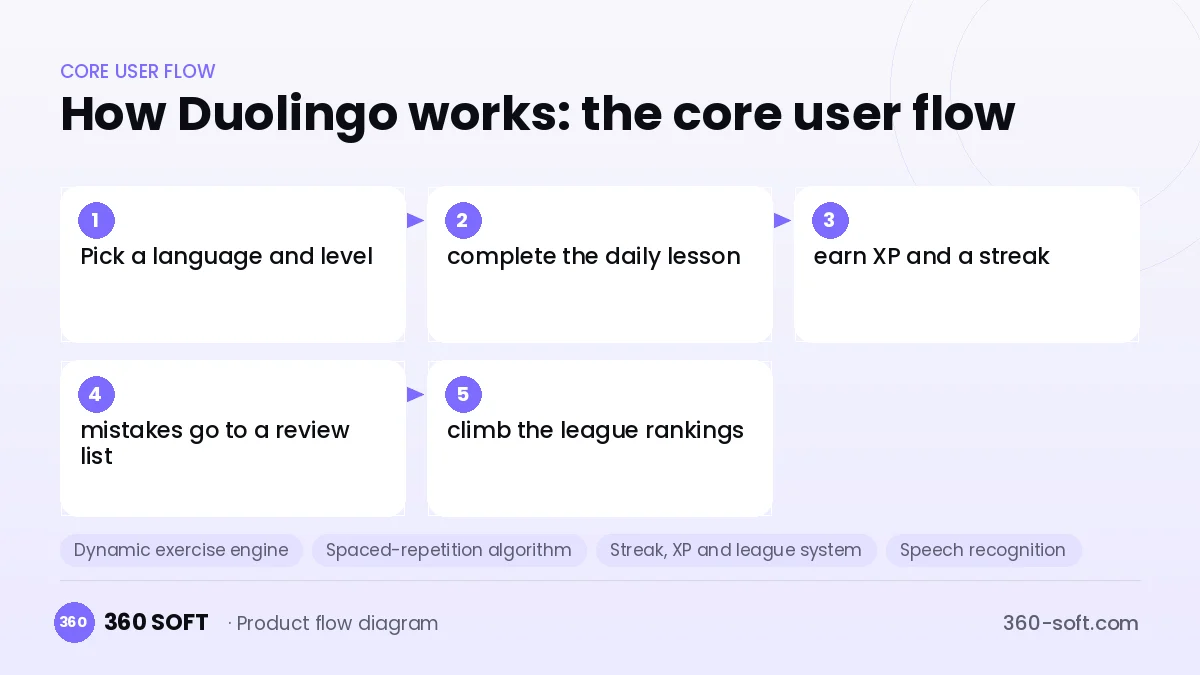
How Duolingo works: the core user flow
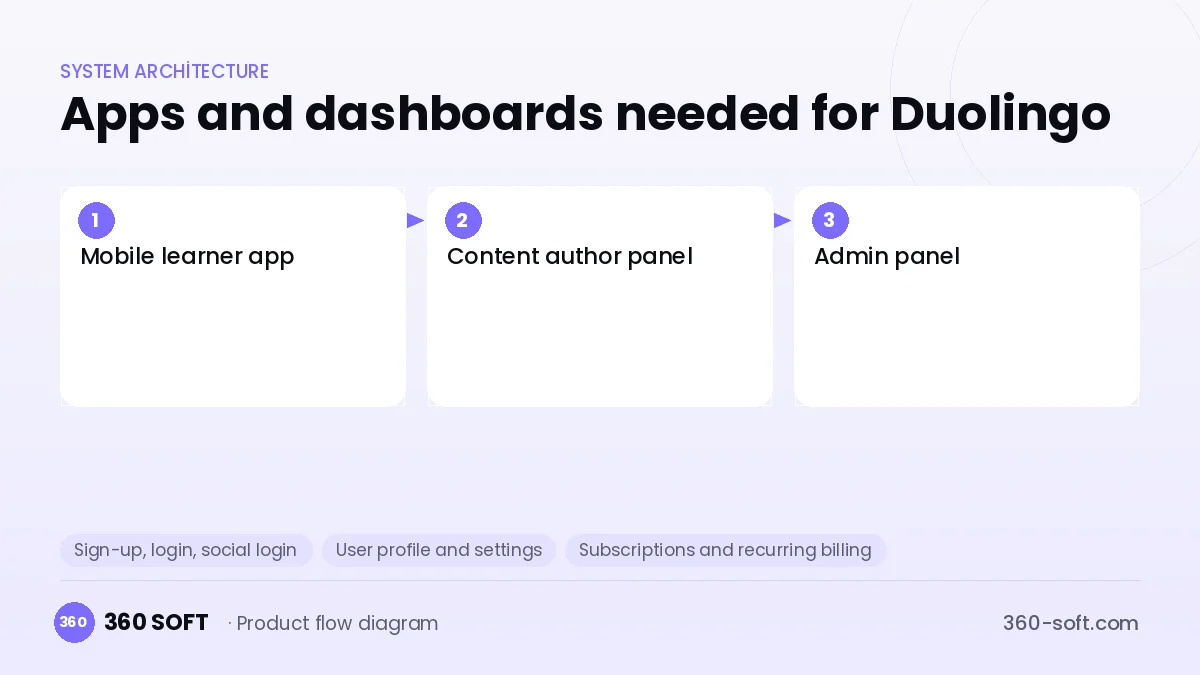
How many apps and dashboards do you need?
Mobile learner app
The app where users solve lessons, track streaks and leagues, and practise speaking.
Content author panel
A panel where language experts prepare the course tree, sentence bank, audio recordings and exercises.
Admin panel
An internal panel for monitoring subscriptions, experiments, notification campaigns and learning metrics.
Critical features of a product like Duolingo
Dynamic exercise engine
Translation, fill-in-the-blank, matching and listening questions are generated automatically from the same sentence bank.
Spaced-repetition algorithm
The user's forgetting curve is modelled, so weak words and structures reappear at the right time.
Streak, XP and league system
Mechanics such as daily streaks, weekly leagues, badges and streak freezes increase engagement.
Speech recognition
The user's pronunciation is assessed with speech recognition and mispronounced sounds are flagged.
Smart notifications
Personalised reminders are sent based on the user's habitual study time.
AI conversation practice
A large language model provides role-play dialogues and explanations for mistakes.
What goes into the first version, what comes later
First version (MVP)
- Course tree for a single language pair and 4 to 5 question types
- XP, daily streak and reminder notifications
- Mistake review and simple spaced repetition
- Content author panel
- Ad-supported free tier and subscription
Later releases
- Weekly leagues and a friends system
- Speech recognition and pronunciation score
- AI conversation partner
- Placement test and certificate
Modules and how the budget is calculated
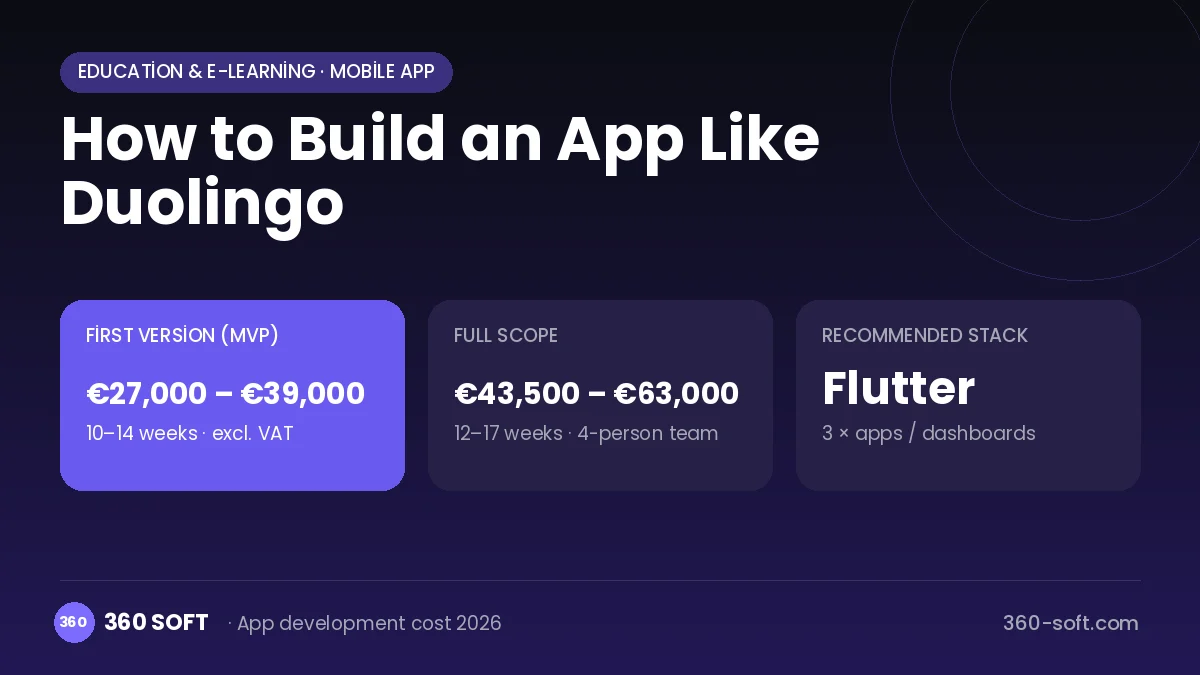
The budget is calculated with 360 SOFT’s pricing model from the modules below, about 30 screens and the project’s complexity: roughly 167 person-days for the full scope and 103 person-days for the first version. Every module you drop lowers the budget directly.
| Module | Phase |
|---|---|
| Sign-up, login, social login | First version |
| User profile and settings | First version |
| Subscriptions and recurring billing | First version |
| Online payments (Stripe / PSP) | First version |
| Push notifications | First version |
| Email / SMS notifications | First version |
| AI features (LLM, RAG, recommendations) | Later release |
| File, photo, video upload | First version |
| Reporting and analytics | Later release |
| Content management / blog | First version |
| Admin dashboard | First version |
| Multi-language | First version |
| Offline mode and sync | First version |
Hosting, SMS, map APIs, app store accounts and payment-provider fees are separate items. Maintenance and improvements (optional): €550 / month. We send a fixed written price within 24 hours after a free discovery call.
The hard parts
Content production load
Every language pair needs thousands of verified sentences and audio recordings; content tools and a quality control process should be set up early.
Engagement design
If gamification isn't balanced well, users either get bored or collect points without learning; continuous A/B testing is essential.
Voice technologies
Reliable speech recognition and natural text-to-speech across the target languages is a balance of cost and quality.
Business model
Freemium is the most effective model for language apps: lessons are free, but ads, limited hearts and restricted review tools nudge users towards a subscription. The premium tier offers an ad-free experience and unlimited mistakes and AI practice; family plans, in-app gem sales and exam certificate fees are additional revenue lines.
Get a free quote for your project
Let us scope it together and send a fixed written quote within 24 hours. NDA on request; you own the source code.
Choosing a company to build an app like Duolingo
Most people searching “build an app like duolingo” are really looking for a reliable app development company. When comparing quotes, check four things:
- Can you try similar products they have shipped, in the stores or live?
- Are the source code, design files, servers and store accounts transferred to you by contract?
- Do they show a working demo every two weeks, with written scope and acceptance criteria?
- Are maintenance, scaling and GDPR/security costs written into the quote?
Copyright and trademarks
A business model and features are generally not protected on their own, but the Duolingo name, logo, interface design, content and source code are. That is why we build a product with similar functionality but your own brand, design and code. This is not legal advice; we recommend a trademark search before launch.
Frequently asked questions
How long does it take to build an app like Duolingo?
A first version with a single language pair and basic gamification can be built in a few months. The longest part is preparing content and improving engagement mechanics through testing.
How many separate applications are needed?
A mobile learner app, a content author panel and an admin panel form the core structure. A web version and a teacher panel for schools can be later steps.
Are there copyright or trademark issues?
The gamified language learning model and mechanics such as streaks are generally free to use. The name, mascot, logo, interface, lesson content and code cannot be copied; this information is not legal advice.
What should I look for when choosing an education app development company?
Pick a team experienced in gamification, notification strategy and content management panels. It matters that they plan to measure product metrics (day-one retention, streak rate) from the start.