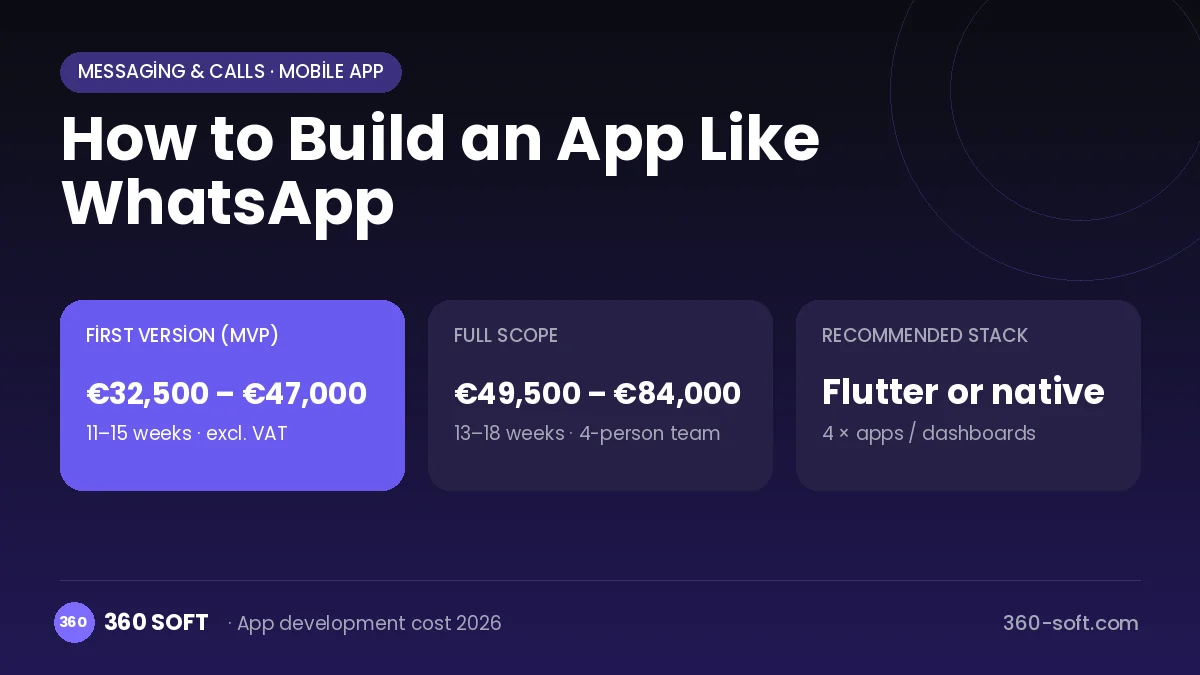
Mobile appMessaging & callsOriginal by Meta
WhatsApp's success comes from using the phone number as an identity, so everyone in your contacts is reachable with a single tap. Sign-up is almost effortless, messages are end-to-end encrypted and get delivered reliably even on a weak connection. Family and work groups, voice notes and calls make the app part of everyday life infrastructure, and because everybody is there, the network effect is very strong.
Building something similar takes iOS and Android apps, an optional desktop and web client, and a real-time messaging server that holds millions of connections at once. Proven encryption such as the Signal protocol, an offline message queue, delivered and read receipts, media storage, WebRTC-based calling, SMS number verification and multi-device linking run behind the scenes.
How WhatsApp works: the core user flow
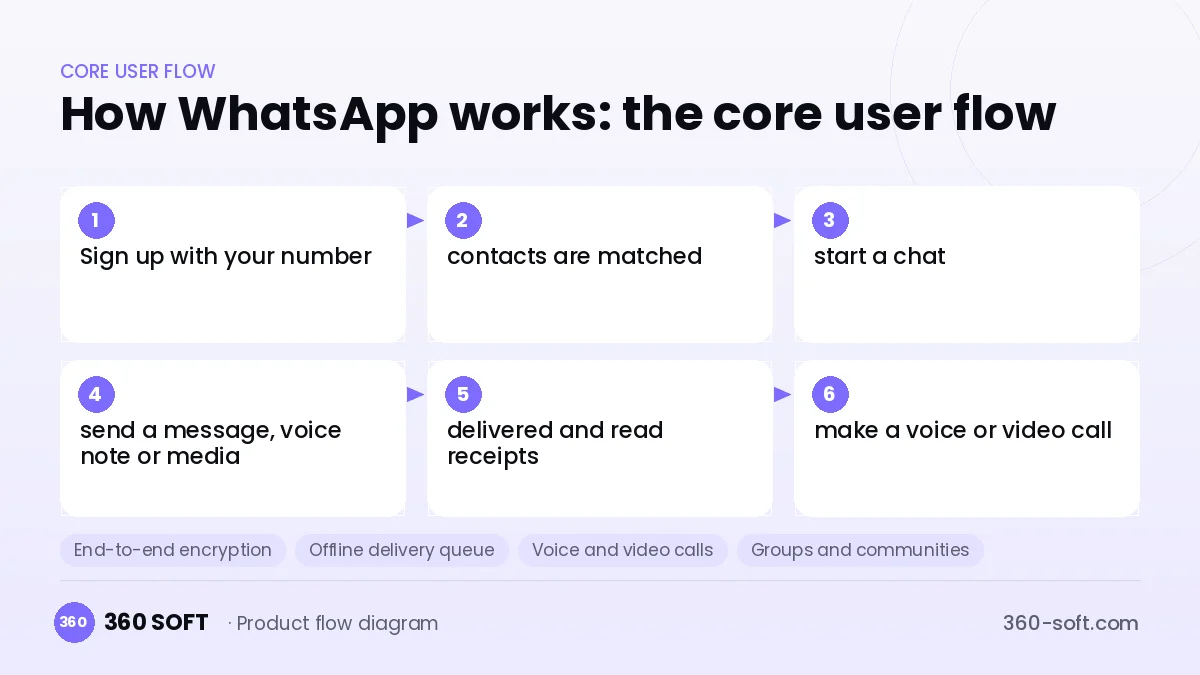
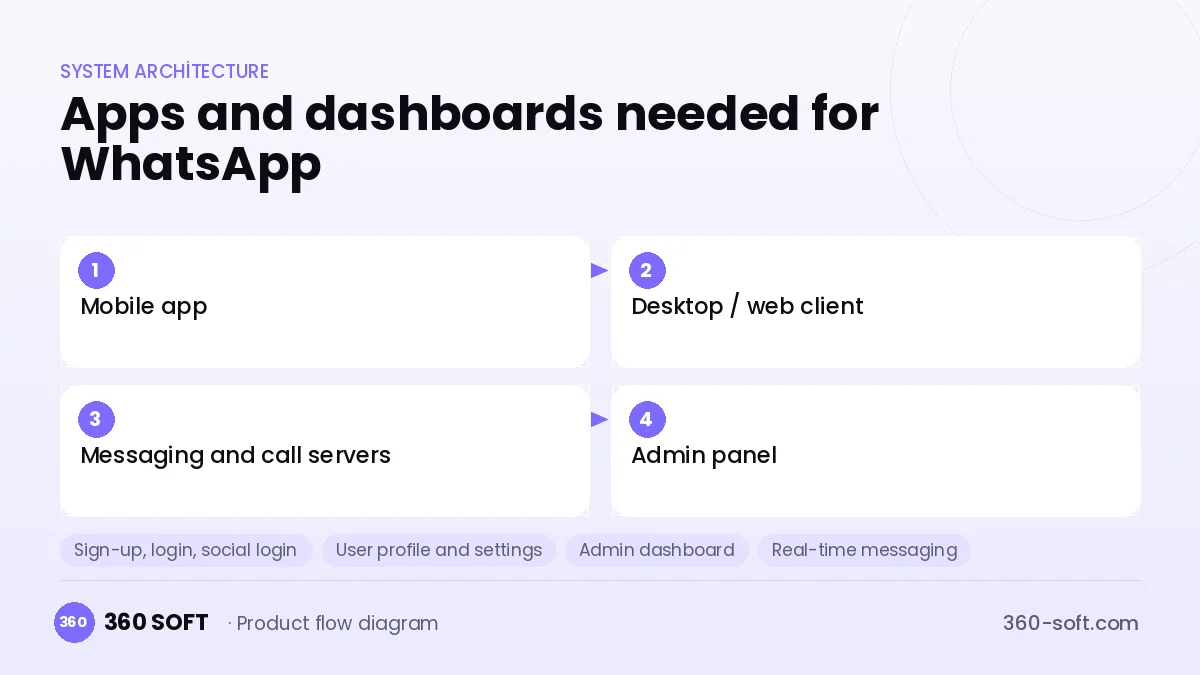
How many apps and dashboards do you need?
Mobile app
The main app where users manage one-to-one and group chats, calls and status updates.
Desktop / web client
The client that links to the phone for messaging from a computer, with an encrypted session.
Messaging and call servers
The infrastructure that holds connections, relays encrypted messages and manages the offline queue and call signalling.
Admin panel
The internal panel that monitors spam and abuse reports, account bans and system health.
Critical features of a product like WhatsApp
End-to-end encryption
Messages and calls are decrypted only on the end devices, the server cannot see the content, and users can verify with a security code.
Offline delivery queue
While the recipient is offline, encrypted messages wait in order and are delivered in full once they reconnect.
Voice and video calls
One-to-one and group calls run over WebRTC, with the bitrate lowered automatically on a weak network.
Groups and communities
Admin permissions, invite links and announcement channels keep large groups organised.
Multi-device support
Encrypted sessions keep working on linked desktop and tablet devices even when the phone is switched off.
Encrypted backup
Chat history is encrypted with a key the user chooses and backed up to cloud storage.
What goes into the first version, what comes later
First version (MVP)
- Verification by number and SMS
- One-to-one and group messaging
- Photos, video, documents and voice notes
- End-to-end encryption and read receipts
- Push notifications
Later releases
- Voice and video group calls
- Desktop and web client
- Status (story) sharing
- Business accounts and channels
Modules and how the budget is calculated
The budget is calculated with 360 SOFT’s pricing model from the modules below, about 30 screens and the project’s complexity: roughly 190 person-days for the full scope and 124 person-days for the first version. Every module you drop lowers the budget directly.
| Module | Phase |
|---|---|
| Sign-up, login, social login | First version |
| User profile and settings | First version |
| Admin dashboard | First version |
| Real-time messaging | First version |
| Push notifications | First version |
| File, photo, video upload | First version |
| Video / voice calls | First version |
| GDPR and security hardening | First version |
| Offline mode and sync | Later release |
| Email / SMS notifications | First version |
| Multi-language | First version |
| Third-party API integration | First version |
Hosting, SMS, map APIs, app store accounts and payment-provider fees are separate items. Maintenance and improvements (optional): €650 / month. We send a fixed written price within 24 hours after a free discovery call.
The hard parts
Scale and real time
Holding millions of open connections at low latency needs a concurrency-friendly architecture such as Erlang/Elixir.
Getting encryption right
Cryptography should never be invented in-house; use proven protocol libraries and get them independently audited.
Spam and the network effect
Switching is hard when users' friends are already on another app, so you need to start with a niche community or enterprise use.
Business model
General-purpose messaging makes charging end users difficult; the fitting model is a messaging API for businesses, verified business accounts and per-conversation pricing. An enterprise edition, on-premise installation or an internal secure communication licence brings revenue faster, while ads need careful thought because they can contradict a privacy promise.
Get a free quote for your project
Let us scope it together and send a fixed written quote within 24 hours. NDA on request; you own the source code.
Choosing a company to build an app like WhatsApp
Most people searching “build an app like whatsapp” are really looking for a reliable app development company. When comparing quotes, check four things:
- Can you try similar products they have shipped, in the stores or live?
- Are the source code, design files, servers and store accounts transferred to you by contract?
- Do they show a working demo every two weeks, with written scope and acceptance criteria?
- Are maintenance, scaling and GDPR/security costs written into the quote?
Copyright and trademarks
A business model and features are generally not protected on their own, but the WhatsApp name, logo, interface design, content and source code are. That is why we build a product with similar functionality but your own brand, design and code. This is not legal advice; we recommend a trademark search before launch.
Frequently asked questions
How long does it take to build an app like WhatsApp?
A first version with one-to-one and group messaging, media and encryption takes a few months. Group calls and multi-device support need a separate, longer phase.
Can I use a ready-made messaging SDK?
Ready-made chat infrastructure works for a fast start, but costs rise as the user base grows and control over encryption stays limited. In the long run your own servers are usually the better choice.
Will there be copyright or trademark issues?
The messaging app business model and its features are generally free to use, but the name, logo, design, icons and code cannot be copied. This is general information, not legal advice.
What should I look for when choosing a company to build an app like WhatsApp?
Ask about real-time systems, WebRTC and encryption experience, and request load tests, a security audit and a GDPR-compliant data retention approach.