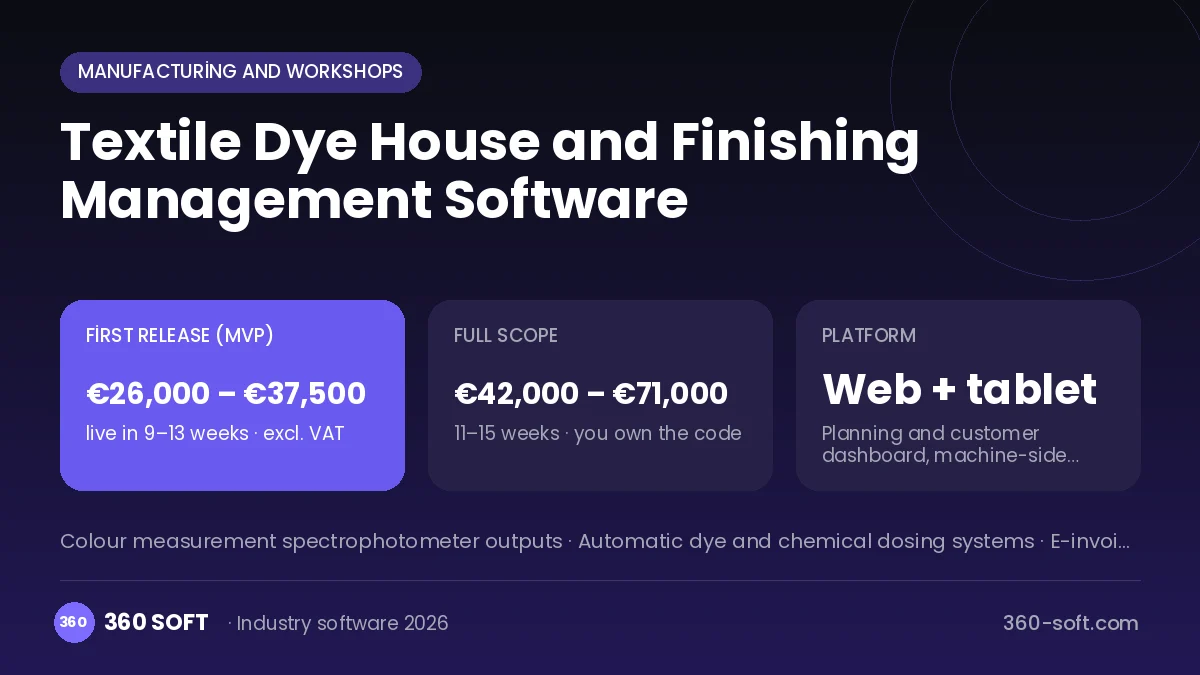
In a dye house every customer batch passes from greige fabric intake to dispatch through pre-treatment, dyeing, washing, stenter and quality control. When batches travel on paper cards, nobody knows which roll is waiting at which machine, how many times an off-shade batch was re-dyed, or the real cost of chemical consumption. In the system we build, greige fabric is received with its roll numbers and length, and each batch moves through the stages on a job card. The colour recipe approved in the lab goes to the chemical kitchen as a weighing list, the machine plan is made by dragging on screen, and re-dyes, waste and commission billing are reported per batch.
Problems we see in dye houses
- No knowledge of which stage rolls are waiting at
- The cost of re-dyes being invisible
- Colour recipes not matching actual chemical consumption
- Customers constantly asking for batch status
Modules
Greige fabric intake
Record of customer, roll number, length, weight and fabric type.
Batch and job card
Barcoded batch card, route and status tracking by stage.
Lab-dip and recipe
Colour sample, approval process and versioned dye recipes.
Machine plan
Capacity-based planning for jet, overflow and stenter machines.
Chemical kitchen
Recipe-based weighing, with dye and chemical stock deduction.
Commission billing and portal
Price by kilo or metre, waste, delivery note and customer status screen.
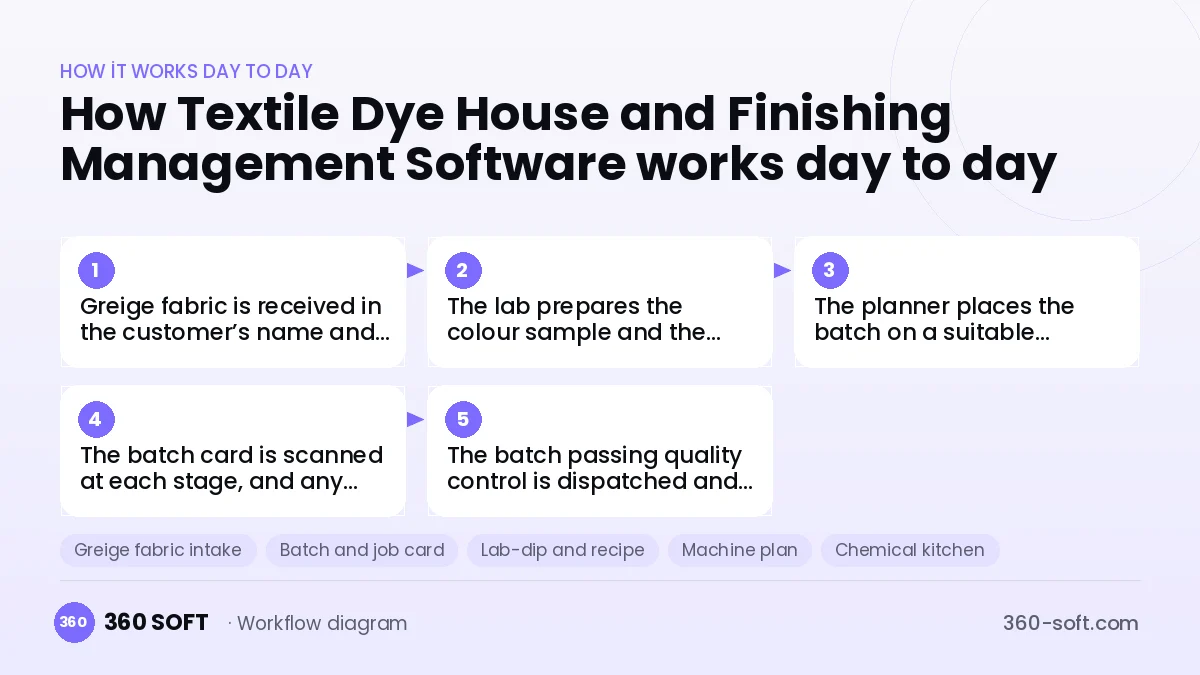
How it works day to day
- 1
Greige fabric is received in the customer’s name and a batch card is printed.
- 2
The lab prepares the colour sample and the customer approves it.
- 3
The planner places the batch on a suitable machine and the recipe goes to the kitchen.
- 4
The batch card is scanned at each stage, and any re-dye is recorded with its reason.
- 5
The batch passing quality control is dispatched and the commission invoice is prepared.
Integrations
Off-the-shelf software or custom-built?
When off-the-shelf is enough
For small dye houses working for one customer or with few machines, an ERP with a general production module may do.
When custom software pays off
For commission dye houses with many machines and hundreds of colour recipes, a custom system joining batch tracking, recipes and costing makes re-dyes and chemical waste visible.
How the budget is built
We launch the workflow that saves you the most time first, then add modules based on real usage. The full scope below is calculated with 22 screens and 9 modules; the final price follows a free discovery call and a written scope.
Maintenance and improvements (optional): €550 / month. Hosting, SMS, WhatsApp and app store fees are listed separately.
Frequently asked questions
Does it work with our automatic dosing system?
Weighing orders can be sent to dosing systems that accept recipe transfer; if yours does not, weighing is done manually from the kitchen screen.
Can customers see their batches?
Yes. Each customer sees only the stage, length and dispatch details of their own batches in the portal.
Does machine data come into the system?
Start-stop and temperature data can be taken from machines whose PLC or control panel provides data.
Can our existing recipe archive be migrated?
Recipes in Excel or your current program are imported and matched to their chemical codes.