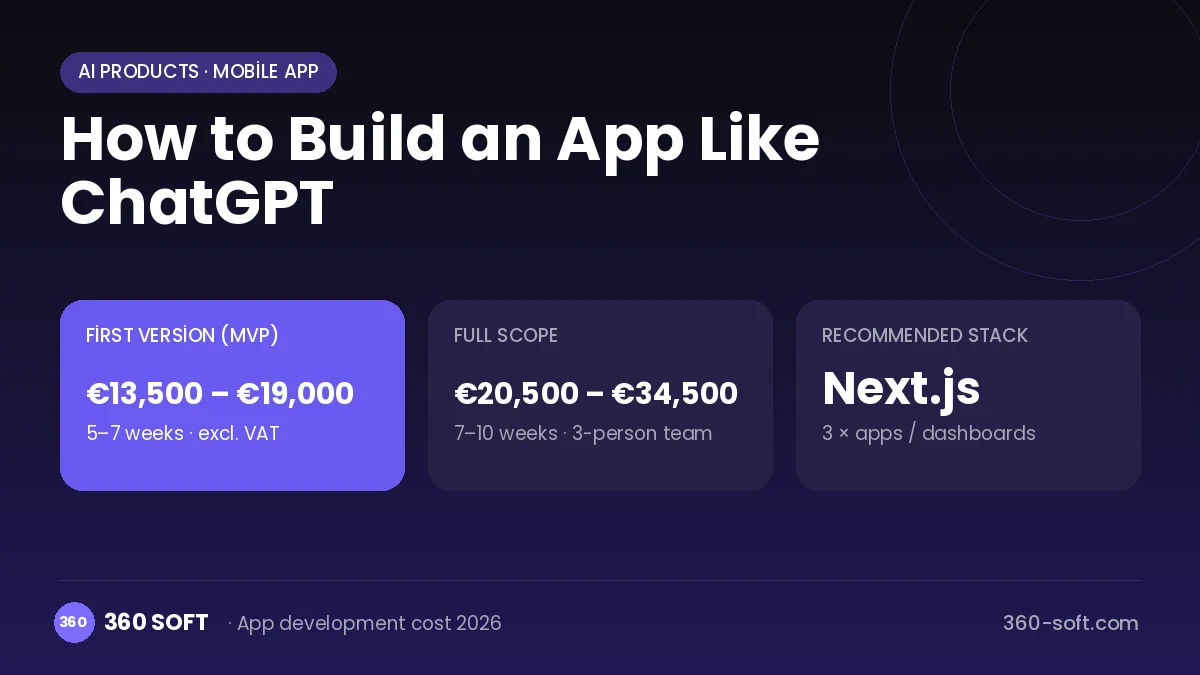
Mobile appAI productsOriginal by OpenAI
ChatGPT spread by boiling a complex AI model down to a chat box everyone already understands. Users ask questions, have text written, upload files for summaries, generate images or talk by voice. The power comes not only from model quality but from product layers such as conversation history, memory, tool use and fast streaming answers. Those layers turn the model into a daily work tool.
To build something similar you do not need to train your own large language model; most products are built on ready-made LLM APIs. What must be built is the chat interface and mobile app, streaming-response infrastructure, conversation and memory storage, file processing and document search (RAG), usage quotas, subscription billing and content-safety filters. The real difference comes from specialisation: better results for a specific language, industry or workflow.
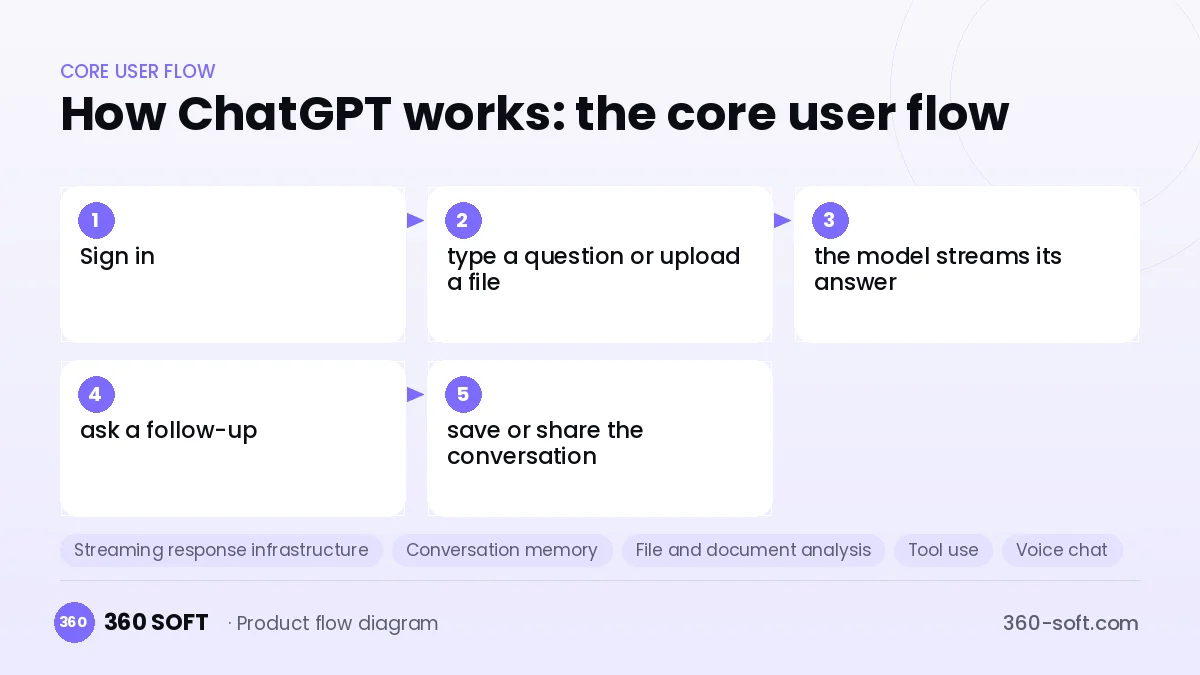
How ChatGPT works: the core user flow
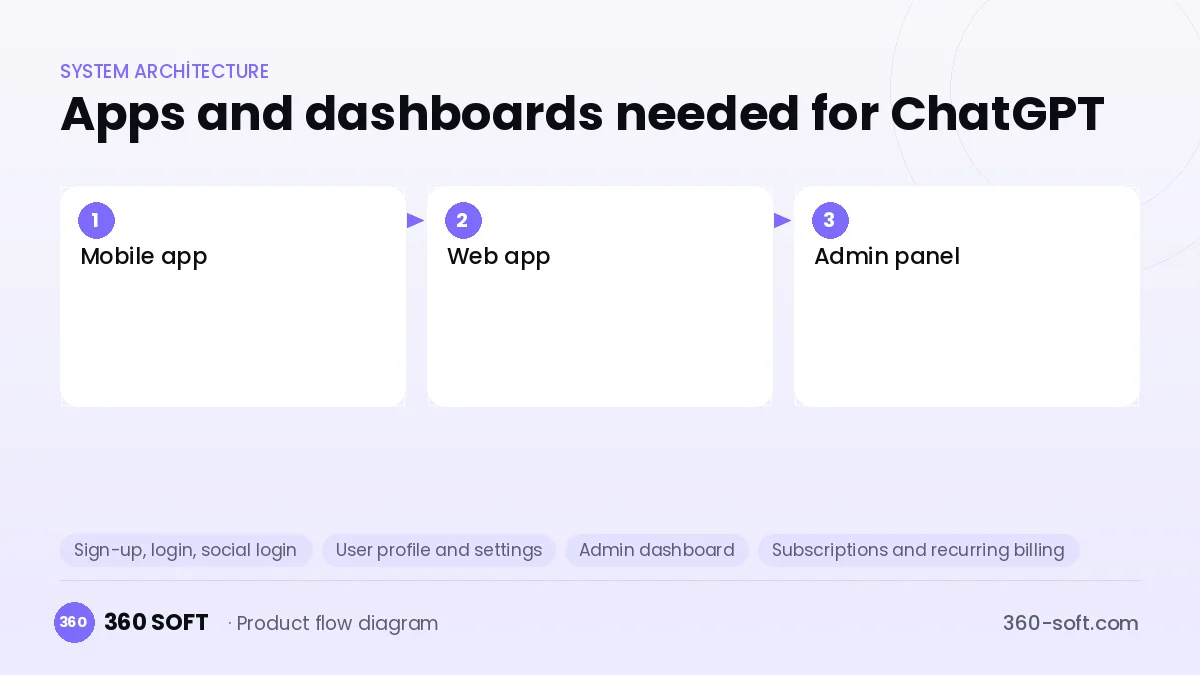
How many apps and dashboards do you need?
Mobile app
The iOS and Android app where users chat by text and voice and upload photos and files.
Web app
The desktop chat interface for long text, file analysis and managing conversation history.
Admin panel
The panel for model settings, quotas, subscriptions, abuse reports and cost tracking.
Critical features of a product like ChatGPT
Streaming response infrastructure
Model output flows onto the screen word by word, which removes the feeling of waiting on long answers.
Conversation memory
Earlier messages are summarised to fit the context window, and user preferences are kept in persistent memory.
File and document analysis
PDFs, tables and images are processed, and relevant sections are found through a vector database and added to the answer.
Tool use
The model produces current, verifiable answers by running web searches, calculations or external API calls.
Voice chat
Speech is converted to text and the answer is read aloud in a natural voice for hands-free use.
Quota and cost control
Each user's token consumption is tracked, with limits and model choice set by free and paid plans.
What goes into the first version, what comes later
First version (MVP)
- Web and mobile chat interface
- LLM API integration and streaming responses
- Conversation history and renaming
- Free-plan quota and a paid subscription
- Basic content-safety filter
Later releases
- File upload and chat with documents
- Voice chat and image generation
- Persistent memory and custom assistants
- Team accounts and enterprise administration
Modules and how the budget is calculated
The budget is calculated with 360 SOFT’s pricing model from the modules below, about 22 screens and the project’s complexity: roughly 78 person-days for the full scope and 50 person-days for the first version. Every module you drop lowers the budget directly.
| Module | Phase |
|---|---|
| Sign-up, login, social login | First version |
| User profile and settings | First version |
| Admin dashboard | First version |
| Subscriptions and recurring billing | First version |
| Online payments (Stripe / PSP) | First version |
| AI features (LLM, RAG, recommendations) | Later release |
| Real-time messaging | First version |
| File, photo, video upload | First version |
| Advanced search and filters | First version |
| Multi-language | First version |
| GDPR and security hardening | First version |
| Third-party API integration | First version |
| Reporting and analytics | Later release |
Hosting, SMS, map APIs, app store accounts and payment-provider fees are separate items. Maintenance and improvements (optional): €300 / month. We send a fixed written price within 24 hours after a free discovery call.
The hard parts
Model cost
Every message incurs an API cost; if free users make up a large share, unit economics break down quickly.
Accuracy and hallucination
A model can produce confidently wrong information, so citations, tool use and disclaimer text are needed.
Data privacy
Users share sensitive information, so GDPR compliance, data retention periods and the policy on sending data to the model must be clear.
Business model
The most common model is a freemium subscription: the free plan offers limited messages and a basic model, while paid plans offer stronger models, file analysis and high quotas. Team and enterprise plans are priced higher with administration, security and data isolation. Selling API access to developers is a separate revenue line. Subscription pricing must always be modelled against token cost.
Get a free quote for your project
Let us scope it together and send a fixed written quote within 24 hours. NDA on request; you own the source code.
Choosing a company to build an app like ChatGPT
Most people searching “build an app like chatgpt” are really looking for a reliable app development company. When comparing quotes, check four things:
- Can you try similar products they have shipped, in the stores or live?
- Are the source code, design files, servers and store accounts transferred to you by contract?
- Do they show a working demo every two weeks, with written scope and acceptance criteria?
- Are maintenance, scaling and GDPR/security costs written into the quote?
Copyright and trademarks
A business model and features are generally not protected on their own, but the ChatGPT name, logo, interface design, content and source code are. That is why we build a product with similar functionality but your own brand, design and code. This is not legal advice; we recommend a trademark search before launch.
Frequently asked questions
How long does it take to build an app like ChatGPT?
A first release built on a ready-made LLM API, with chat history and subscriptions, can ship in a few weeks. The timeline stretches to months as file analysis, voice chat and enterprise features are added.
Do I need to train my own AI model?
For most products you do not; ready-made models are used through an API, and the difference comes from product experience, prompt design and enriching with your own data. Custom fine-tuning should be considered only if there is a clear quality or cost need.
Will there be copyright or trademark issues?
The AI chat assistant business model is generally free to use; however, the name, logo, interface design, copy and code cannot be copied. You must also comply with the terms of use of the model provider you use; this is not legal advice.
What should I look for when choosing a company to build an AI app?
Look at live projects with LLM integration, RAG architecture and cost optimisation. Ask about flexibility to switch models and their approach to data privacy.