SaaS / business softwareBusiness software & SaaSOriginal by Shopify
What makes Shopify powerful is that it turned opening a store from a software project into a few hours of setup. A merchant adds products, picks a theme, turns on payments and starts selling. The real moat is the ecosystem: apps and themes written by thousands of developers solve each business's special needs without touching the core. As the platform grows, so does the app store, and that loop makes it hard for rivals to catch up.
Building something similar is very different from launching a single online shop. A multi-tenant store engine, a merchant dashboard, a theme language and theme editor, payment and shipping integrations, and an open API and webhook layer for app developers are all built together. Buyers also expect Stripe or PayPal payments, e-invoicing and VAT handling, and carrier integrations such as DHL, UPS or DPD.
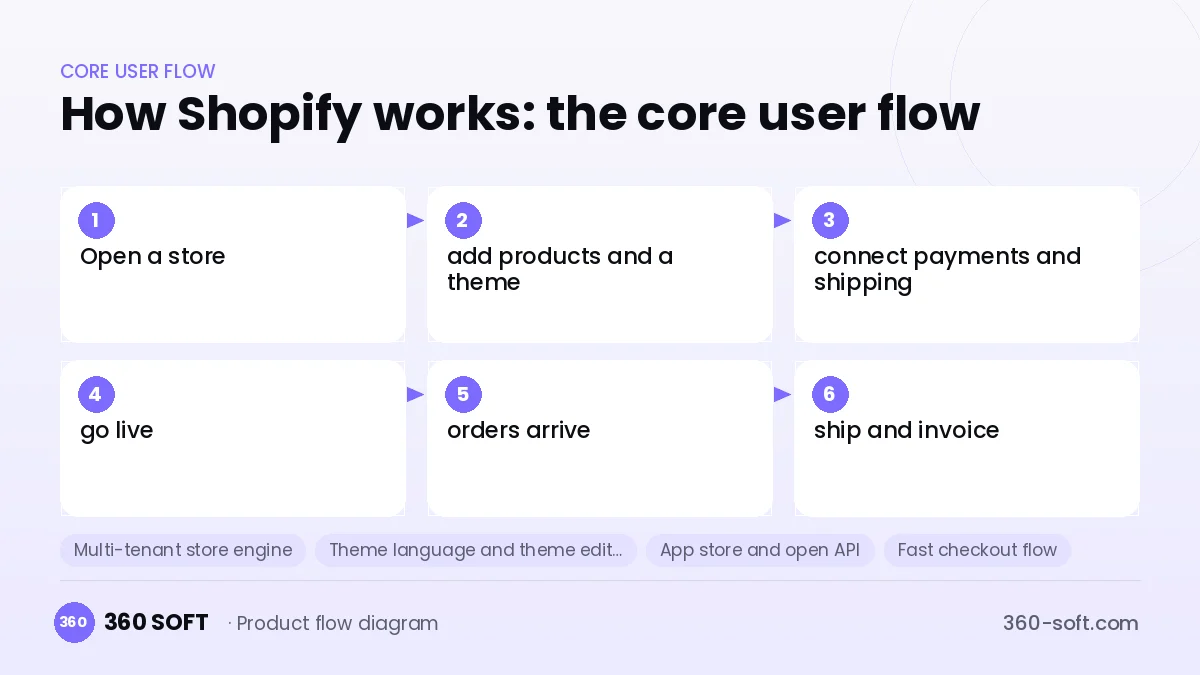
How Shopify works: the core user flow
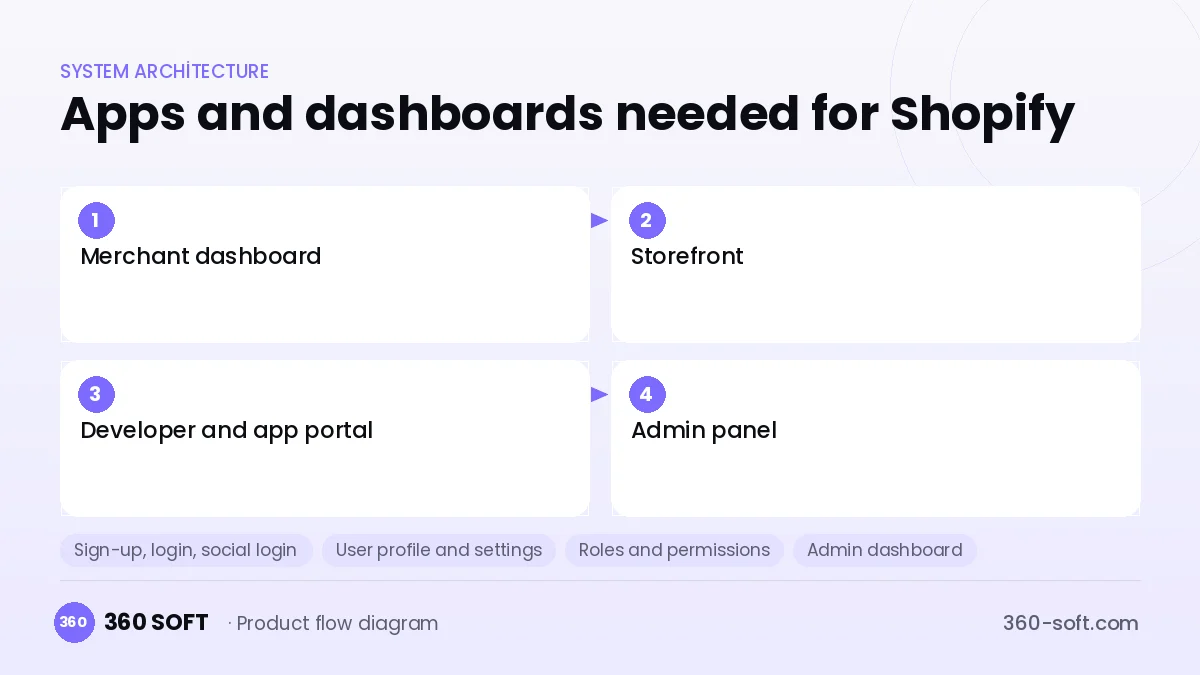
How many apps and dashboards do you need?
Merchant dashboard
The web and mobile dashboard where store owners manage products, stock, orders, customers and campaigns.
Storefront
The theme-driven site where buyers browse products, build a cart and pay.
Developer and app portal
The portal where third-party developers publish apps and themes and manage their API keys.
Admin panel
The internal panel for managing plans, stores, payment risk, app approvals and support.
Critical features of a product like Shopify
Multi-tenant store engine
Each store looks isolated, with its own domain, theme and data, yet runs on a shared, scalable core.
Theme language and theme editor
Themes written in a templating language can be customised section by section by the merchant without any coding.
App store and open API
Apps authorised through OAuth access order, product and customer data and react to events through webhooks.
Fast checkout flow
One-page checkout, saved addresses, instalment or pay-later options and 3-D Secure bring down the abandoned-cart rate.
Shipping and e-invoicing integration
Shipping labels are generated from the order, tracking numbers go to the customer and VAT-compliant invoices are issued automatically.
Multichannel selling
The same catalogue syncs to marketplaces, social media shops and in-person POS.
What goes into the first version, what comes later
First version (MVP)
- Store creation, product and stock management
- A few ready-made themes and a basic theme editor
- Cart, payments (Stripe / PayPal) and order management
- Shipping integration and invoice generation
- Subscription plans and a free trial
Later releases
- Third-party app store
- Marketplace and social selling integrations
- In-store POS and inventory sync
- Multi-language, multi-currency and cross-border selling
Modules and how the budget is calculated
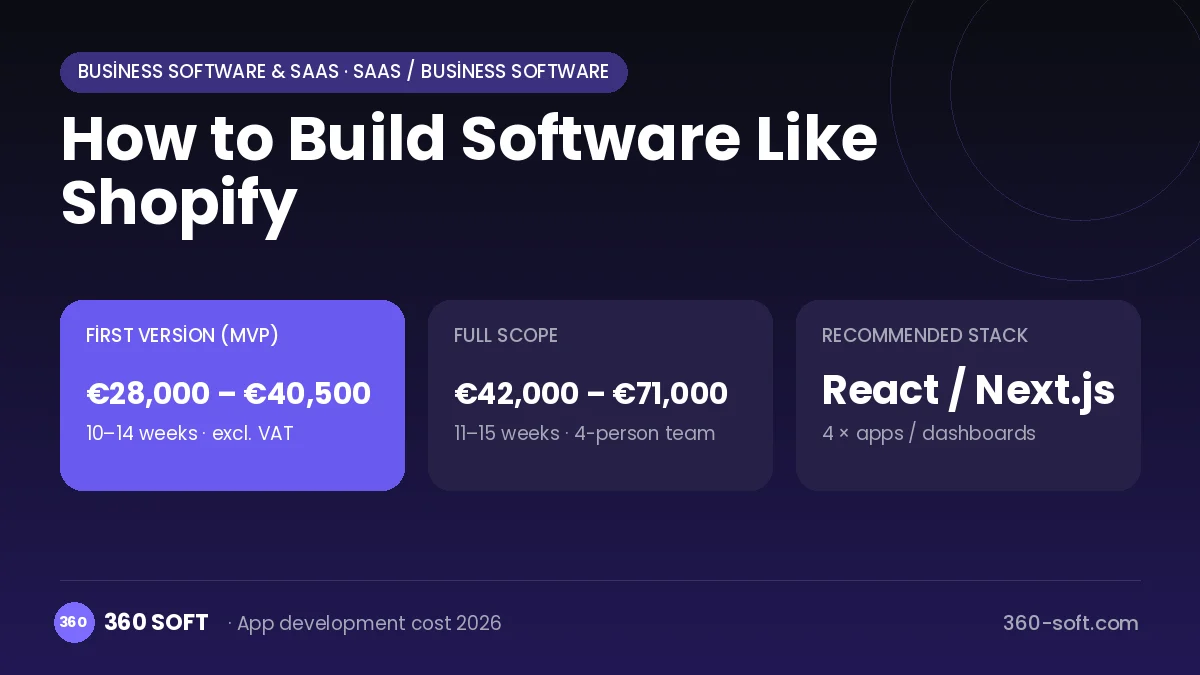
The budget is calculated with 360 SOFT’s pricing model from the modules below, about 38 screens and the project’s complexity: roughly 160 person-days for the full scope and 107 person-days for the first version. Every module you drop lowers the budget directly.
| Module | Phase |
|---|---|
| Sign-up, login, social login | First version |
| User profile and settings | First version |
| Roles and permissions | First version |
| Admin dashboard | First version |
| Subscriptions and recurring billing | First version |
| Online payments (Stripe / PSP) | First version |
| Product / content catalogue | First version |
| Cart and checkout | First version |
| Advanced search and filters | First version |
| Content management / blog | First version |
| E-invoicing | First version |
| Marketplace integration (Amazon, etc.) | Later release |
| Reporting and analytics | Later release |
| Third-party API integration | First version |
| GDPR and security hardening | First version |
Hosting, SMS, map APIs, app store accounts and payment-provider fees are separate items. Maintenance and improvements (optional): €550 / month. We send a fixed written price within 24 hours after a free discovery call.
The hard parts
Scale during campaign peaks
On big sale days thousands of stores get traffic at once; if payment and stock services fail, every customer is affected.
Balancing flexibility and stability
Giving merchants freedom with themes and apps requires limits, versioning and a sandbox that protect the core.
Payment risk and fraud
Fake stores and stolen-card transactions can jeopardise the platform's relationship with its payment partner, so risk scoring is a must.
Business model
The main revenue is tiered monthly subscription plans. On top come a share of payment processing, commission on paid themes and apps, and sales of domains, shipping labels and POS hardware. This blended model, where platform revenue grows as the merchant's turnover grows, removes the revenue ceiling that subscriptions alone would create.
Get a free quote for your project
Let us scope it together and send a fixed written quote within 24 hours. NDA on request; you own the source code.
Choosing a company to build an app like Shopify
Most people searching “build software like shopify” are really looking for a reliable app development company. When comparing quotes, check four things:
- Can you try similar products they have shipped, in the stores or live?
- Are the source code, design files, servers and store accounts transferred to you by contract?
- Do they show a working demo every two weeks, with written scope and acceptance criteria?
- Are maintenance, scaling and GDPR/security costs written into the quote?
Copyright and trademarks
A business model and features are generally not protected on their own, but the Shopify name, logo, interface design, content and source code are. That is why we build a product with similar functionality but your own brand, design and code. This is not legal advice; we recommend a trademark search before launch.
Frequently asked questions
How long does it take to build software like Shopify?
A first release covering the core store, themes and checkout can go live in a few months. Adding an app store, multichannel selling and enterprise scale is a multi-year roadmap.
Ready-made e-commerce script or custom software?
For your own shop, a ready-made platform is enough. If you will rent stores to other businesses, the multi-tenant architecture, billing and API layer must be custom-built.
Will there be copyright or trademark issues?
The business model of renting out e-commerce infrastructure and its features are generally free to use; however, the name, logo, theme designs, copy and code cannot be copied. This is general information, not legal advice.
What should I look for when choosing a company to build an e-commerce platform?
Look for experience with high-traffic e-commerce, payment providers and carrier integrations. Ask how they handle multi-tenant data isolation and load testing for sale periods.