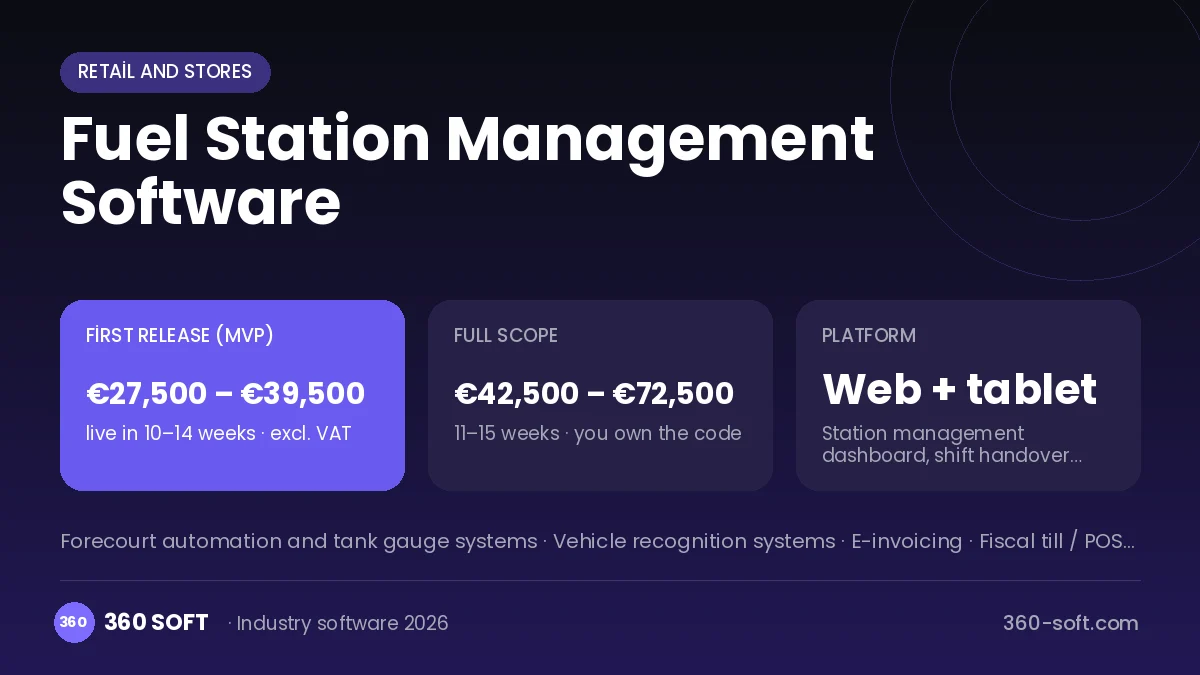
Margins at a fuel station are thin and losses hide in small variances: the gap between tank dipping and pump meters, cash shortfalls at shift handover, a fleet customer’s overdue balance. The supplier’s forecourt system records sales, but the operator has to track shifts, accounts and the shop on their own. In the system we build, forecourt automation and tank gauge data are pulled in and pump meters, tank levels and sales are compared per shift. Attendants hand over on a tablet and cash is reconciled across cash, card and fleet payments; fleet customers are managed with plate-based limits and statements, and the shop with its own stock.
Problems we see at fuel stations
- Inability to explain differences between tank and pump meters
- Cash shortfalls at shift handover
- Weak tracking of fleet customers’ terms and limits
- Shop stock not tracked separately from fuel
Modules
Pumps and tanks
Meter readings, tank level measurement, deliveries and variance analysis.
Shift handover
Cash reconciliation by attendant, split into cash, card, fleet and on-account sales.
Fleet accounts
Limits by vehicle plate and driver, fuel type restrictions and periodic statements.
Shop and car care
Separate stock and sales for shop items, motor oil and car wash services.
Tanker receipt
Delivery note, dip before and after, and receiving variance.
Multi-site reporting
Litres, turnover, margin and variance reports by station.
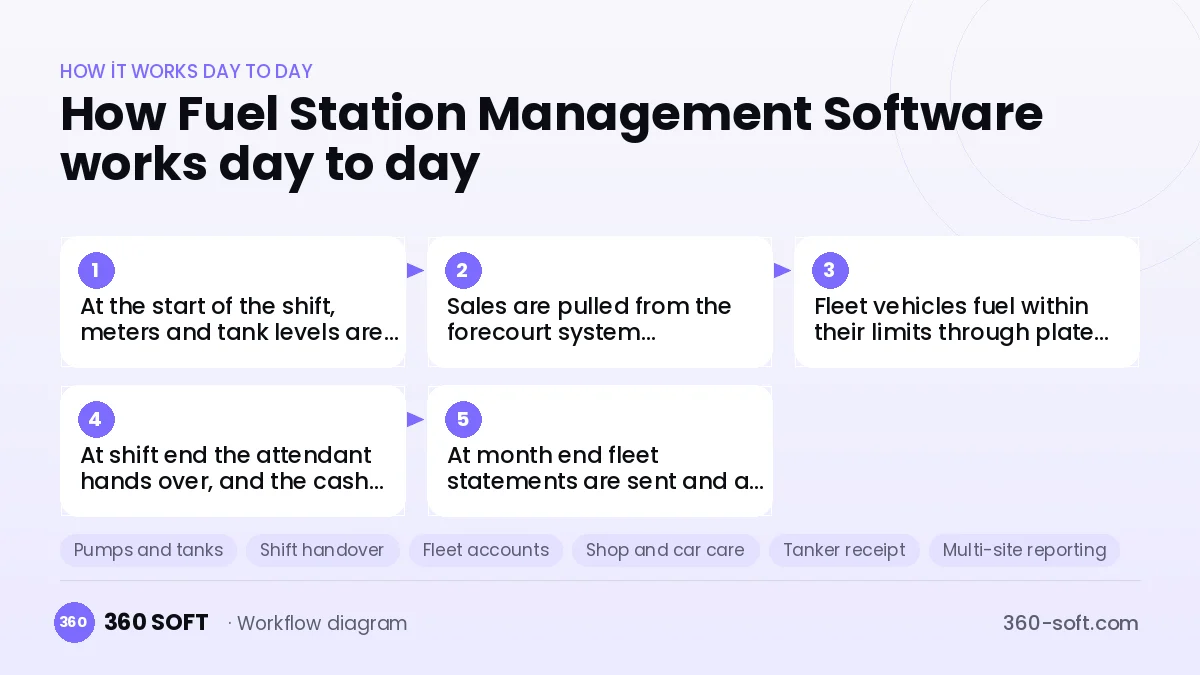
How it works day to day
- 1
At the start of the shift, meters and tank levels are recorded.
- 2
Sales are pulled from the forecourt system throughout the day.
- 3
Fleet vehicles fuel within their limits through plate recognition.
- 4
At shift end the attendant hands over, and the cash and meter variance is calculated.
- 5
At month end fleet statements are sent and a station profitability report is produced.
Integrations
Off-the-shelf software or custom-built?
When off-the-shelf is enough
For a single station with few fleet customers, the supplier’s software and an accounting program may be enough.
When custom software pays off
For multi-site operators with heavy fleet sales and a shop, a custom system that combines forecourt data with shifts, accounts and variance analysis makes losses visible.
How the budget is built
We launch the workflow that saves you the most time first, then add modules based on real usage. The full scope below is calculated with 20 screens and 10 modules; the final price follows a free discovery call and a written scope.
Maintenance and improvements (optional): €550 / month. Hosting, SMS, WhatsApp and app store fees are listed separately.
Frequently asked questions
Can data be taken from the fuel supplier’s system?
Sales and level data are read from automation and tank gauge systems that offer data transfer; access scope is agreed during discovery.
Can fleet customers see their own statements?
Yes. The fleet portal shows purchases by plate, balance and invoices.
How are shift variances reported?
Meter readings, forecourt sales and cash handover are compared, and variances are listed by attendant and shift.
Can LPG and car wash be managed too?
Yes. LPG is set up as a separate product, and washing and maintenance as service items.