Mobile appFintech & paymentsOriginal by Revolut
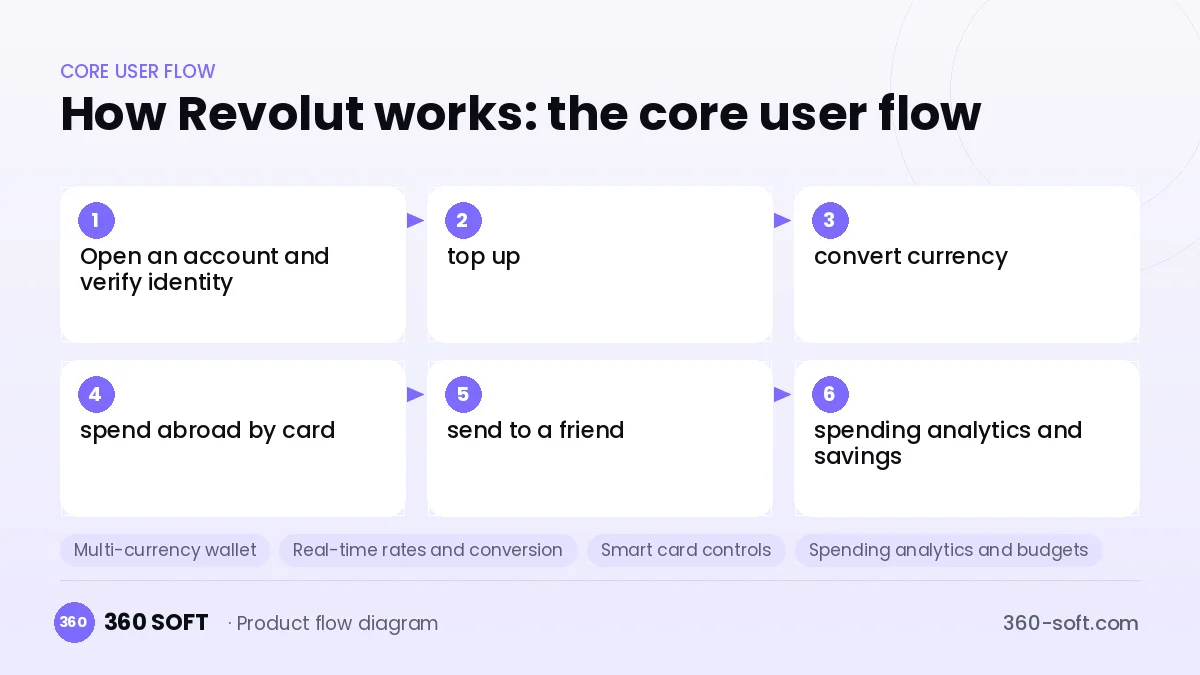
The appeal of Revolut is that it turns a banking app into a multi-currency finance super app. Users hold many currencies in one account, spend abroad at a fair rate, send money to a friend instantly, categorise their spending and reach savings or investment products from the same app. For travellers and people who do business abroad, it is a transparent experience that clearly reduces bank fees.
Something similar needs separate licences and regulation in every country: an e-money or payment licence for payments, a securities licence for investment products and a banking licence for deposits, and licensed infrastructure partners are the realistic way to start. Technically you must build a multi-currency ledger, a rate and liquidity engine, a card processor, international transfer networks, eKYC, transaction monitoring and a modular product architecture.
How Revolut works: the core user flow
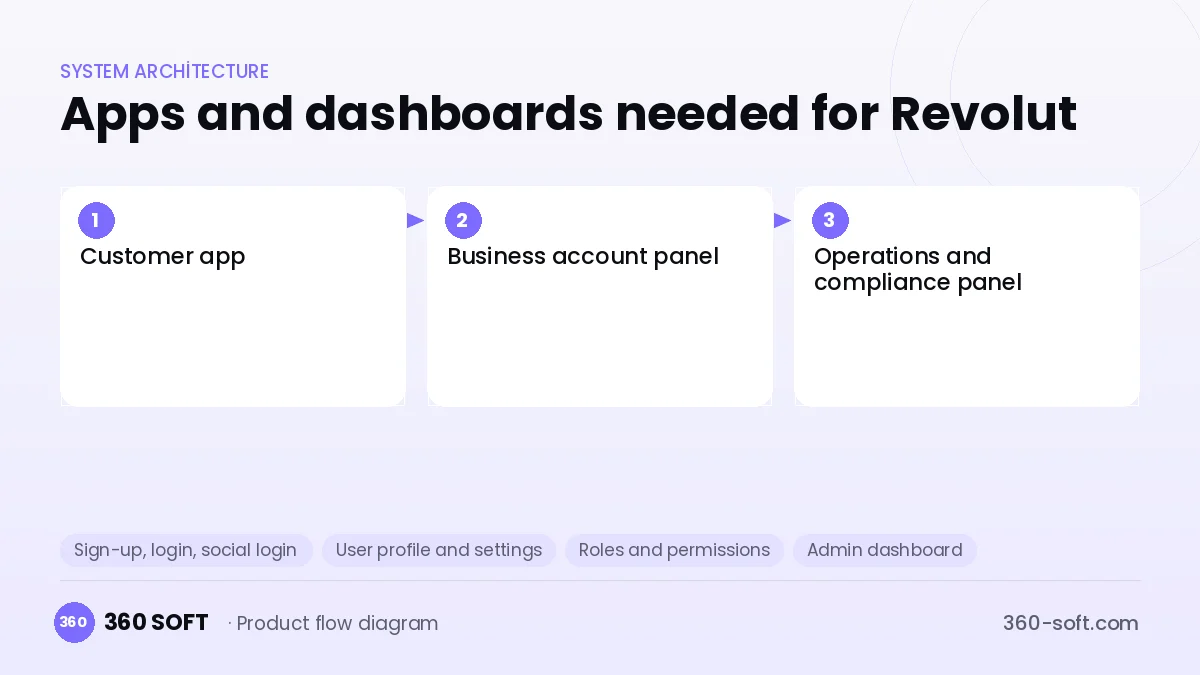
How many apps and dashboards do you need?
Customer app
Users manage a multi-currency account, exchange currency, use cards, make transfers and access extra products.
Business account panel
Companies manage employee cards, spending limits, bulk payments and invoice matching.
Operations and compliance panel
The team handles identity checks, sanctions screening, suspicious transactions and country-specific regulatory reports.
Critical features of a product like Revolut
Multi-currency wallet
A user keeps sub-accounts in several currencies, each managed with its own balance, statement and IBAN.
Real-time rates and conversion
Instant conversion uses rates from liquidity providers, and automatic conversion orders can be set for a target rate.
Smart card controls
Virtual, single-use and physical cards, location-based security and contactless and online settings are managed in the app.
Spending analytics and budgets
Each transaction is categorised automatically, with monthly budget goals and overspend alerts.
Savings pot and round-ups
Card spending is rounded up and the difference moves automatically into a savings pot.
Plan-based product tiers
Free, standard and premium plans are configured with different currency limits, card types and extra perks.
What goes into the first version, what comes later
First version (MVP)
- Account opening with eKYC and sanctions screening
- Multi-currency balances and conversion on licensed infrastructure
- A virtual card and instant spending notifications
- Transfers between users
- Spending categories and an operations panel
Later releases
- A physical card and premium plan perks
- International transfer network integrations
- Business accounts and employee cards
- Investment and crypto products through licensed partners
Modules and how the budget is calculated
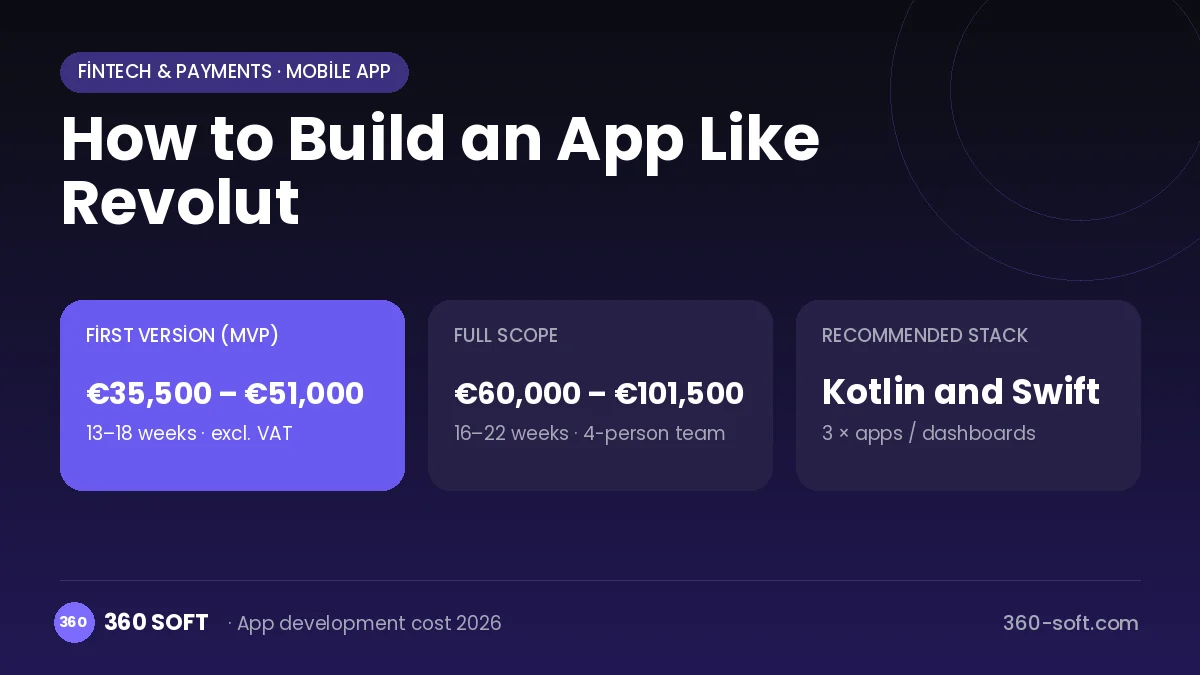
The budget is calculated with 360 SOFT’s pricing model from the modules below, about 40 screens and the project’s complexity: roughly 229 person-days for the full scope and 135 person-days for the first version. Every module you drop lowers the budget directly.
| Module | Phase |
|---|---|
| Sign-up, login, social login | First version |
| User profile and settings | First version |
| Roles and permissions | First version |
| Admin dashboard | First version |
| Online payments (Stripe / PSP) | First version |
| Subscriptions and recurring billing | First version |
| Push notifications | First version |
| Email / SMS notifications | First version |
| Real-time messaging | First version |
| Reporting and analytics | Later release |
| Multi-language | First version |
| GDPR and security hardening | First version |
| Third-party API integration | First version |
| AI features (LLM, RAG, recommendations) | Later release |
Hosting, SMS, map APIs, app store accounts and payment-provider fees are separate items. Maintenance and improvements (optional): €750 / month. We send a fixed written price within 24 hours after a free discovery call.
The hard parts
Country-by-country regulation
Each market brings its own licensing, identity verification and reporting rules; the architecture must handle rules that vary by country.
FX risk and liquidity
Weekend and volatile markets can turn exchange differences into losses; hedging, FX margins and liquidity provider redundancy must be planned.
Transaction monitoring at scale
Fast growth raises money-laundering and fraud risk; real-time monitoring and an adequate compliance team are critical.
Business model
The model is built on freemium and subscriptions: the basic account is free, while higher currency limits, insurance, special cards and extra perks are sold through monthly plans. In addition, interchange on card spending, fees on currency conversion above the limit, weekend FX margins and commissions on investment products offered via partners bring revenue.
Get a free quote for your project
Let us scope it together and send a fixed written quote within 24 hours. NDA on request; you own the source code.
Choosing a company to build an app like Revolut
Most people searching “build an app like revolut” are really looking for a reliable app development company. When comparing quotes, check four things:
- Can you try similar products they have shipped, in the stores or live?
- Are the source code, design files, servers and store accounts transferred to you by contract?
- Do they show a working demo every two weeks, with written scope and acceptance criteria?
- Are maintenance, scaling and GDPR/security costs written into the quote?
Copyright and trademarks
A business model and features are generally not protected on their own, but the Revolut name, logo, interface design, content and source code are. That is why we build a product with similar functionality but your own brand, design and code. This is not legal advice; we recommend a trademark search before launch.
Frequently asked questions
How long does it take to build an app like Revolut?
With a single country and a limited product set, a first release can be ready within months alongside a licensed infrastructure partner. New countries and products are added, each like a separate project.
Which licences are needed?
In the EU, an e-money or payment institution licence is needed for payments, securities authorisation for investment products and a banking licence for deposits and lending. Starting through partnerships with licensed institutions is a common approach.
Will there be copyright or trademark issues?
The multi-currency digital account model is free to use, but the name, logo, card design, interface and code cannot be copied. This is general information, not legal advice.
What should I look for in a fintech software company?
Choose a team experienced in multi-currency ledgers, card processor integration and regulatory compliance. Ask about their scalable microservice architecture and security audit track record.