Web platformDating & live streaming
The appeal of random video chat websites is that, with no installation or profile, you can talk to a stranger instantly from the browser. Matching by entering a shared interest, a choice between text and video mode, and moving on to a new person with one click make the experience fast and curiosity-driven. But this simplicity also carries the biggest risk: anonymity attracts abuse, and if safety is weak the platform quickly loses trust.
To build something similar you need a WebRTC-based web app running in the browser, a queue service that matches by interest and language, and signalling and TURN servers. More important than these are an age verification gate, AI that scans video live, report and ban infrastructure, and a moderation panel that runs around the clock. For a responsible product, account creation, device and IP bans and clear terms of use should be designed from the start.
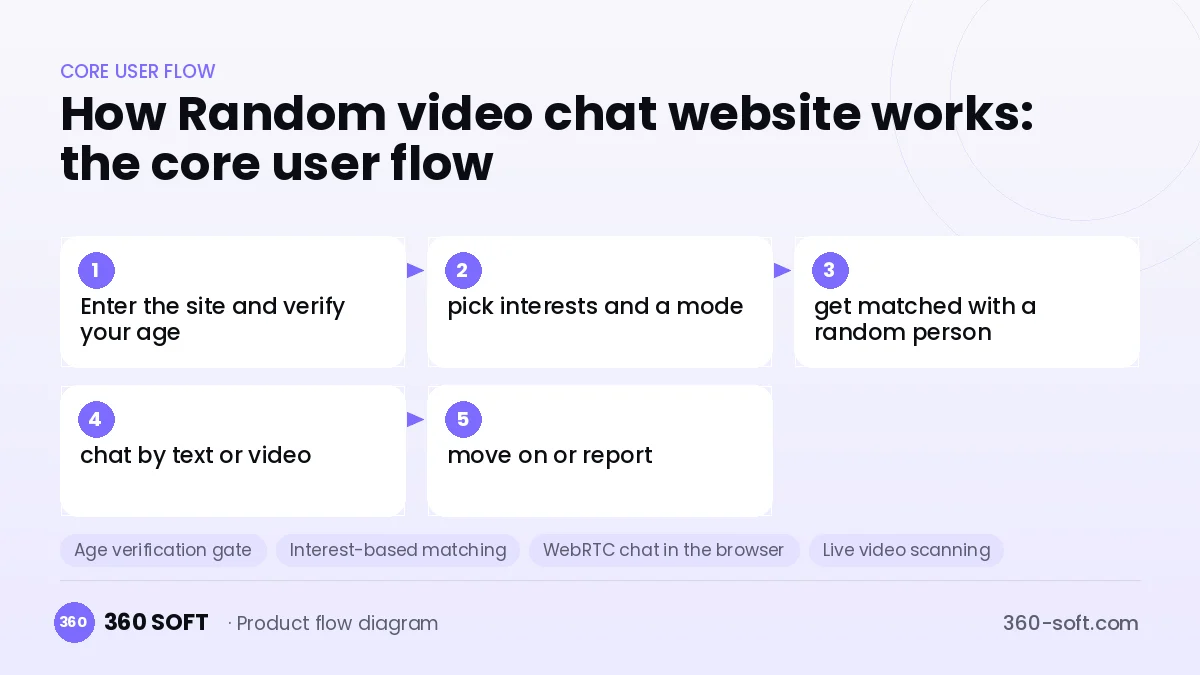
How Random video chat website works: the core user flow
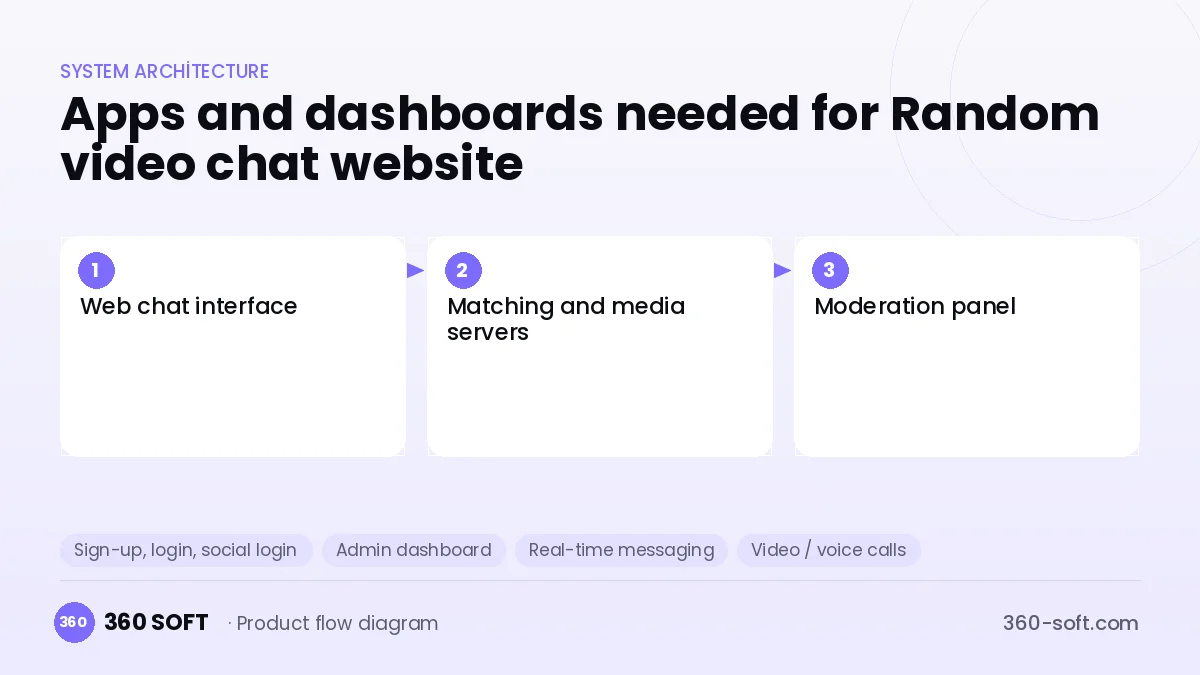
How many apps and dashboards do you need?
Web chat interface
Adult visitors choose interests in the browser, get matched at random and chat by text or video.
Matching and media servers
A backend that pairs waiting users by interest and language and manages WebRTC signalling and TURN relay.
Moderation panel
A team interface that reviews sessions flagged by AI and reports, and enforces device- and account-level bans.
Critical features of a product like Random video chat website
Age verification gate
Before entering a chat, an age declaration and, depending on risk, extra verification are required; unverified users are not admitted to video mode.
Interest-based matching
People who share the tags a user enters are matched first; if no match is found, the user moves into the general queue.
WebRTC chat in the browser
Peer-to-peer video chat runs with camera and microphone without any plugin; a text mode is offered separately.
Live video scanning
Frames taken at set intervals are analysed by AI; on inappropriate content the session is cut instantly.
Device- and IP-based bans
Users who exceed the report threshold are blocked temporarily or permanently by account, device fingerprint and network information.
Moderated room options
For those who want a safer experience, separate chat pools of verified users under strict rules can be opened.
What goes into the first version, what comes later
First version (MVP)
- Entry with an age declaration and acceptance of the rules
- Interest-based matching and text chat
- Video chat with WebRTC and skipping to the next person
- A report button, AI video scanning and banning
- A moderation panel and incident logs
Later releases
- Account creation and a verified-user pool
- Language-preference matching and automatic translation
- A mobile app version
- An ad-free premium membership with filters
Modules and how the budget is calculated
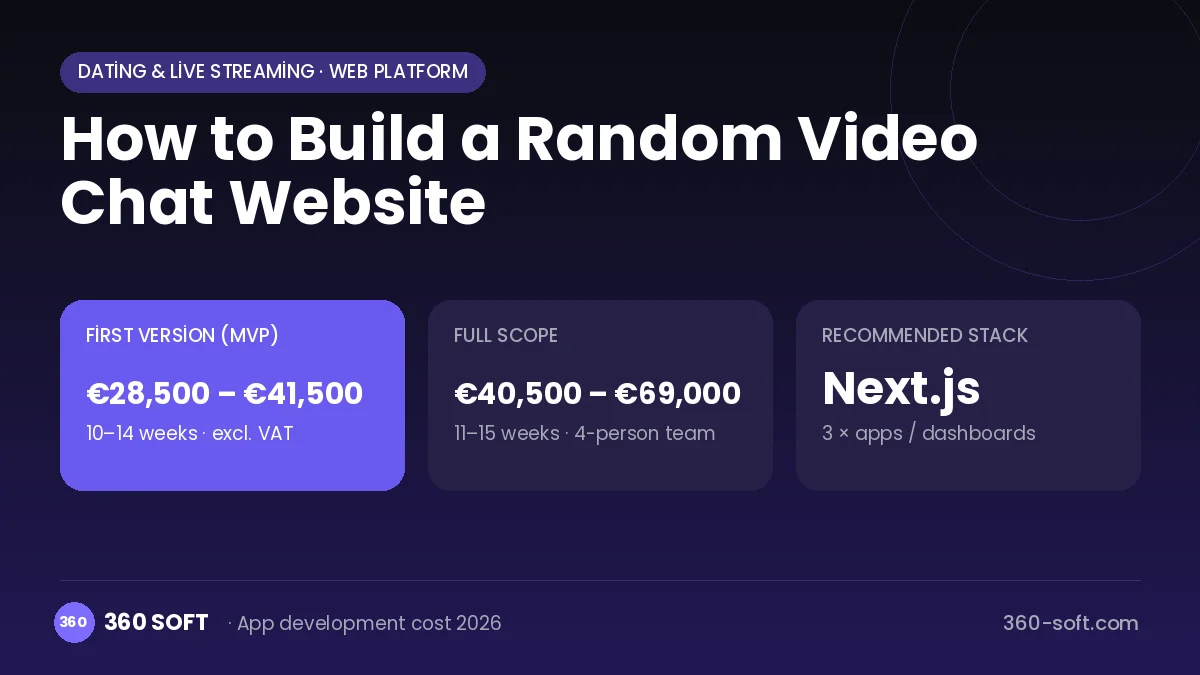
The budget is calculated with 360 SOFT’s pricing model from the modules below, about 14 screens and the project’s complexity: roughly 155 person-days for the full scope and 109 person-days for the first version. Every module you drop lowers the budget directly.
| Module | Phase |
|---|---|
| Sign-up, login, social login | First version |
| Admin dashboard | First version |
| Real-time messaging | First version |
| Video / voice calls | First version |
| Subscriptions and recurring billing | First version |
| Online payments (Stripe / PSP) | First version |
| Multi-language | First version |
| GDPR and security hardening | First version |
| AI features (LLM, RAG, recommendations) | Later release |
| Reporting and analytics | First version |
Hosting, SMS, map APIs, app store accounts and payment-provider fees are separate items. Maintenance and improvements (optional): €550 / month. We send a fixed written price within 24 hours after a free discovery call.
The hard parts
Abuse and child safety
Anonymous video chat carries a serious risk for minors; without strong age verification, live scanning, fast intervention and a process for reporting to the authorities, this product cannot be operated responsibly.
Legal liability
Liability for user content, the GDPR, the EU Digital Services Act, the UK Online Safety Act and other local rules must be assessed; the terms of use and the logging policy should be prepared with a lawyer.
Media and moderation cost
TURN traffic and video analysis grow in line with user numbers; moderation capacity must be planned ahead of growth.
Business model
A responsible revenue model for this type of site is a premium membership offering ad-free use, interest and region filters, and access to a verified-user pool. Limited advertising with family-friendly ad networks is also possible, but advertisers are cautious in this category. When planning revenue, the moderation team and media infrastructure should be expected to be the main cost items.
Get a free quote for your project
Let us scope it together and send a fixed written quote within 24 hours. NDA on request; you own the source code.
Choosing a company to build an app like Random video chat website
Most people searching “random video chat website development” are really looking for a reliable app development company. When comparing quotes, check four things:
- Can you try similar products they have shipped, in the stores or live?
- Are the source code, design files, servers and store accounts transferred to you by contract?
- Do they show a working demo every two weeks, with written scope and acceptance criteria?
- Are maintenance, scaling and GDPR/security costs written into the quote?
Copyright and trademarks
A business model and features are generally not protected on their own, but the Random video chat website name, logo, interface design, content and source code are. That is why we build a product with similar functionality but your own brand, design and code. This is not legal advice; we recommend a trademark search before launch.
Frequently asked questions
How long does it take to build a random video chat website?
A first version with matching, WebRTC chat, reporting and basic moderation can be built in a relatively short time. However, getting a reliable age verification and moderation process in place takes more time than the technical development.
Does it make sense to allow use without an account?
Use without an account speeds up growth but also increases abuse. Requiring an account and age verification at least for video mode makes bans effective.
What legal obligations apply?
Hosting-provider duties, the GDPR, the Digital Services Act and content removal procedures should be assessed, and if you serve other countries their online safety rules apply too. This is not legal advice; consult a lawyer.
What should I look for when choosing a software company for this kind of site?
Choose a team with WebRTC and real-time moderation experience that treats safety as a core requirement, not a feature. Ask how they test abuse scenarios.