Mobile appService marketplaces & freelance
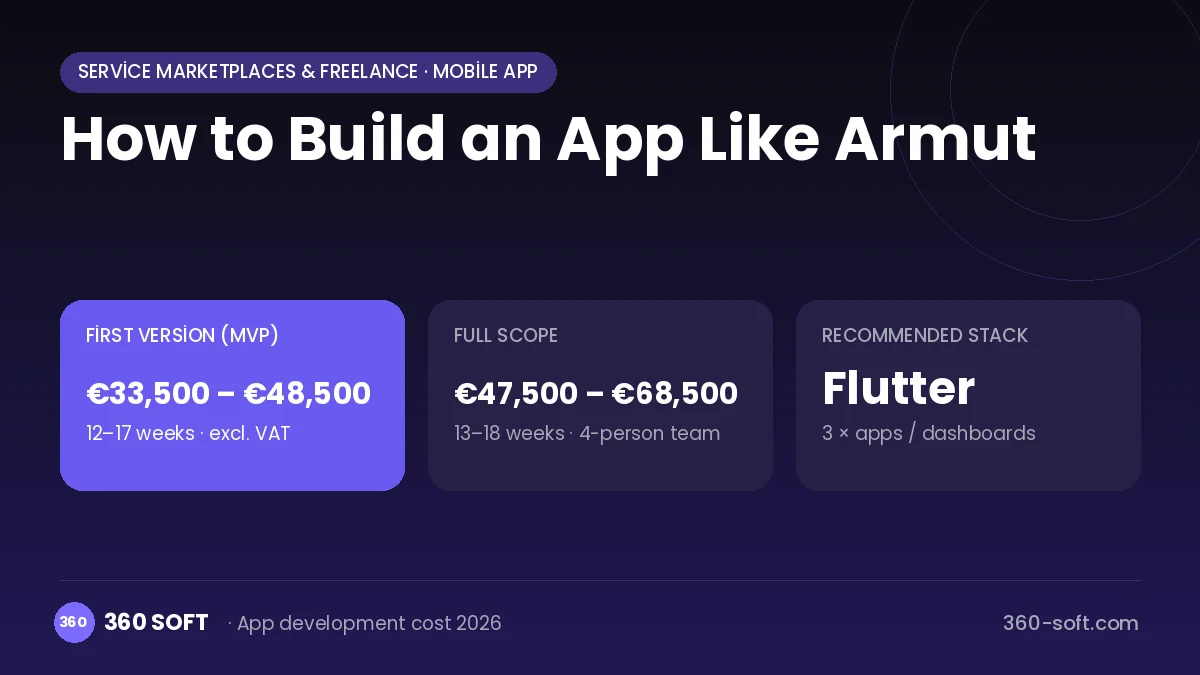
Armut is Turkey's leading local services marketplace, comparable to Bark or Thumbtack. A platform like this solves local service needs, from home cleaning and renovation to removals and private tutoring, with a short request of a few questions. Users describe what they need and quickly receive quotes from suitable providers in their area; reviews and ratings make the choice easier. For providers, the cost of finding customers falls, since instead of advertising they only quote on requests they are interested in.
Building something similar requires a customer app and website, a provider app where pros see requests and send quotes, category-specific question sets and an admin panel. Behind the scenes run area and category matching, a quote credit system, messaging, a notification engine and provider verification. A field and telesales team is needed to recruit providers category by category.
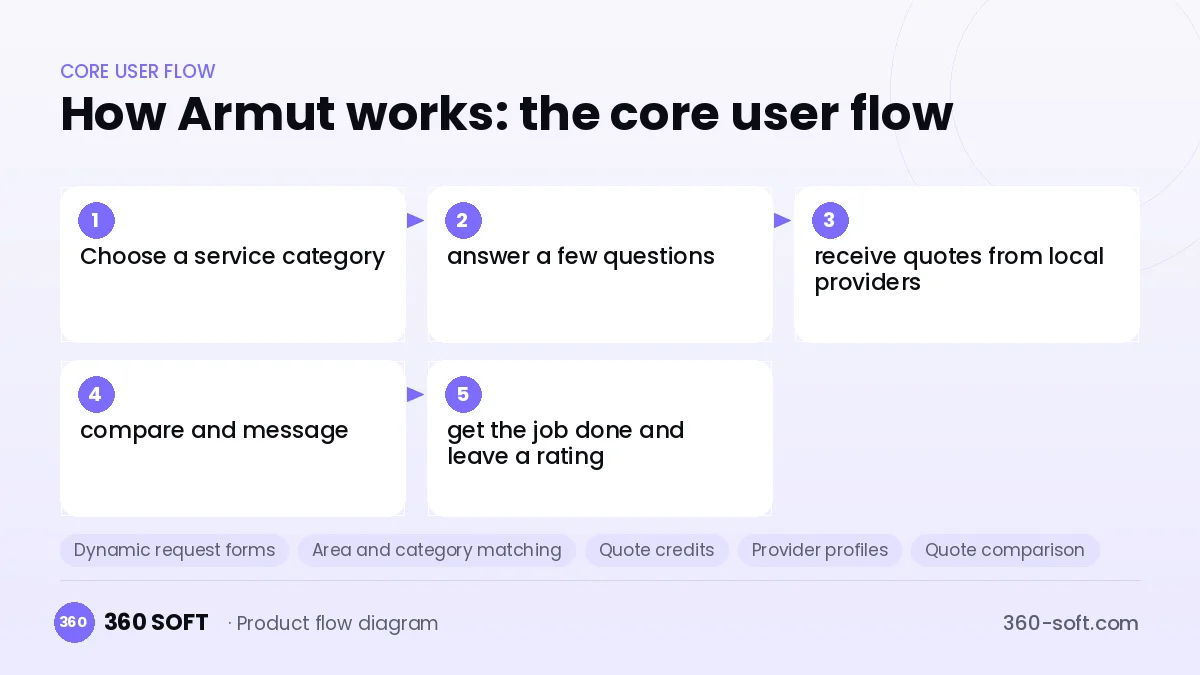
How Armut works: the core user flow
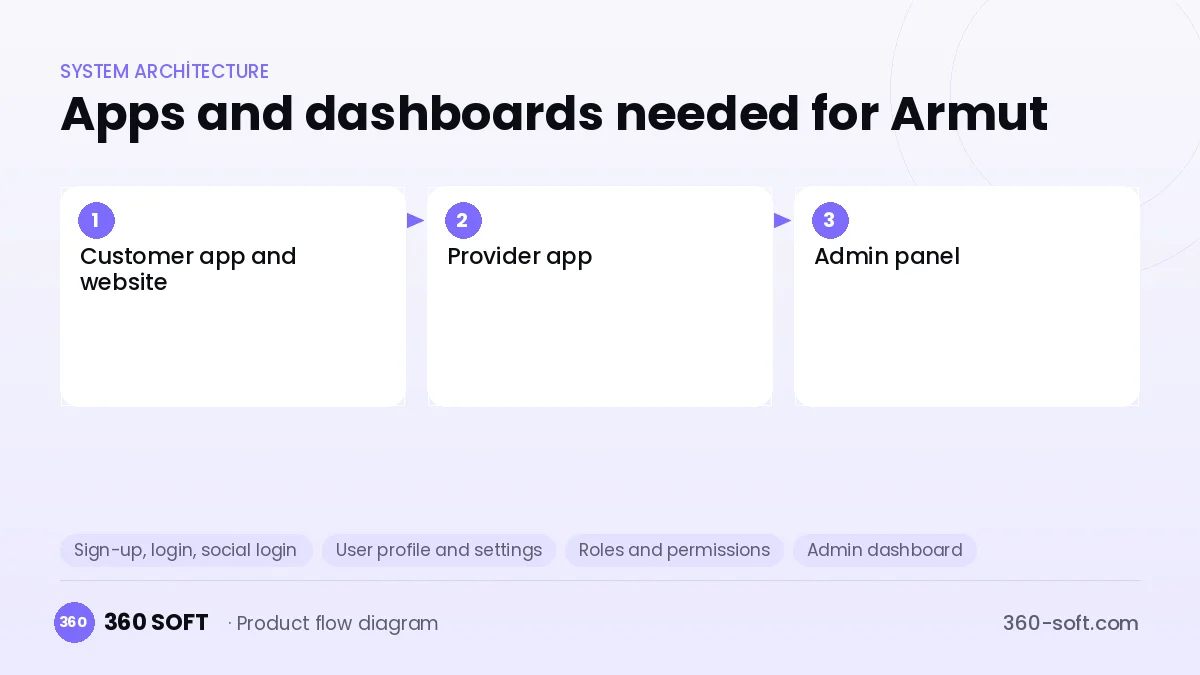
How many apps and dashboards do you need?
Customer app and website
Users create service requests, compare quotes and choose a provider.
Provider app
Tradespeople and companies see requests in their area, spend credits to quote and chat with customers.
Admin panel
The team manages categories and question sets, provider verification, credits and complaints.
Critical features of a product like Armut
Dynamic request forms
Each service category has its own questions (number of rooms, floor area, date), from which the provider works out the right price.
Area and category matching
Requests are sent only to providers who serve that district and are registered in the relevant category.
Quote credits
Providers spend credits to quote on a request; the number of quotes is capped so customers aren't overwhelmed.
Provider profiles
Certificates, photo examples of past work, response time and verified reviews appear on the profile.
Quote comparison
Customers review incoming quotes side by side by price, rating and response time.
Fixed-price services
For standard jobs such as cleaning, customers book a fixed-price service directly and pay online.
What goes into the first version, what comes later
First version (MVP)
- Dynamic request forms for a few categories
- Area-based request matching and notifications
- Provider quotes and credit purchases
- Messaging, ratings and reviews
- Provider approval and admin panel
Later releases
- Online booking and payment for fixed-price services
- Provider subscription packages
- Service guarantee and insurance option
- Business customer accounts
Modules and how the budget is calculated
The budget is calculated with 360 SOFT’s pricing model from the modules below, about 32 screens and the project’s complexity: roughly 181 person-days for the full scope and 129 person-days for the first version. Every module you drop lowers the budget directly.
| Module | Phase |
|---|---|
| Sign-up, login, social login | First version |
| User profile and settings | First version |
| Roles and permissions | First version |
| Admin dashboard | First version |
| Product / content catalogue | First version |
| Advanced search and filters | First version |
| Maps, location, routing | First version |
| Real-time messaging | First version |
| Push notifications | First version |
| Email / SMS notifications | First version |
| Online payments (Stripe / PSP) | First version |
| Ratings and reviews | First version |
| Booking / reservations | First version |
| Reporting and analytics | Later release |
Hosting, SMS, map APIs, app store accounts and payment-provider fees are separate items. Maintenance and improvements (optional): €600 / month. We send a fixed written price within 24 hours after a free discovery call.
The hard parts
Category variety
Each of hundreds of categories needs its own question set and pricing logic; a flexible form engine is essential.
Quote-to-conversion balance
If providers spend credits and don't win work, they leave the platform; request quality and quote limits must be tuned carefully.
Trust and quality
For customers letting someone into their home, identity verification, certificate checks and complaint resolution are critical.
Business model
The credits that providers buy to quote on requests are the core of the model. Provider subscription packages, profile boosts, commission per transaction on fixed-price services and add-on products such as a service guarantee diversify revenue. For jobs paid online, a licensed payment provider's infrastructure should be used.
Get a free quote for your project
Let us scope it together and send a fixed written quote within 24 hours. NDA on request; you own the source code.
Choosing a company to build an app like Armut
Most people searching “build an app like armut” are really looking for a reliable app development company. When comparing quotes, check four things:
- Can you try similar products they have shipped, in the stores or live?
- Are the source code, design files, servers and store accounts transferred to you by contract?
- Do they show a working demo every two weeks, with written scope and acceptance criteria?
- Are maintenance, scaling and GDPR/security costs written into the quote?
Copyright and trademarks
A business model and features are generally not protected on their own, but the Armut name, logo, interface design, content and source code are. That is why we build a product with similar functionality but your own brand, design and code. This is not legal advice; we recommend a trademark search before launch.
Frequently asked questions
How long does it take to build an app like Armut?
A first version with request forms for a few categories, quotes and a credit system can reach the app stores in a few months. Fixed-price booking and guarantees are added later.
How many separate apps are needed?
You need a customer app, a provider app and an admin panel. A web version of the customer side is also important for SEO.
Are there copyright or trademark issues?
The services marketplace model is free to use; names, logos, design, content and code cannot be copied. This is not legal advice.
Which categories should we start with?
Starting in one city with frequently repeated categories where providers are easy to find (cleaning, removals, painting) is recommended. Categories and cities are added as density builds.