Mobile appVideo, music & mediaOriginal by Apple
Apple Music positions music streaming as a premium experience from the start, with no free tier. Lossless and spatial audio quality, lyrics that scroll in time with the song, editor-curated playlists and live radio make the product attractive to listeners who care about sound. Deep integration with the device ecosystem also ties users in easily.
Building something similar takes an encoding and delivery pipeline that can handle high-bit-rate and lossless audio, time-stamped lyrics data, an editorial playlist panel and a live radio broadcast stack. Matching a user's own music library to the cloud, offline downloads and family sharing are other things the backend has to solve.
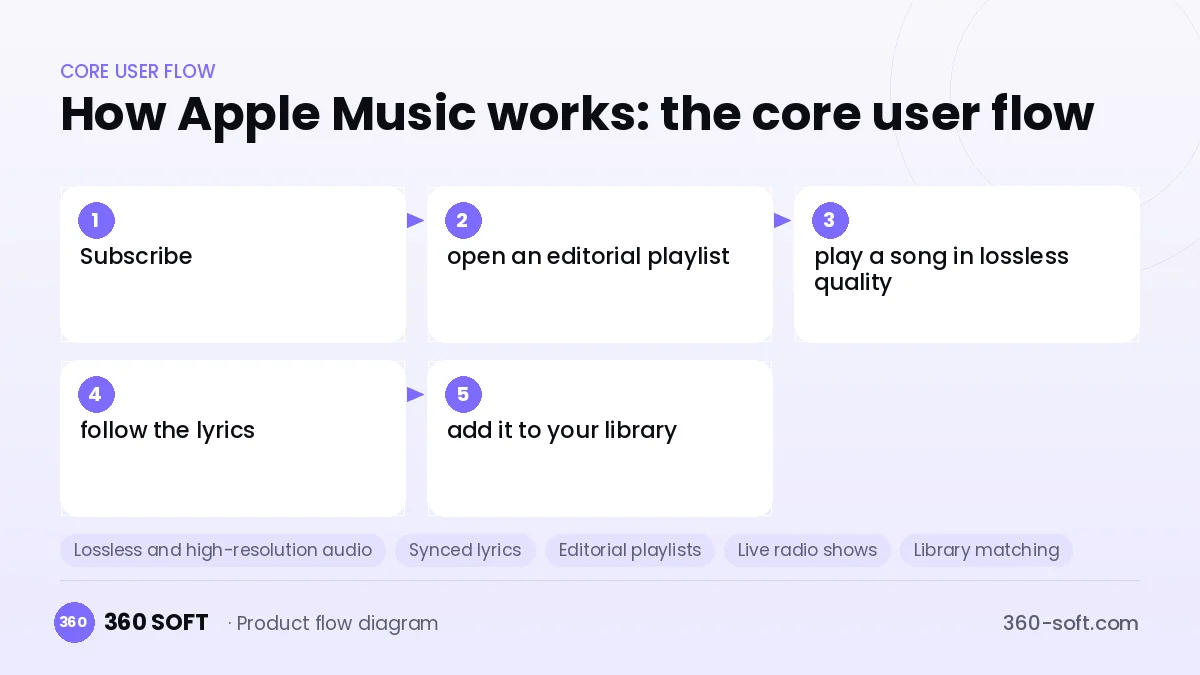
How Apple Music works: the core user flow
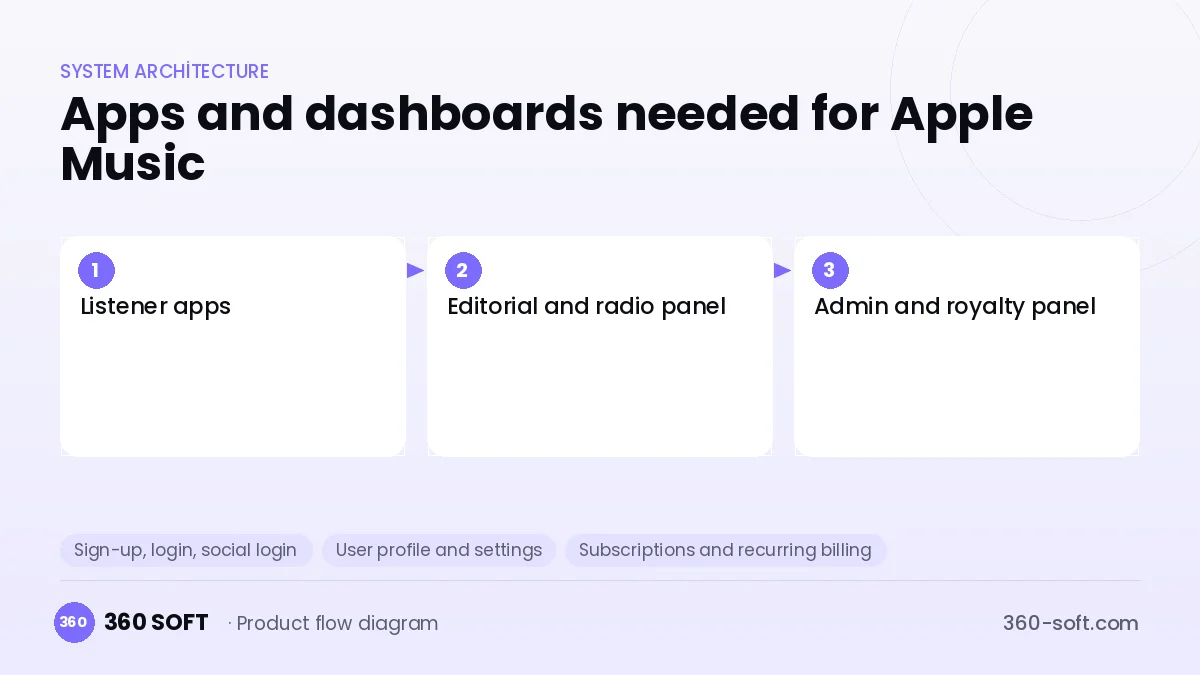
How many apps and dashboards do you need?
Listener apps
Subscribers who listen to music and build libraries on mobile, desktop, web and smart speakers.
Editorial and radio panel
The panel where editors prepare themed playlists and plan the broadcast schedule of radio shows.
Admin and royalty panel
An internal panel for catalogue ingestion, subscriptions, family sharing and royalty reports.
Critical features of a product like Apple Music
Lossless and high-resolution audio
Several quality levels are stored for each song, and users can pick a lossless format to suit their network and device.
Synced lyrics
Line- or word-level time-stamped lyrics flow with the song, and tapping a line jumps to that point in the track.
Editorial playlists
Playlists themed by genre, mood and occasion are updated regularly by editors and promoted in the showcase.
Live radio shows
Radio programmes with hosts are broadcast live and can be listened to on demand afterwards.
Library matching
Songs on the user's device are matched against the catalogue and added to the cloud library.
Family sharing
Several personal accounts are created under one subscription, and each member's recommendations are kept separate.
What goes into the first version, what comes later
First version (MVP)
- iOS and Android player
- Subscription and free trial
- Catalogue, search and library
- Editorial playlists
- Synced lyrics
Later releases
- Lossless and spatial audio
- Live radio shows
- Family sharing and a desktop app
- Smart speaker and in-car integration
Modules and how the budget is calculated
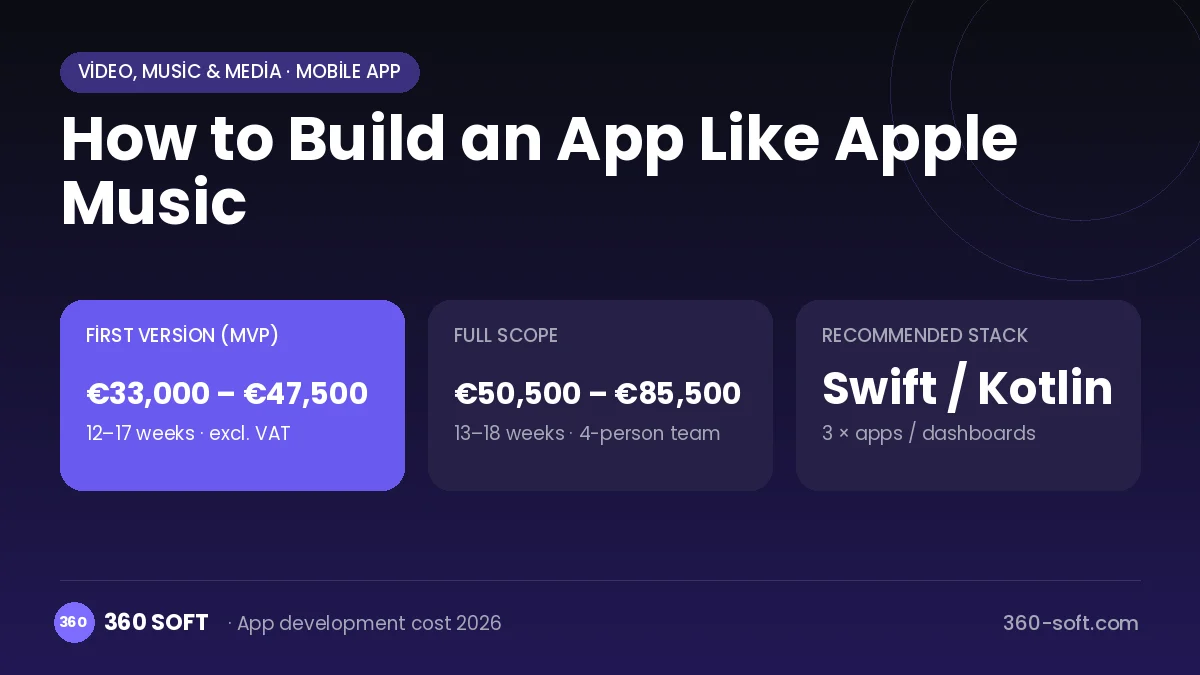
The budget is calculated with 360 SOFT’s pricing model from the modules below, about 30 screens and the project’s complexity: roughly 193 person-days for the full scope and 126 person-days for the first version. Every module you drop lowers the budget directly.
| Module | Phase |
|---|---|
| Sign-up, login, social login | First version |
| User profile and settings | First version |
| Subscriptions and recurring billing | First version |
| Online payments (Stripe / PSP) | First version |
| Product / content catalogue | First version |
| Advanced search and filters | First version |
| File, photo, video upload | First version |
| Offline mode and sync | First version |
| Content management / blog | First version |
| Push notifications | First version |
| Reporting and analytics | Later release |
| Admin dashboard | First version |
| GDPR and security hardening | First version |
Hosting, SMS, map APIs, app store accounts and payment-provider fees are separate items. Maintenance and improvements (optional): €650 / month. We send a fixed written price within 24 hours after a free discovery call.
The hard parts
Cost of lossless audio
Lossless files are much larger, so storage and CDN cost have to be balanced against mobile data usage.
Lyrics licensing
Lyrics are a separate rights matter from the music, so you need separate agreements with lyrics providers.
Growth without a free tier
Acquiring users is hard in a paid-only model, which makes trial periods and operator bundles critical.
Business model
The model is an ad-free monthly subscription, with price tiers for individual, student and family plans. Instead of a free tier, long trial periods and bundled subscriptions that arrive through operators or device sales bring in users. Most of the revenue is passed on to rights holders as royalties based on plays.
Get a free quote for your project
Let us scope it together and send a fixed written quote within 24 hours. NDA on request; you own the source code.
Choosing a company to build an app like Apple Music
Most people searching “build an app like apple music” are really looking for a reliable app development company. When comparing quotes, check four things:
- Can you try similar products they have shipped, in the stores or live?
- Are the source code, design files, servers and store accounts transferred to you by contract?
- Do they show a working demo every two weeks, with written scope and acceptance criteria?
- Are maintenance, scaling and GDPR/security costs written into the quote?
Copyright and trademarks
A business model and features are generally not protected on their own, but the Apple Music name, logo, interface design, content and source code are. That is why we build a product with similar functionality but your own brand, design and code. This is not legal advice; we recommend a trademark search before launch.
Frequently asked questions
How long does it take to build an app like Apple Music?
A first version with a player, subscriptions, catalogue and editorial playlists can ship in a few months. Lossless audio, live radio and family sharing are added in later phases.
Is lossless audio needed in the first version?
For a general audience it is not needed in the first version; starting at standard quality and designing the infrastructure to be ready for lossless is enough. If you are targeting an audio-focused niche, priorities may change.
Are there copyright or trademark issues?
The subscription music streaming business model and its features are generally free to use, but the name, logo, design, content and code cannot be copied. Separate licences are needed for music and lyrics; this information is not legal advice.
What should I look for when choosing a company to build an app like Apple Music?
Look for experience in audio encoding, DRM, offline downloads and subscription infrastructure. Knowledge of in-store payment rules matters too.