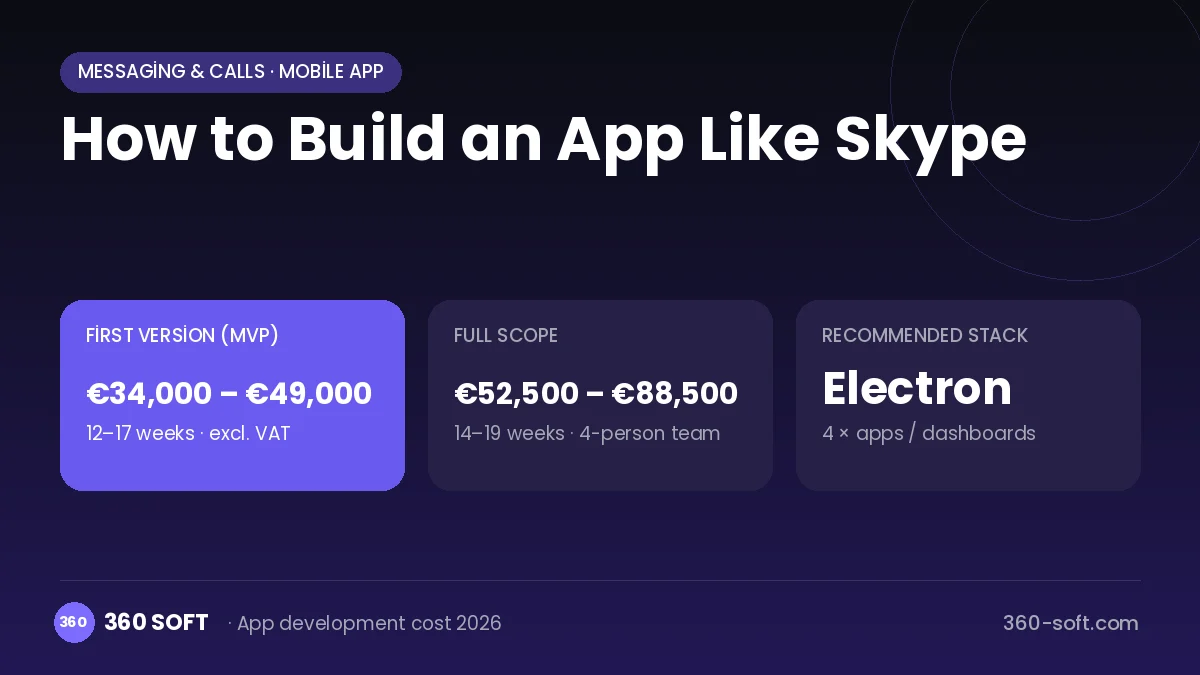
Mobile appMessaging & callsOriginal by Microsoft
Skype is one of the products that brought video calling over the internet into ordinary people's lives. Identity by username, access to the same account from a computer and a phone, and the ability to call the phone of someone who does not use the app made it a universal calling tool for both family calls and business meetings. Today a similar product can create value by focusing on a specific industry or user group.
Building something similar takes desktop and mobile clients, WebRTC-based video calling and media servers (SFU) for group calls. Contact search by username, chat and file sharing, screen sharing, live captions, and a SIP gateway with a credit system for outbound calls to phone networks are added. Adaptive codecs that keep a call alive even in poor network conditions are critical.
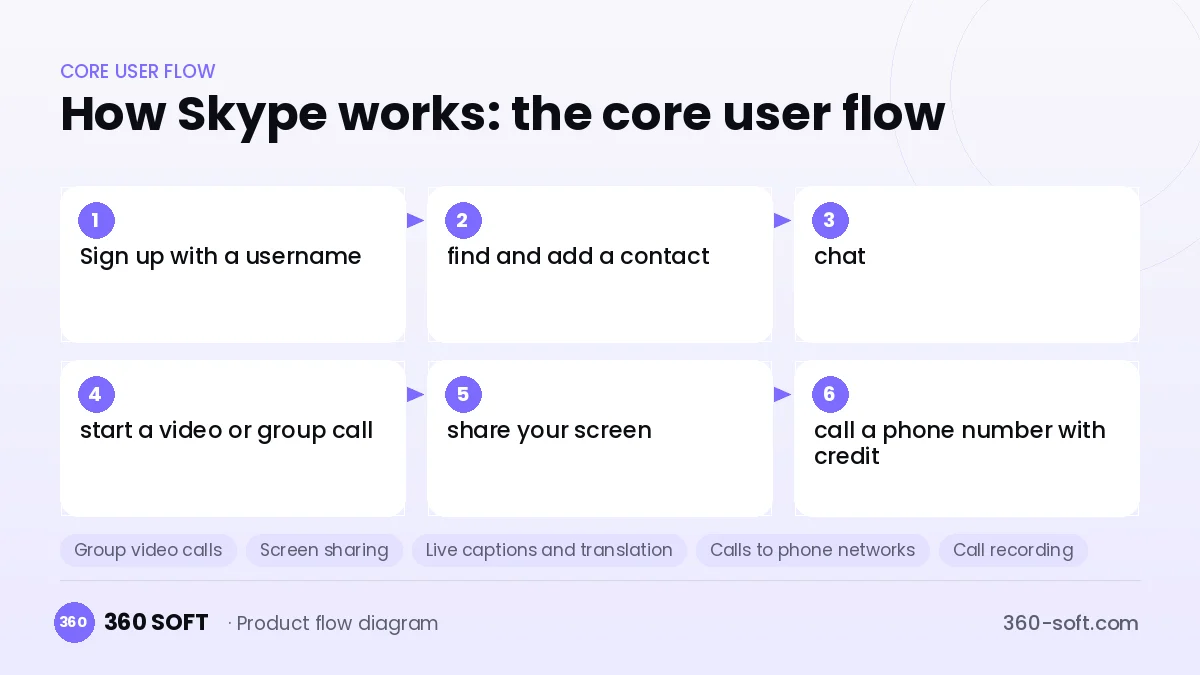
How Skype works: the core user flow
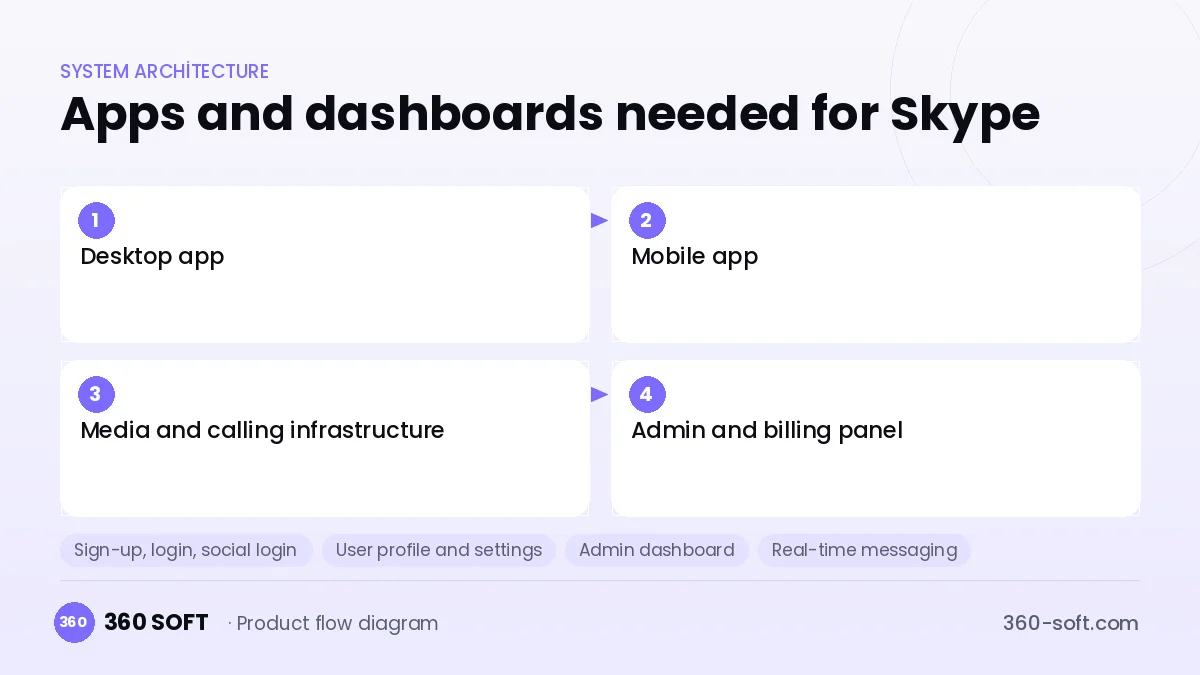
How many apps and dashboards do you need?
Desktop app
The app users run on a computer for video calls, screen sharing and chat.
Mobile app
The app that makes calls and messages from the same account on a phone and delivers notifications.
Media and calling infrastructure
A back end made up of SFU servers that run group calls, TURN relays and a SIP gateway.
Admin and billing panel
The panel that watches credit sales, rates, abuse and quality metrics.
Critical features of a product like Skype
Group video calls
With an SFU architecture, each participant in a multi-party call receives video at a quality suited to them.
Screen sharing
The whole screen or a single window is shared, while participants' video stays in a small window during sharing.
Live captions and translation
Speech is converted to text in real time and optionally translated into another language.
Calls to phone networks
Landline and mobile numbers are called through a SIP gateway with credit or a minute bundle.
Call recording
Calls are recorded with participants notified and stored in the cloud for a set period.
Join by link
People without an account can join a call from a browser with a shared link.
What goes into the first version, what comes later
First version (MVP)
- Sign-up by username and contact search
- One-to-one voice and video calls
- Chat and file sharing
- Group video calls
- Screen sharing
Later releases
- Paid calls to phone networks and credit
- Live captions and translation
- Call recording
- Joining by link without an account
Modules and how the budget is calculated
The budget is calculated with 360 SOFT’s pricing model from the modules below, about 26 screens and the project’s complexity: roughly 200 person-days for the full scope and 129 person-days for the first version. Every module you drop lowers the budget directly.
| Module | Phase |
|---|---|
| Sign-up, login, social login | First version |
| User profile and settings | First version |
| Admin dashboard | First version |
| Real-time messaging | First version |
| Video / voice calls | First version |
| Push notifications | First version |
| File, photo, video upload | First version |
| Online payments (Stripe / PSP) | First version |
| GDPR and security hardening | First version |
| AI features (LLM, RAG, recommendations) | Later release |
| Multi-language | First version |
| Reporting and analytics | First version |
Hosting, SMS, map APIs, app store accounts and payment-provider fees are separate items. Maintenance and improvements (optional): €700 / month. We send a fixed written price within 24 hours after a free discovery call.
The hard parts
Network resilience
Packet loss and latency break the picture, so adaptive bitrate, echo cancellation and TURN relays are a must.
Media server cost
Group calls consume serious bandwidth, and infrastructure costs climb quickly as users grow.
Telecom regulation
Calling phone networks requires telecom authorisation that varies by country and an agreement with a licensed carrier.
Business model
In-app calls can stay free while revenue comes from credit for calls to phone networks and minute bundles. A subscription with recording, long group calls and a dedicated number for professionals and small businesses is the second revenue line. Versions tailored to niches such as education or healthcare can be sold as enterprise licences.
Get a free quote for your project
Let us scope it together and send a fixed written quote within 24 hours. NDA on request; you own the source code.
Choosing a company to build an app like Skype
Most people searching “build an app like skype” are really looking for a reliable app development company. When comparing quotes, check four things:
- Can you try similar products they have shipped, in the stores or live?
- Are the source code, design files, servers and store accounts transferred to you by contract?
- Do they show a working demo every two weeks, with written scope and acceptance criteria?
- Are maintenance, scaling and GDPR/security costs written into the quote?
Copyright and trademarks
A business model and features are generally not protected on their own, but the Skype name, logo, interface design, content and source code are. That is why we build a product with similar functionality but your own brand, design and code. This is not legal advice; we recommend a trademark search before launch.
Frequently asked questions
How long does it take to build an app like Skype?
A first version with one-to-one and group video calling, chat and screen sharing takes a few months. Calls to phone networks and live captions are planned in separate phases.
A ready-made video platform or our own servers?
At the start ready-made video APIs give quick results, but per-minute costs grow. As the user base grows, moving to your own infrastructure on an open source SFU is usually more economical.
Will there be copyright or trademark issues?
The video calling business model and its features are generally free to use, but the name, logo, design, sounds and code cannot be copied. This is general information, not legal advice.
What should I look for when choosing a company to build a video calling app?
Choose a team with WebRTC, media server and quality testing experience across different network conditions, and ask for an infrastructure cost projection.