SaaS / business softwareBusiness software & SaaSOriginal by GitHub
GitHub turned hosting Git repositories into a social environment where developers work together. A proposed change arrives as a pull request that is reviewed line by line, discussed and merged, while issues, projects and automated tests live in the same place. Open source projects gathering there created a powerful network effect: a developer's profile became their résumé.
Building something similar takes a reliable Git server infrastructure (push and pull over SSH and HTTPS) with a storage and backup layer. On top you build code browsing in the web interface, a diff view, pull requests and code review, issue tracking, organisation and permission management, webhooks and CI/CD runners. For enterprise customers, a self-hosted option and audit logs matter just as much.
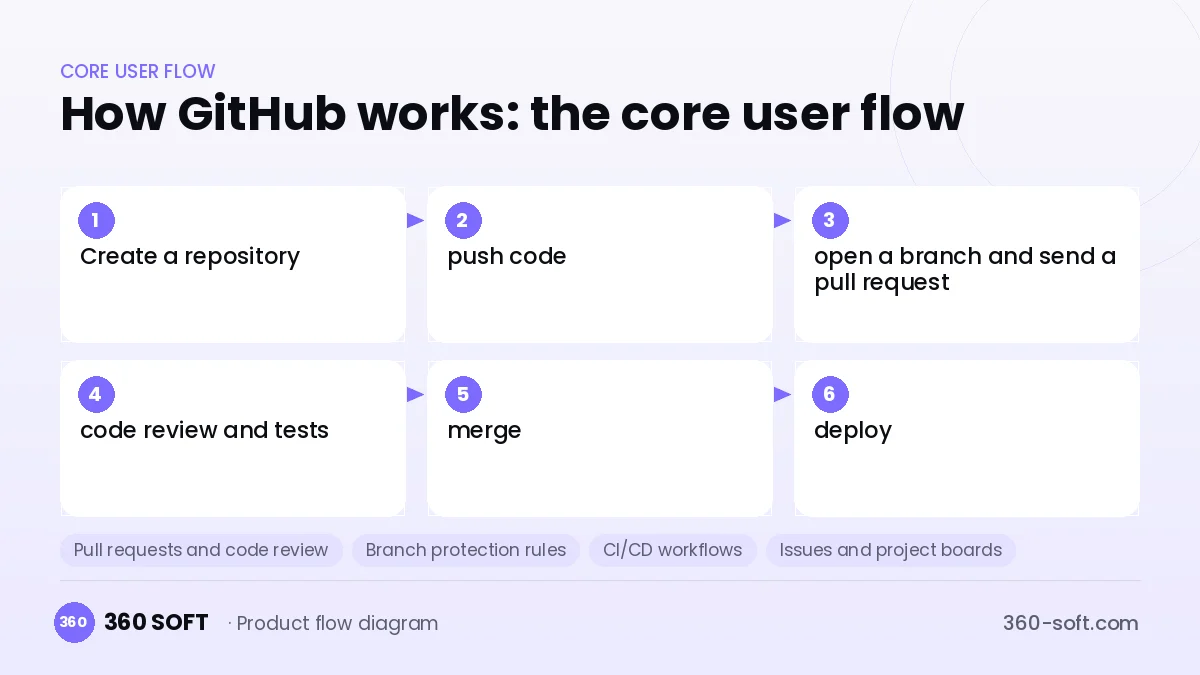
How GitHub works: the core user flow
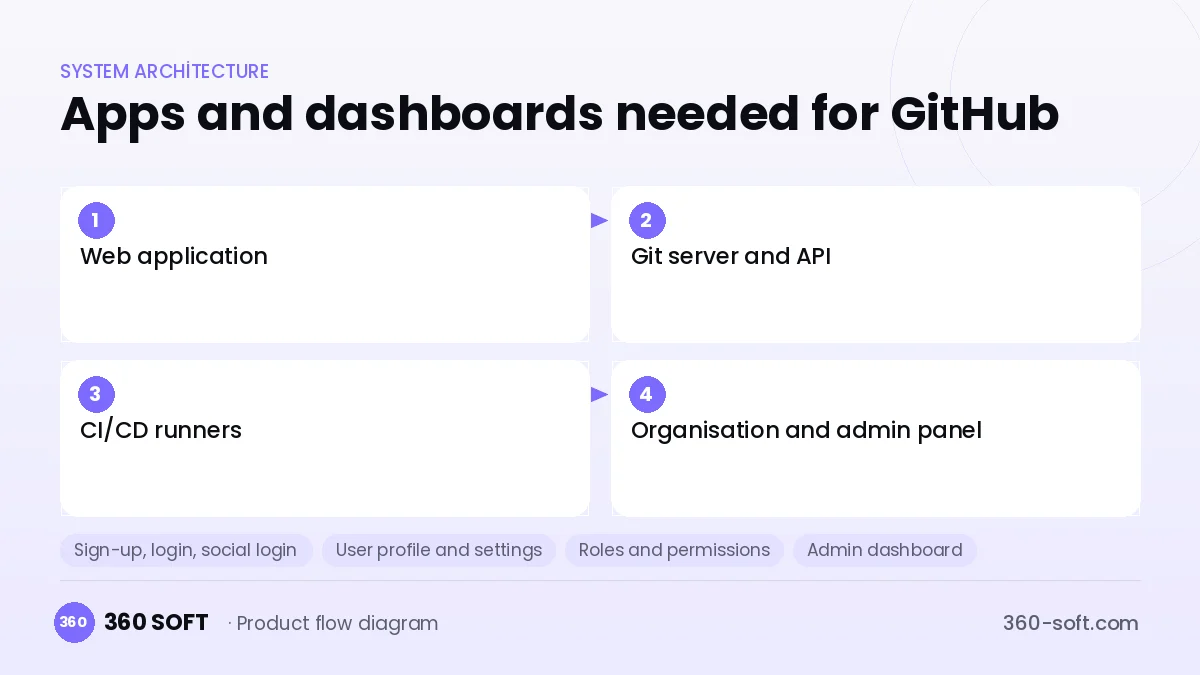
How many apps and dashboards do you need?
Web application
The main interface where developers manage repositories, pull requests, issues and code reviews.
Git server and API
The layer that handles push and pull requests from the command line and IDEs and exposes REST and webhooks to external tools.
CI/CD runners
The infrastructure that runs test, build and deployment workflows in isolated environments on every change.
Organisation and admin panel
The panel for managing teams, roles, billing, security policies and audit logs.
Critical features of a product like GitHub
Pull requests and code review
Line-level comments, suggested changes, required approvals and conflict detection make merging safe.
Branch protection rules
Direct pushes to the main branch are blocked, and you can require passing tests and a set number of approvals.
CI/CD workflows
Workflows defined in YAML run automatically in containers on every push or pull request.
Issues and project boards
Bugs and tasks are tracked with labels, milestones and kanban boards and linked to commits.
Secret scanning
API keys and passwords accidentally committed to a repository are detected automatically and flagged.
Fine-grained permissions
Read, write and admin roles at organisation, team and repository level come with SSO integration.
What goes into the first version, what comes later
First version (MVP)
- Git hosting with SSH and HTTPS access
- Code browsing and diff view
- Pull requests and code review
- Issue tracking
- Organisation, team and permission management
Later releases
- CI/CD runners
- Package registry
- Security scanning and dependency alerts
- Self-hosted version
Modules and how the budget is calculated
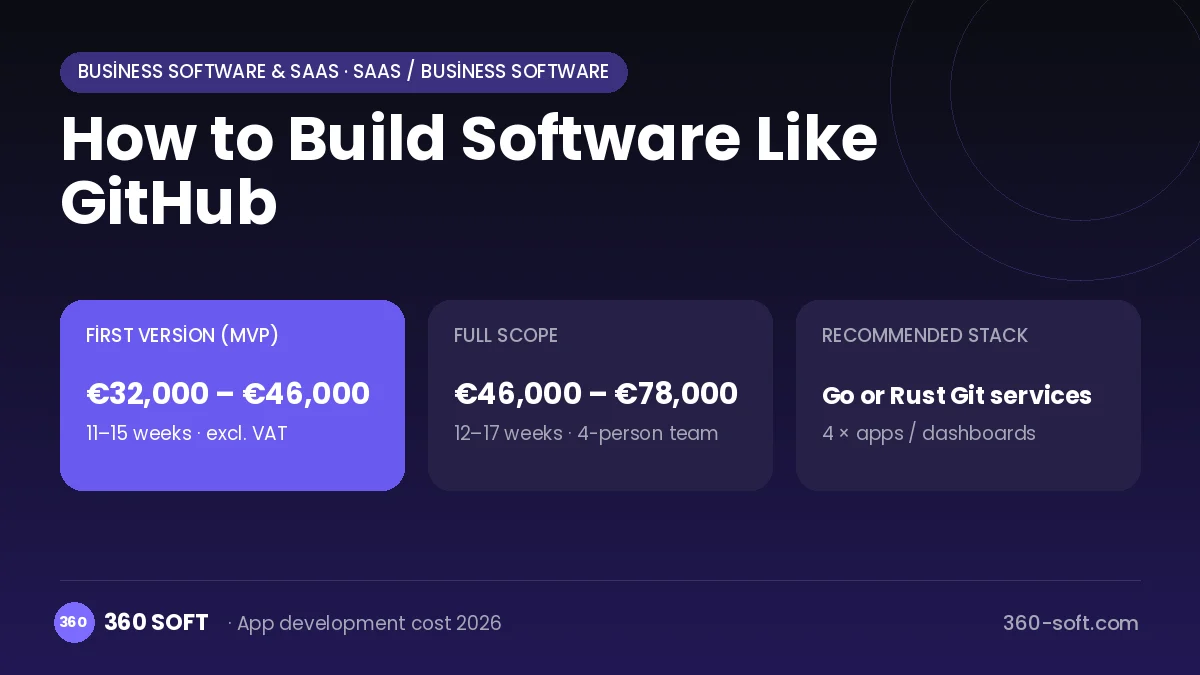
The budget is calculated with 360 SOFT’s pricing model from the modules below, about 34 screens and the project’s complexity: roughly 176 person-days for the full scope and 121 person-days for the first version. Every module you drop lowers the budget directly.
| Module | Phase |
|---|---|
| Sign-up, login, social login | First version |
| User profile and settings | First version |
| Roles and permissions | First version |
| Admin dashboard | First version |
| GDPR and security hardening | First version |
| Third-party API integration | First version |
| Advanced search and filters | First version |
| Email / SMS notifications | First version |
| Subscriptions and recurring billing | First version |
| Online payments (Stripe / PSP) | First version |
| Reporting and analytics | Later release |
| Real-time messaging | First version |
Hosting, SMS, map APIs, app store accounts and payment-provider fees are separate items. Maintenance and improvements (optional): €600 / month. We send a fixed written price within 24 hours after a free discovery call.
The hard parts
Storage and performance
Large repositories, thousands of branches and binary files slow Git operations, so the storage layer needs a custom design.
CI security and cost
Running user code needs isolation, and abuse such as crypto mining and compute costs must be managed.
Trust and continuity
Source code is a company's most valuable asset, so backups, availability and security controls must be flawless.
Business model
A freemium per-seat subscription is the best-fit model: free for individuals and open source, paid plans for teams with advanced permissions and CI minutes. In the enterprise package, SSO, audit logs and self-hosting are sold as a high-value licence. Extra CI minutes, storage and security add-ons are charged on usage.
Get a free quote for your project
Let us scope it together and send a fixed written quote within 24 hours. NDA on request; you own the source code.
Choosing a company to build an app like GitHub
Most people searching “build software like github” are really looking for a reliable app development company. When comparing quotes, check four things:
- Can you try similar products they have shipped, in the stores or live?
- Are the source code, design files, servers and store accounts transferred to you by contract?
- Do they show a working demo every two weeks, with written scope and acceptance criteria?
- Are maintenance, scaling and GDPR/security costs written into the quote?
Copyright and trademarks
A business model and features are generally not protected on their own, but the GitHub name, logo, interface design, content and source code are. That is why we build a product with similar functionality but your own brand, design and code. This is not legal advice; we recommend a trademark search before launch.
Frequently asked questions
How long does it take to build software like GitHub?
A first version with Git hosting, pull requests and issue tracking matures in somewhere between a few months and a year. The CI/CD infrastructure is a separate and extensive project.
Is it possible to start from open source tools?
Open source projects such as Gitea or GitLab can be used as a base within their licence terms. To stand out, though, you need to build features for a niche audience.
Will there be copyright or trademark issues?
The code hosting business model and its features are generally free to use, but the name, logo, design, content and code cannot be copied. This is general information, not legal advice.
What should I look for when choosing a company to build this kind of software?
Choose a team experienced in distributed systems, security and developer tools with a strong DevOps culture, and ask about their approach to scale and isolation.