SaaS / business softwareNews, forums & reviews
Hosted blogging platforms take servers, updates and security off the user's shoulders so they can focus purely on writing. A blog that opens in minutes, ready-made themes, custom domain connection and automatic backups appeal to a wide audience, from personal writers to small businesses. The platform's strength is gathering a large user base with a free start and meeting growing needs with paid plans.
To build something similar you need a multi-tenant architecture that hosts thousands of blogs on a single codebase, a block-based post editor, a theme engine and domain and SSL automation. A user dashboard, subscription billing, a comment spam filter, content moderation and a platform admin panel are added. Customising an existing open-source CMS in multisite mode can be a quicker way to start than writing from scratch.
How Blogging platform works: the core user flow

How many apps and dashboards do you need?
Blog sites
The public sites where readers visit each user's blog with its own theme and domain.
Author dashboard
The control panel where users manage posts, pages, themes, comments and stats.
Platform admin panel
The screen that monitors subscription plans, the theme library, abuse reports and server health.

Critical features of a product like Blogging platform
Block-based editor
Text, image, gallery, code and embed blocks are arranged by drag and drop, and writing works comfortably on mobile too.
Multi-tenant hosting
Thousands of blogs run on one infrastructure with isolated data, with backups and updates handled centrally.
Custom domain and automatic SSL
Users connect their domain, and certificates are issued and renewed automatically.
Theme marketplace
Free and paid themes are previewed and applied in one click, and designers can sell themes.
Newsletter and reader subscriptions
New posts become email newsletters, and authors can open paid reader subscriptions.
Spam and content control
Comment spam is filtered with machine learning, and reports of illegal content are processed quickly.
What goes into the first version, what comes later
First version (MVP)
- Blog creation on a subdomain with a block editor
- Ready-made theme selection and customisation
- Comment system and spam filter
- Custom domain and SSL automation
- Free and paid plan subscriptions
Later releases
- Theme marketplace and designer revenue sharing
- Email newsletter and paid reader subscriptions
- Plugin system and integrations
- AI writing and SEO assistant
Modules and how the budget is calculated
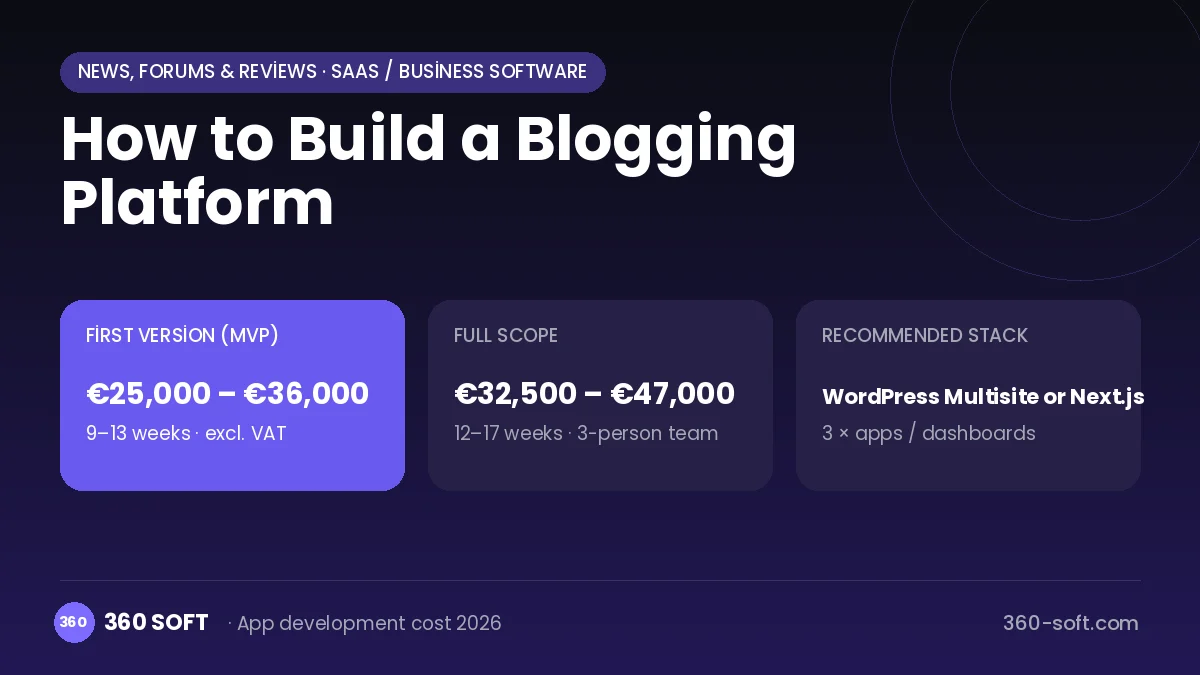
The budget is calculated with 360 SOFT’s pricing model from the modules below, about 24 screens and the project’s complexity: roughly 124 person-days for the full scope and 94 person-days for the first version. Every module you drop lowers the budget directly.
| Module | Phase |
|---|---|
| Sign-up, login, social login | First version |
| User profile and settings | First version |
| Roles and permissions | First version |
| Admin dashboard | First version |
| Content management / blog | First version |
| File, photo, video upload | First version |
| Subscriptions and recurring billing | Later release |
| Online payments (Stripe / PSP) | First version |
| Ratings and reviews | First version |
| GDPR and security hardening | First version |
| Advanced search and filters | First version |
| Third-party API integration | First version |
Hosting, SMS, map APIs, app store accounts and payment-provider fees are separate items. Maintenance and improvements (optional): €450 / month. We send a fixed written price within 24 hours after a free discovery call.
The hard parts
Multi-tenant security
Data isolation, permission checks and resource limits must be designed carefully so a flaw in one blog does not affect the others.
Abuse
Free blogs can be used for spam, phishing and illegal content, so automated scanning and fast takedown are essential.
Scale and cost
The hosting cost of free users must be balanced by paid conversion, and caching and static page generation keep costs down.
Business model
A freemium model is essential: free blogs show platform ads, while paid plans remove ads and offer custom domains, advanced themes and storage. Domain sales, theme marketplace commission and a share of authors' paid reader subscriptions add revenue. Business plans for companies can be added too.
Get a free quote for your project
Let us scope it together and send a fixed written quote within 24 hours. NDA on request; you own the source code.
Choosing a company to build an app like Blogging platform
Most people searching “build a blogging platform” are really looking for a reliable app development company. When comparing quotes, check four things:
- Can you try similar products they have shipped, in the stores or live?
- Are the source code, design files, servers and store accounts transferred to you by contract?
- Do they show a working demo every two weeks, with written scope and acceptance criteria?
- Are maintenance, scaling and GDPR/security costs written into the quote?
Copyright and trademarks
A business model and features are generally not protected on their own, but the Blogging platform name, logo, interface design, content and source code are. That is why we build a product with similar functionality but your own brand, design and code. This is not legal advice; we recommend a trademark search before launch.
Frequently asked questions
How long does it take to build a blogging platform?
A first version with blog creation, an editor, themes and subscriptions can be ready in a few months. Building on an open-source CMS shortens the timeline considerably.
Should I build from scratch or use open source?
An open-source multisite foundation gives a quick start and a wide plugin ecosystem. If you want a highly original experience or top performance, a custom architecture is a better fit.
Who is responsible for content users write?
Platforms generally act as hosting providers and must remove unlawful content once notified. Terms of use and the notice process should be prepared with a lawyer.
What should I look for in a software company?
Look for multi-tenant SaaS architecture, automated domain management and security experience. Who is responsible for hosting and maintenance should be clear in the contract.