Web platformNews, forums & reviewsOriginal by Medium
Medium is a clean publishing platform where writers can find readers without the hassle of running their own blog. A distraction-free reading experience, an editor that makes writing enjoyable and a recommendation system mean even a brand-new writer can reach an audience with a first post. As readers follow topics and authors the feed becomes personal, and paid membership gives good writers a revenue loop.
Building something similar takes a rich yet minimal block-based editor, author profiles, publications with editor roles, and tags and following logic. Behind the scenes run a recommendation engine based on reading time, a paywall, subscription infrastructure and revenue sharing for writers. SEO-friendly pages, custom domain support and spam control are also essential for the platform's credibility.
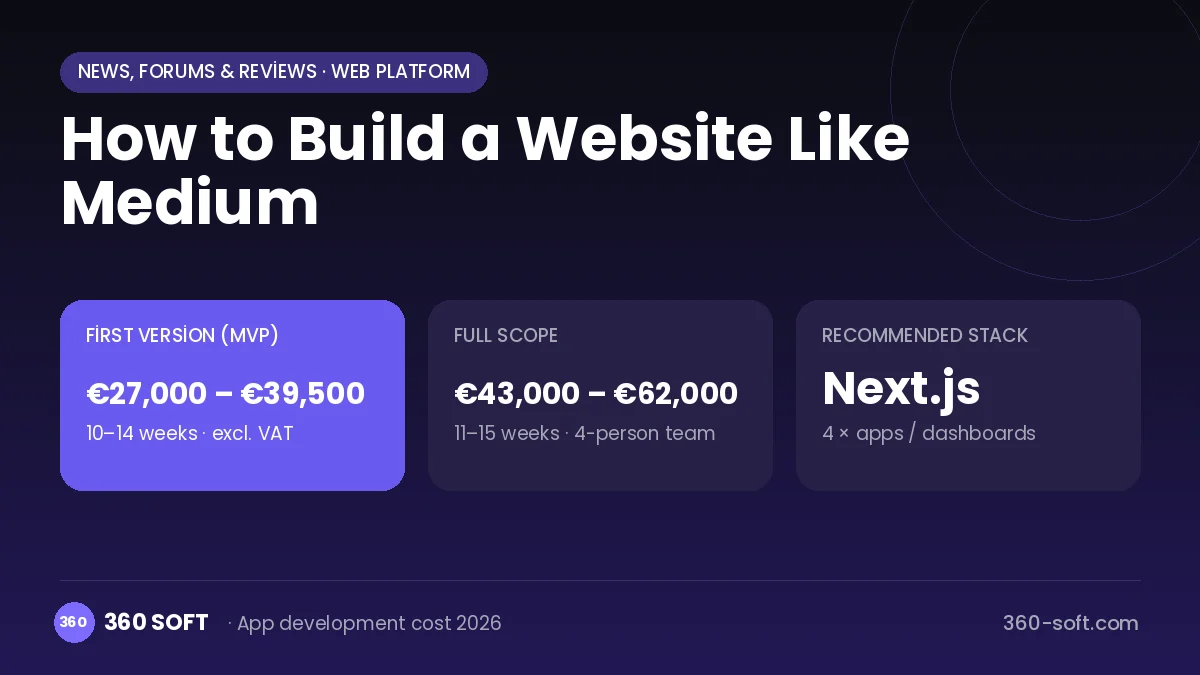
How Medium works: the core user flow
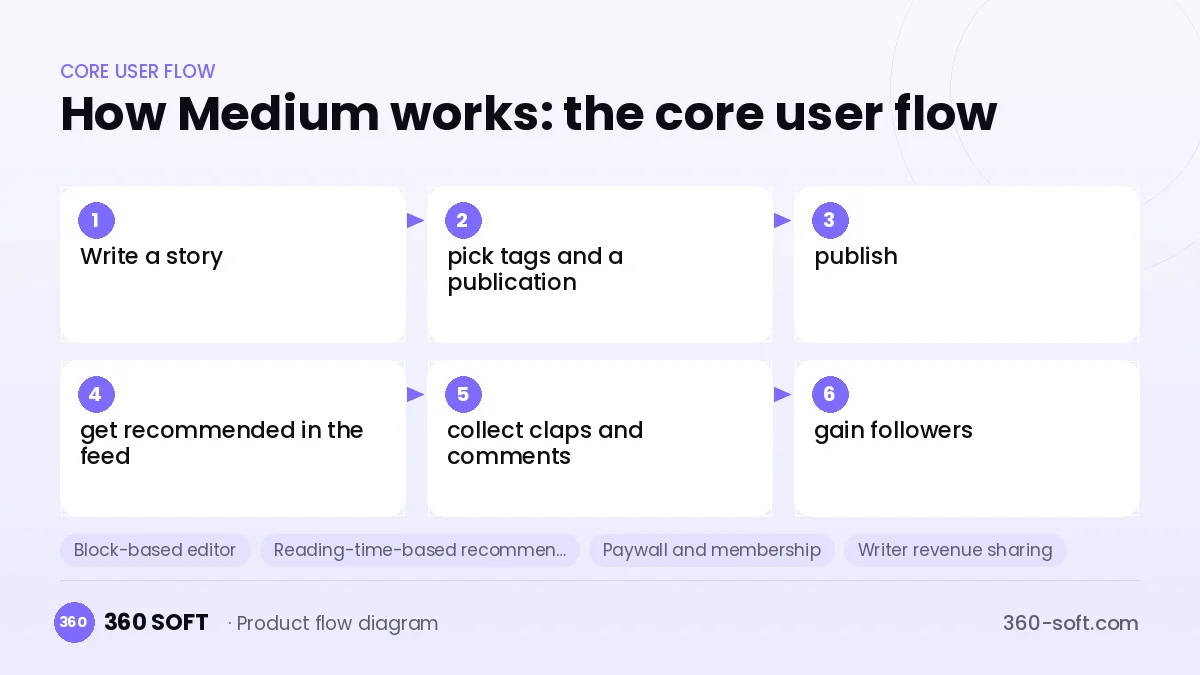
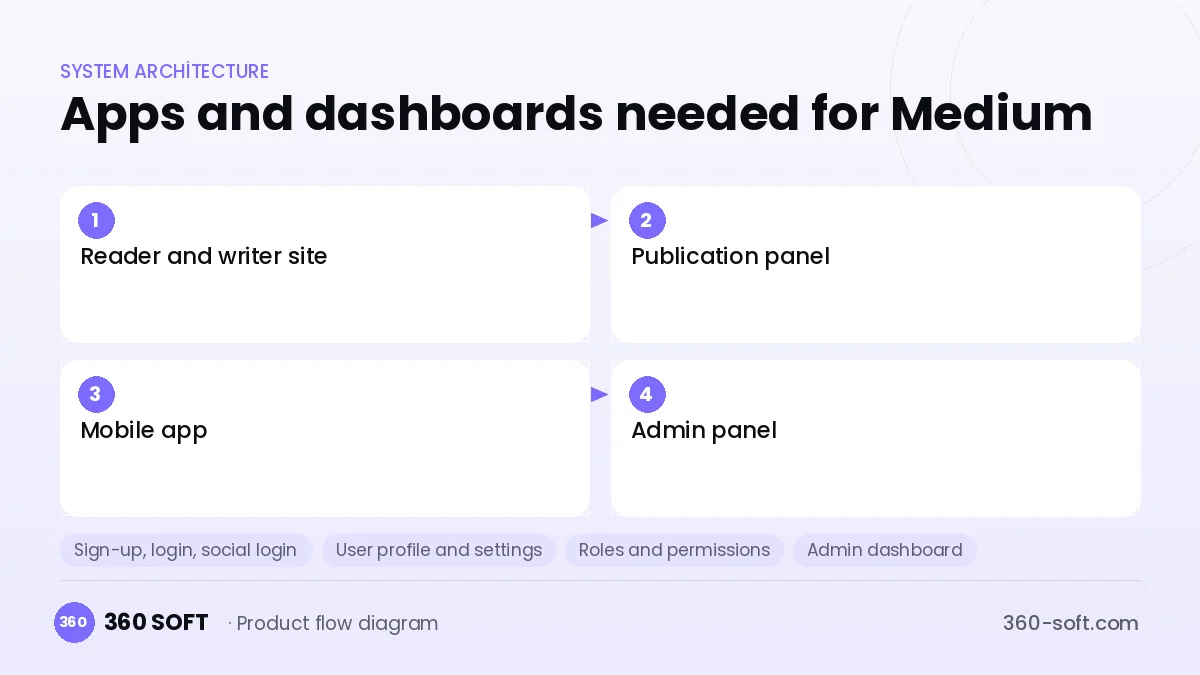
How many apps and dashboards do you need?
Reader and writer site
The main web app where readers discover stories and writers draft and publish with the editor.
Publication panel
The screen where editors review and approve submissions for magazine-style publications.
Mobile app
The app that builds a daily reading habit with reading lists, offline reading and notifications.
Admin panel
The internal panel that manages memberships, writer payouts, spam control and recommendation settings.
Critical features of a product like Medium
Block-based editor
Headings, quotes, code blocks, images and embeds are added through a minimal interface, and drafts save automatically.
Reading-time-based recommendations
The system measures how much of each story a reader actually reads; real reading, not clicks, drives the ranking.
Paywall and membership
Writers make selected stories members-only, and non-members can read a limited number of free stories each month.
Writer revenue sharing
A portion of membership revenue is shared with writers according to members' reading time and reported monthly.
Publications and editor workflow
Submission, editing and approval steps are managed for publications with several contributing writers.
Highlights and notes
Readers can highlight sentences and take notes, and the most highlighted sentences are surfaced in the story.
What goes into the first version, what comes later
First version (MVP)
- Block editor and draft management
- Author profiles, following and tags
- Main feed and a simple recommendation system
- Claps, comments and reading list
- SEO-friendly story pages
Later releases
- Paid membership and paywall
- Revenue sharing for writers
- Publications and editor roles
- Mobile app and offline reading
Modules and how the budget is calculated
The budget is calculated with 360 SOFT’s pricing model from the modules below, about 26 screens and the project’s complexity: roughly 164 person-days for the full scope and 104 person-days for the first version. Every module you drop lowers the budget directly.
| Module | Phase |
|---|---|
| Sign-up, login, social login | First version |
| User profile and settings | First version |
| Roles and permissions | First version |
| Admin dashboard | First version |
| Content management / blog | First version |
| Advanced search and filters | First version |
| Subscriptions and recurring billing | First version |
| Online payments (Stripe / PSP) | First version |
| Ratings and reviews | First version |
| Push notifications | First version |
| AI features (LLM, RAG, recommendations) | Later release |
| Reporting and analytics | Later release |
| Offline mode and sync | First version |
Hosting, SMS, map APIs, app store accounts and payment-provider fees are separate items. Maintenance and improvements (optional): €550 / month. We send a fixed written price within 24 hours after a free discovery call.
The hard parts
Recommendation quality
Data is thin at launch; poor recommendations drive readers away, and rewarding clickbait erodes quality.
Spam and duplicate content
Automated or copied posts written for SEO damage the platform's reputation, so detection and removal processes are needed.
Fair revenue distribution
Building a payout model that is transparent, tax-compliant and protected against reading-time manipulation is hard.
Business model
The best-fit model is a monthly or annual reader membership: limited free reading for non-members and unlimited access for members. Part of the revenue goes to writers based on reading time, which encourages quality content. Corporate blog hosting, custom domains and team plans can be additional subscription items.
Get a free quote for your project
Let us scope it together and send a fixed written quote within 24 hours. NDA on request; you own the source code.
Choosing a company to build an app like Medium
Most people searching “website like medium” are really looking for a reliable app development company. When comparing quotes, check four things:
- Can you try similar products they have shipped, in the stores or live?
- Are the source code, design files, servers and store accounts transferred to you by contract?
- Do they show a working demo every two weeks, with written scope and acceptance criteria?
- Are maintenance, scaling and GDPR/security costs written into the quote?
Copyright and trademarks
A business model and features are generally not protected on their own, but the Medium name, logo, interface design, content and source code are. That is why we build a product with similar functionality but your own brand, design and code. This is not legal advice; we recommend a trademark search before launch.
Frequently asked questions
How long does it take to build a site like Medium?
A first version with the editor, profiles, following and feed is ready in a few months. Paid membership and writer revenue sharing usually go live in the second phase.
What is needed to pay writers?
For revenue sharing you need to settle writers' tax status, invoicing or self-billing processes and the payment institution setup. Working with licensed payment providers such as Stripe Connect is the safest route.
Will there be copyright or trademark issues?
The publishing platform model and its features are generally free to use, but the name, logo, design, content and code cannot be copied. This is general information, not legal advice.
What should I look for when choosing a company to build a site like Medium?
Ask about rich text editor development, recommendation systems and subscription infrastructure, and request references on SEO performance.