Web platformEducation & e-learning
Private tutoring platforms connect students and parents with the right tutor by subject, city and budget, much like Superprof or Tutorful. Tutors create profiles across a wide range, from maths to piano and from exam preparation to foreign languages; parents decide after seeing experience, rates, reviews and in-person or online options. Trustworthy profiles and fast communication bring a tutoring market traditionally driven by flyers and word of mouth online.
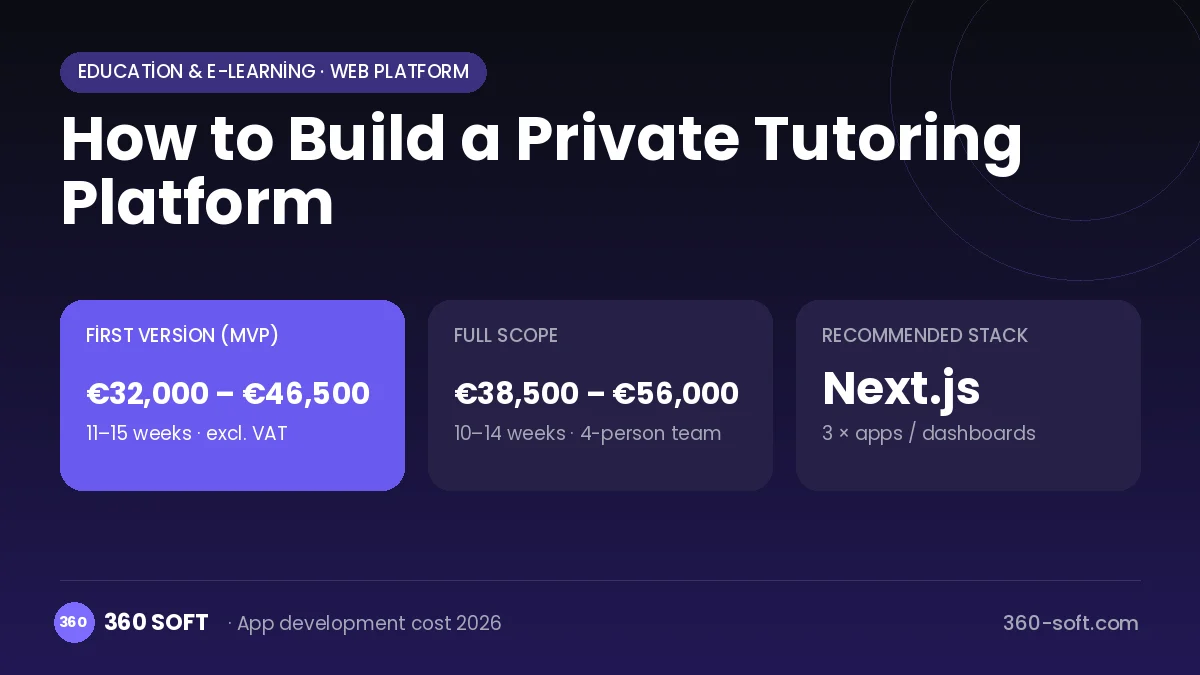
Building something similar requires a tutor profile and listing system, search by subject, city and district, student lesson requests with tutor offers, messaging, a tutor panel and an admin panel. If online lessons are offered, calendar, booking and video lesson integration are added. Structuring pages around searches like “[subject] tutor in [area]” with SEO in mind is the main growth engine.
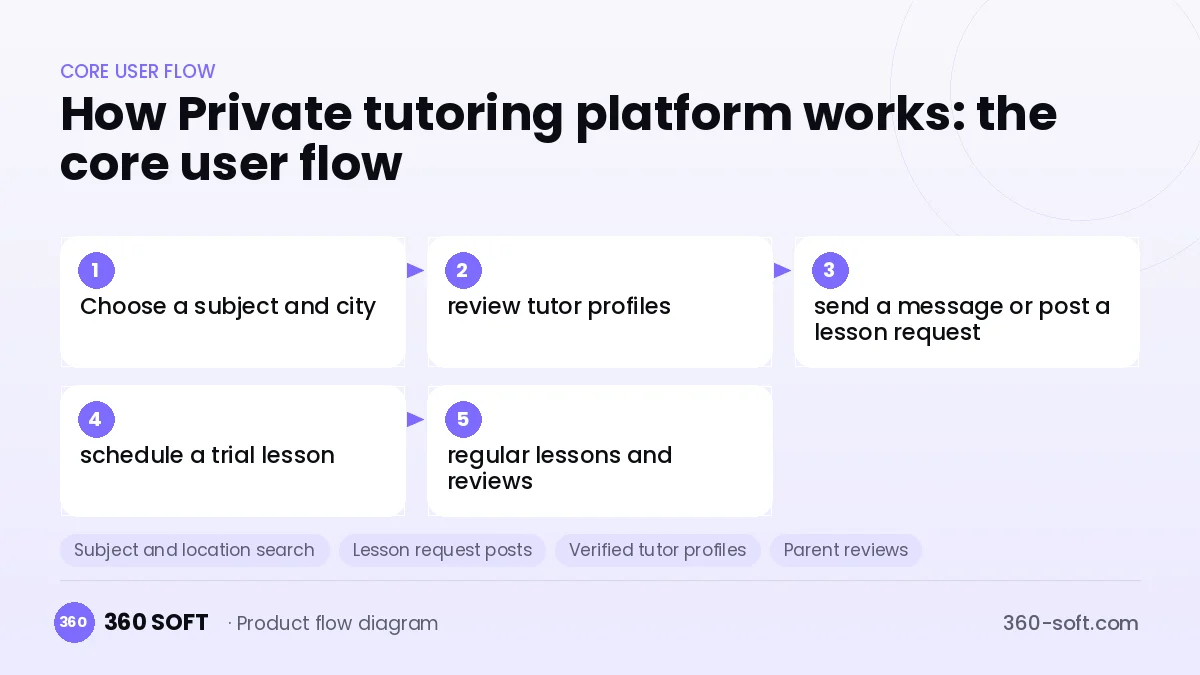
How Private tutoring platform works: the core user flow
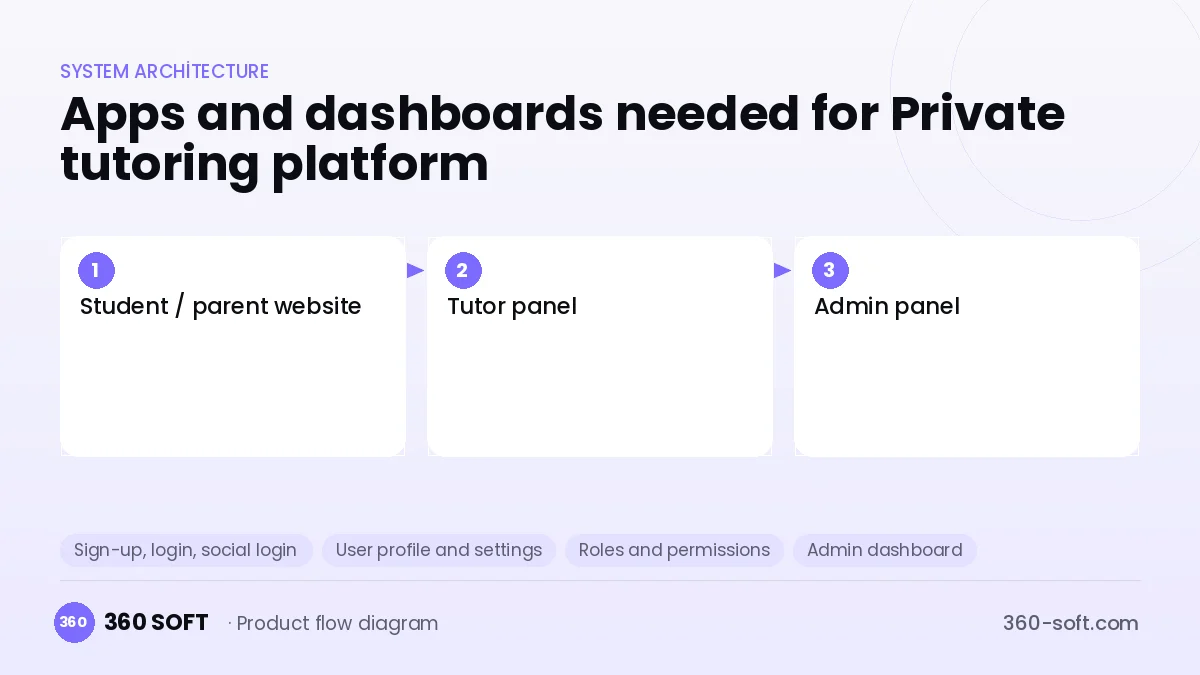
How many apps and dashboards do you need?
Student / parent website
Students and parents search for tutors, compare them, send messages or post lesson requests.
Tutor panel
Tutors manage their profile, subjects, rates, offers on requests and membership plans.
Admin panel
The team manages tutor approval, document checks, complaints, packages and SEO pages.
Critical features of a product like Private tutoring platform
Subject and location search
Tutors are listed with filters for subject, level, city, district and in-person/online.
Lesson request posts
Students post their needs as a request; tutors in the relevant subject and area send offers.
Verified tutor profiles
Tutors whose degrees, certificates and identity have been checked are shown with a badge.
Parent reviews
Students and parents who have taken lessons leave ratings and reviews linked to a real lesson relationship.
Online lesson support
A time is picked from the calendar and booked; a video lesson link is created automatically.
SEO-focused list pages
Pages are generated automatically for city-district-subject combinations such as “maths tutor in Camden”.
What goes into the first version, what comes later
First version (MVP)
- Tutor sign-up, profile and subject selection
- Search by subject and city, with SEO list pages
- Messaging and lesson request form
- Tutor membership plans and online payment
- Tutor approval and admin panel
Later releases
- Calendar-based online lesson booking and video lessons
- Collecting lesson fees through the platform
- Lesson bundles and homework/progress tracking
- Mobile app
Modules and how the budget is calculated
The budget is calculated with 360 SOFT’s pricing model from the modules below, about 24 screens and the project’s complexity: roughly 147 person-days for the full scope and 122 person-days for the first version. Every module you drop lowers the budget directly.
| Module | Phase |
|---|---|
| Sign-up, login, social login | First version |
| User profile and settings | First version |
| Roles and permissions | First version |
| Admin dashboard | First version |
| Advanced search and filters | First version |
| Real-time messaging | First version |
| Online payments (Stripe / PSP) | First version |
| Subscriptions and recurring billing | First version |
| Ratings and reviews | First version |
| Booking / reservations | First version |
| Video / voice calls | First version |
| Email / SMS notifications | First version |
| Content management / blog | First version |
Hosting, SMS, map APIs, app store accounts and payment-provider fees are separate items. Maintenance and improvements (optional): €500 / month. We send a fixed written price within 24 hours after a free discovery call.
The hard parts
Child safety
Parental consent, tutor verification (such as DBS-style background checks) and message monitoring must be designed meticulously for communication with minors.
Off-platform leakage
After the first contact, the tutoring relationship continues off-platform; a tutor subscription may be more sustainable than commission.
Profile quality
Incomplete profiles without photos lower conversion; profile completion prompts and a quality score are needed.
Business model
Keeping the student side free and selling monthly or annual membership plans to tutors is the most common model. Profile boosts, offer credits for lesson requests and, if lesson fees are collected through the platform for online lessons, a per-lesson commission complete the model. If payments are collected, a licensed payment provider's infrastructure should be used.
Get a free quote for your project
Let us scope it together and send a fixed written quote within 24 hours. NDA on request; you own the source code.
Choosing a company to build an app like Private tutoring platform
Most people searching “build a private tutoring website” are really looking for a reliable app development company. When comparing quotes, check four things:
- Can you try similar products they have shipped, in the stores or live?
- Are the source code, design files, servers and store accounts transferred to you by contract?
- Do they show a working demo every two weeks, with written scope and acceptance criteria?
- Are maintenance, scaling and GDPR/security costs written into the quote?
Copyright and trademarks
A business model and features are generally not protected on their own, but the Private tutoring platform name, logo, interface design, content and source code are. That is why we build a product with similar functionality but your own brand, design and code. This is not legal advice; we recommend a trademark search before launch.
Frequently asked questions
How long does it take to build a private tutoring platform?
A first version with tutor profiles, search, messaging and membership plans can go live relatively quickly. Online lessons and payment collection are a second phase.
Is commission or membership the better model?
For in-person lessons the relationship continues off-platform, so tutor membership is more sustainable. For online lessons, where payment stays on the platform, a commission model can work.
Off-the-shelf script or custom software?
Ready-made classifieds scripts can cover the basics but fall short on SEO page structure, parental consent and online lessons. If you are aiming for growth, custom software is more flexible.
Are there copyright or trademark issues?
The private tutoring platform model is free to use; another platform's name, logo, design, content and code cannot be copied. This is not legal advice.