Web platformSocial media & communityOriginal by Adobe
Behance is a portfolio network where designers, illustrators and photographers present their work as projects with a story rather than as single images. A project page tells the process, the sketches and the final result together, and likes, follows and editorial picks give creators visibility. For agencies and employers it has become one of the fastest ways to look for talent.
Building something similar takes a project editor that combines image, video and text blocks, a media infrastructure that serves high-resolution images fast, and a discovery system by field, tool and colour. On top you build creator profiles, following and feeds, a panel for editorial picks, job listings and direct contact with employers. Watermarking and reporting processes against image theft should be planned too.
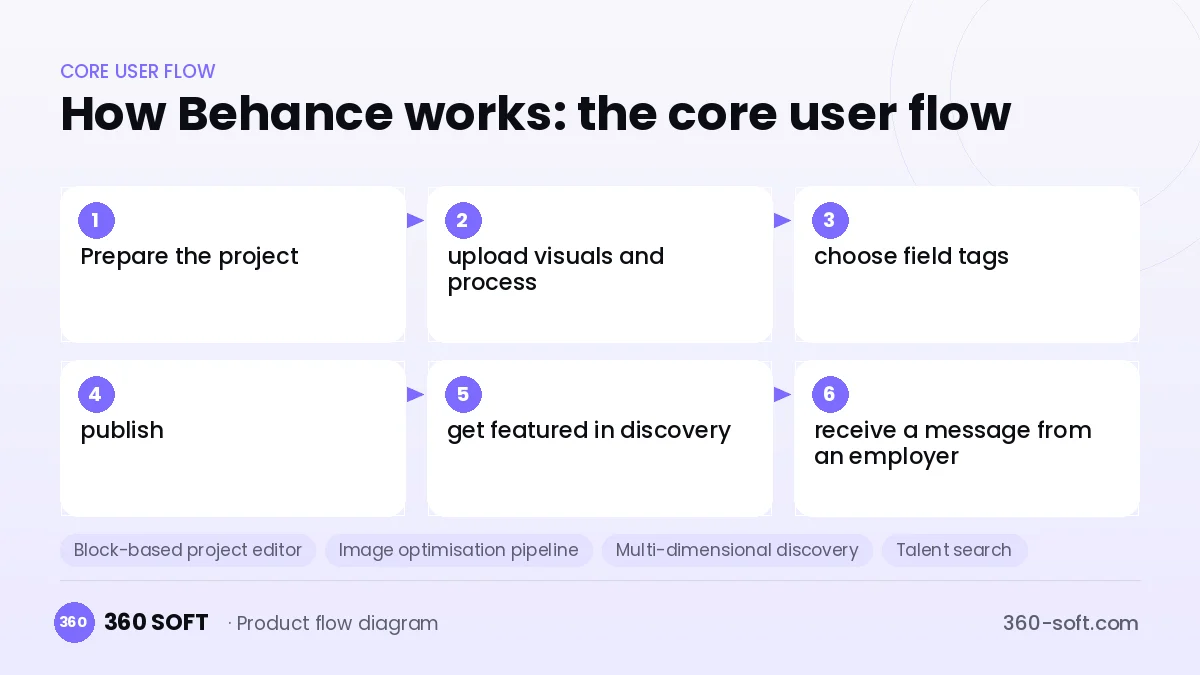
How Behance works: the core user flow
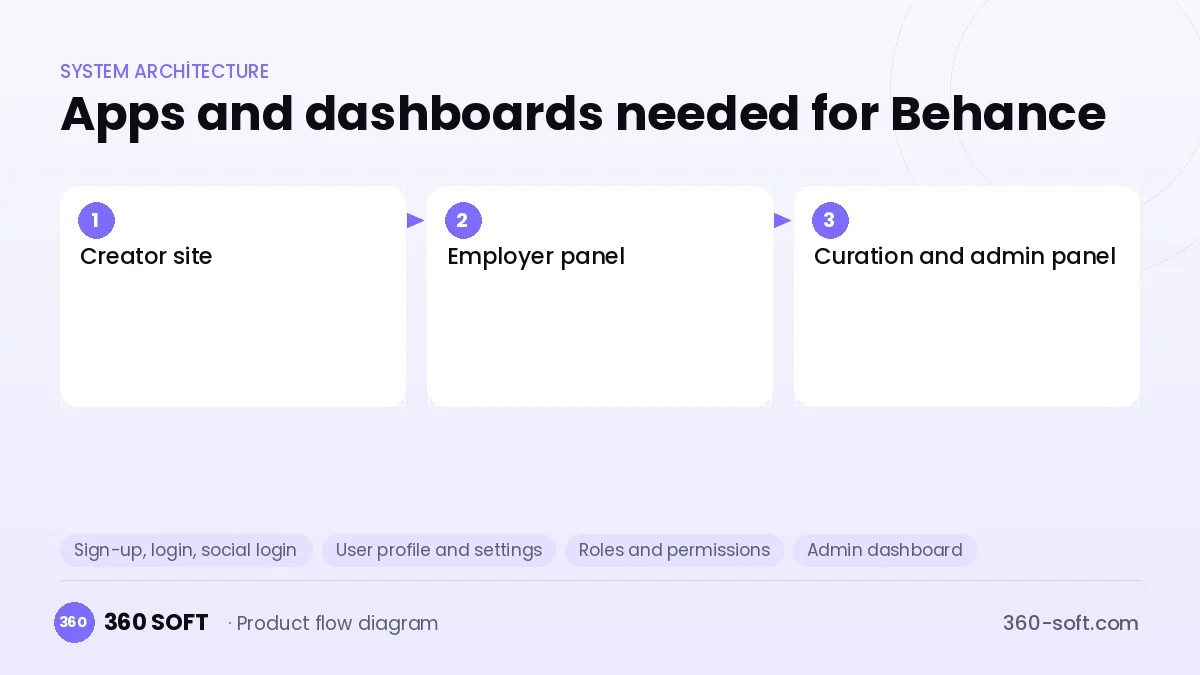
How many apps and dashboards do you need?
Creator site
The web interface where creators upload projects, manage their portfolio and explore other work.
Employer panel
The panel where agencies and companies search for talent, post jobs and contact creators.
Curation and admin panel
The internal panel where editors pick featured projects and manage reports and listing payments.
Critical features of a product like Behance
Block-based project editor
Image, video, GIF, text and embedded prototype blocks are combined on a single project page by drag and drop.
Image optimisation pipeline
Uploaded files are automatically converted to different sizes and formats and served quickly through a CDN.
Multi-dimensional discovery
Projects are filtered by field, tools used, colour palette and location, while editorial picks sit in a separate feed.
Talent search
Employers filter creators by skill, city, availability and experience and build shortlists.
Job listings and applications
Full-time or freelance jobs are published, and creators apply in one click with their portfolio.
Copyright protection
Licence type selection, right-click blocking, watermarks and a copied-content report form protect the creator's work.
What goes into the first version, what comes later
First version (MVP)
- Creator profile and project editor
- Image upload and automatic optimisation
- Likes, follows and comments
- Field-based discovery and search
- Editorial picks panel
Later releases
- Job listings and application system
- Employer talent search panel
- Mobile app
- Paid premium portfolio features
Modules and how the budget is calculated
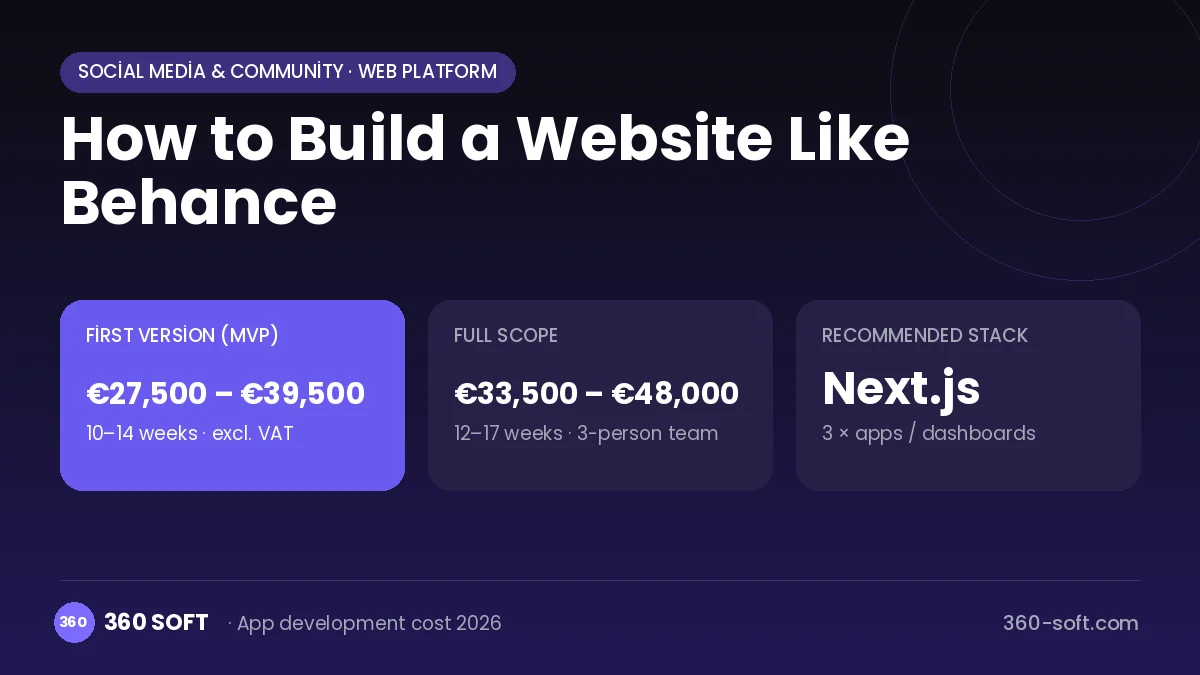
The budget is calculated with 360 SOFT’s pricing model from the modules below, about 24 screens and the project’s complexity: roughly 127 person-days for the full scope and 104 person-days for the first version. Every module you drop lowers the budget directly.
| Module | Phase |
|---|---|
| Sign-up, login, social login | First version |
| User profile and settings | First version |
| Roles and permissions | First version |
| Admin dashboard | First version |
| File, photo, video upload | First version |
| Advanced search and filters | First version |
| Ratings and reviews | First version |
| Real-time messaging | First version |
| Email / SMS notifications | First version |
| Online payments (Stripe / PSP) | First version |
| Subscriptions and recurring billing | First version |
| Content management / blog | First version |
Hosting, SMS, map APIs, app store accounts and payment-provider fees are separate items. Maintenance and improvements (optional): €450 / month. We send a fixed written price within 24 hours after a free discovery call.
The hard parts
Media costs
Storage and bandwidth costs for high-resolution images and videos grow quickly, so smart compression is needed.
Discovery quality
If only popular projects get featured, new creators walk away; curation and the algorithm must be balanced.
Unauthorised copying
Uploading other people's work undermines the platform's credibility, so reporting and takedown must be quick.
Business model
Portfolio publishing can stay free while revenue comes from the employer side: paid job listings, featured listings and a talent search subscription. A premium membership with custom domains, advanced statistics and sales features can be added for creators. Commission on digital product or freelance payments can be a second revenue line.
Get a free quote for your project
Let us scope it together and send a fixed written quote within 24 hours. NDA on request; you own the source code.
Choosing a company to build an app like Behance
Most people searching “website like behance” are really looking for a reliable app development company. When comparing quotes, check four things:
- Can you try similar products they have shipped, in the stores or live?
- Are the source code, design files, servers and store accounts transferred to you by contract?
- Do they show a working demo every two weeks, with written scope and acceptance criteria?
- Are maintenance, scaling and GDPR/security costs written into the quote?
Copyright and trademarks
A business model and features are generally not protected on their own, but the Behance name, logo, interface design, content and source code are. That is why we build a product with similar functionality but your own brand, design and code. This is not legal advice; we recommend a trademark search before launch.
Frequently asked questions
How long does it take to build a site like Behance?
A first version with profiles, a project editor, image infrastructure and discovery can go live in a few months. Job listings and the employer panel are usually added in the second phase.
Does a niche portfolio site make sense?
Focusing on a narrow field such as architecture, fashion or game art makes it easier to compete with general platforms. Filters and job opportunities tailored to the audience make the difference.
Will there be copyright or trademark issues?
The portfolio platform business model is generally free to use, but the name, logo, design, content and code cannot be copied. This is general information, not legal advice.
What should I look for when choosing a company to build a portfolio site?
Choose a team that works with large media files, understands image performance and CDN optimisation, and can design a clean but powerful interface.