Web platformSocial media & communityOriginal by Dribbble
Dribbble began as a showcase where designers share small, striking slices of their work, known as "shots". Its community focused on interface design, icons and illustration quickly grew into a source of inspiration and a marketplace for finding designers. Companies discover designers here and contact them directly, while designers turn the visibility they gain into new clients and steady work.
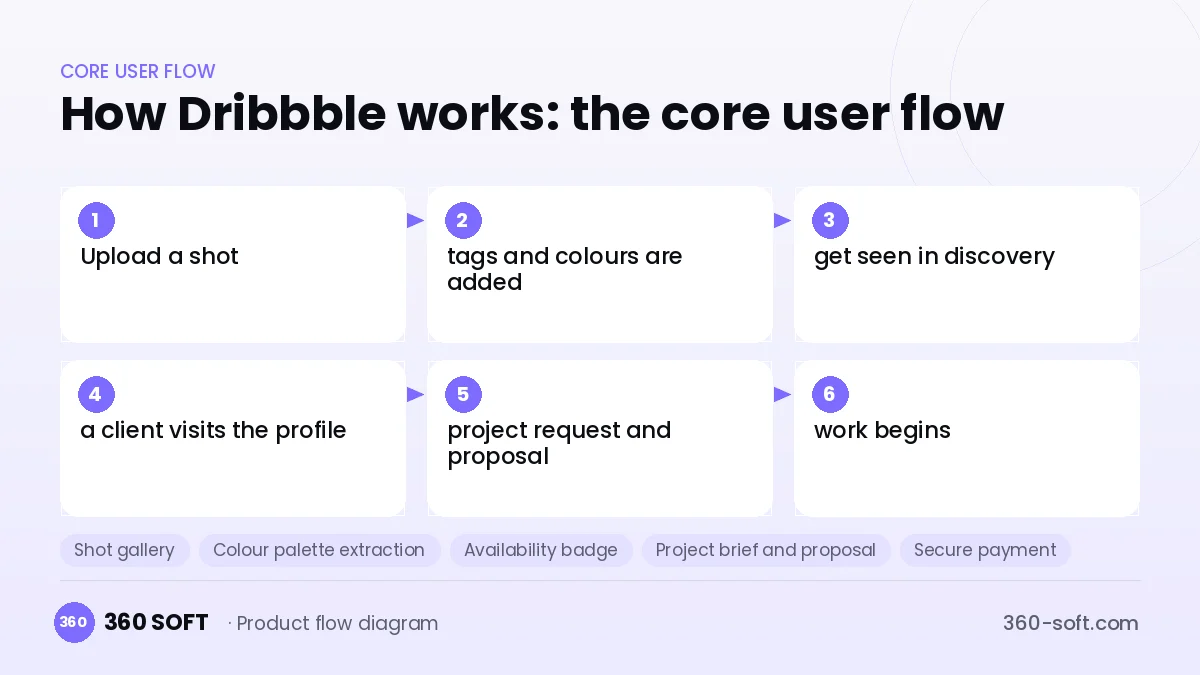
Building something similar takes a fast grid-style gallery, shot uploads with colour palette extraction, tag-based discovery and designer profiles. The real business value sits on the hiring and project request side: a client posts a brief, suitable designers send proposals and payment moves forward securely. That makes messaging, proposals, payments and subscription infrastructure part of the product too.
How Dribbble works: the core user flow
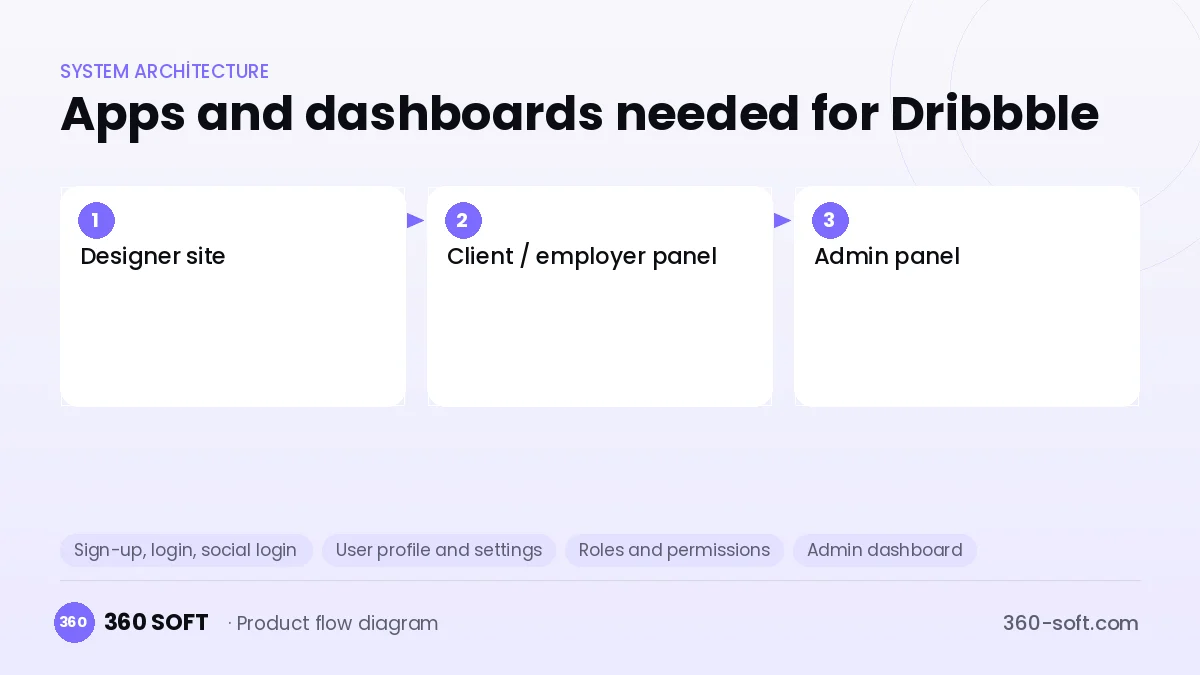
How many apps and dashboards do you need?
Designer site
The web interface where designers upload shots, build a portfolio, look for inspiration and answer incoming requests.
Client / employer panel
The panel where companies search for designers, post project briefs and compare proposals.
Admin panel
The internal panel that manages featured shots, subscriptions, payments and community reports.
Critical features of a product like Dribbble
Shot gallery
Square and portrait works appear in a grid layout, with animated GIF and short video support.
Colour palette extraction
Dominant colours are extracted from the uploaded image automatically, so users can search by colour.
Availability badge
Designers state on their profile that they are open to new work, and stand out in client filters.
Project brief and proposal
A client opens a request with a budget range and scope, and designers reply with messages and proposals.
Secure payment
Project payment is held by a licensed payment institution and released to the designer once delivery is approved.
Pro subscription
Designers subscribe for unlimited uploads, statistics and a boost in search results.
What goes into the first version, what comes later
First version (MVP)
- Shot upload and gallery
- Designer profile and following
- Discovery by tag and colour
- Client-to-designer messaging
- Pro designer subscription
Later releases
- Project brief and proposal system
- Secure payment and delivery approval
- Job board
- Design resources and digital product sales
Modules and how the budget is calculated
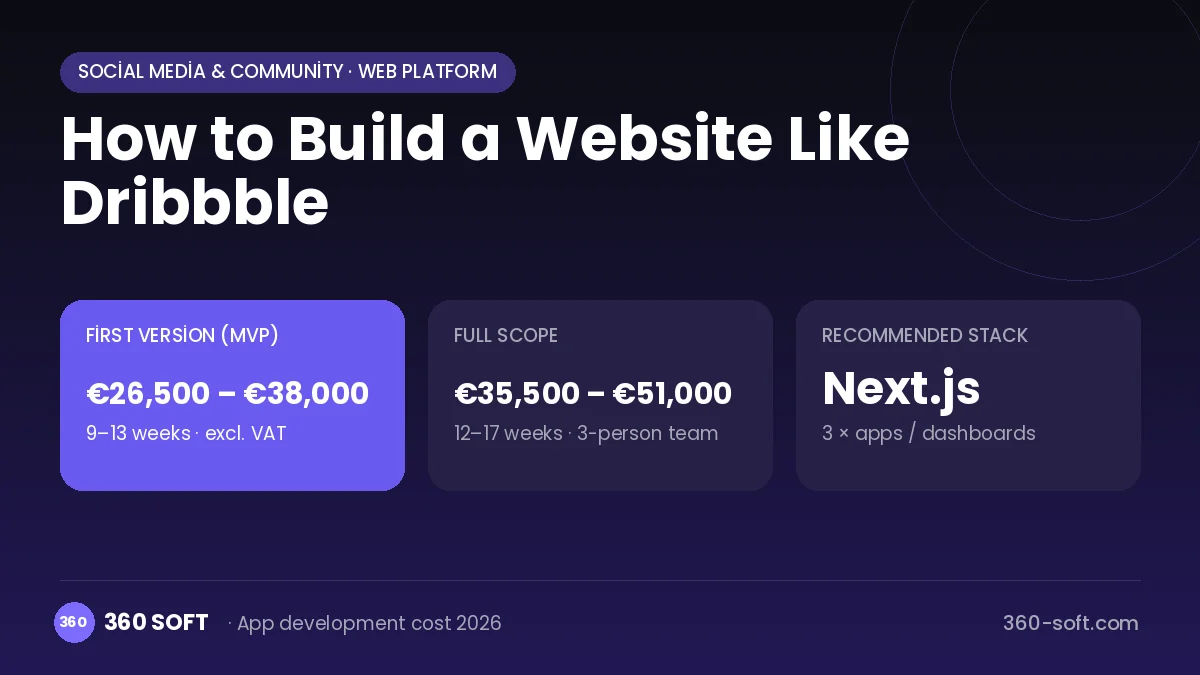
The budget is calculated with 360 SOFT’s pricing model from the modules below, about 24 screens and the project’s complexity: roughly 135 person-days for the full scope and 101 person-days for the first version. Every module you drop lowers the budget directly.
| Module | Phase |
|---|---|
| Sign-up, login, social login | First version |
| User profile and settings | First version |
| Roles and permissions | First version |
| Admin dashboard | First version |
| File, photo, video upload | First version |
| Advanced search and filters | First version |
| Real-time messaging | First version |
| Online payments (Stripe / PSP) | First version |
| Subscriptions and recurring billing | First version |
| Marketplace integration (Amazon, etc.) | Later release |
| Ratings and reviews | First version |
| Email / SMS notifications | First version |
Hosting, SMS, map APIs, app store accounts and payment-provider fees are separate items. Maintenance and improvements (optional): €450 / month. We send a fixed written price within 24 hours after a free discovery call.
The hard parts
Two-sided marketplace balance
If clients do not show up, designers will not subscribe, and without designers clients will not come, so the launch strategy is critical.
Payment intermediation
Holding and distributing project payments can require a licence, so use marketplace solutions from licensed providers such as Stripe Connect.
Leakage off the platform
Clients and designers can strike a deal outside after the first message, so you need to offer assurance and tools that add real value.
Business model
The best-fit model combines a pro subscription on the designer side with paid job listings on the client side and a commission on project payments. Featured profiles, sponsored design resources and design contests opened by brands add further revenue. If project payments run through a licensed payment institution, the platform commission can be separated out safely.
Get a free quote for your project
Let us scope it together and send a fixed written quote within 24 hours. NDA on request; you own the source code.
Choosing a company to build an app like Dribbble
Most people searching “website like dribbble” are really looking for a reliable app development company. When comparing quotes, check four things:
- Can you try similar products they have shipped, in the stores or live?
- Are the source code, design files, servers and store accounts transferred to you by contract?
- Do they show a working demo every two weeks, with written scope and acceptance criteria?
- Are maintenance, scaling and GDPR/security costs written into the quote?
Copyright and trademarks
A business model and features are generally not protected on their own, but the Dribbble name, logo, interface design, content and source code are. That is why we build a product with similar functionality but your own brand, design and code. This is not legal advice; we recommend a trademark search before launch.
Frequently asked questions
How long does it take to build a site like Dribbble?
A first version with a shot gallery, profiles, discovery and messaging takes a few months. The proposal and secure payment system goes live in the second stage.
Can the platform hold project payments?
Collecting and distributing payments on behalf of others can require a payment institution licence. That is why marketplace and sub-merchant solutions from licensed payment providers are preferred.
Will there be copyright or trademark issues?
The design showcase business model is generally free to use, but the name, logo, design, content and code cannot be copied. This is general information, not legal advice.
What should I look for when choosing a company to build a site like Dribbble?
Choose a team with experience in image-heavy galleries, marketplace payment flows and subscription systems, and pay special attention to interface quality.