Mobile appSocial media & communityOriginal by Meetup
Meetup brings people with shared interests together from online groups into in-person meetups. Developer meetups, running groups, book clubs and language practice communities all run regular events here, and someone who has just moved to a new city finds a fitting community in a few minutes. The value of the model is the lively community network created by group organisers who keep hosting events.
To build something similar you need group creation and membership management, an events and RSVP system, in-group chat and announcements, discovery by location and interest, and organiser tools. Because it is a platform where strangers meet in person, user reports, blocking, content moderation, age limits and compliance with app store rules must be designed in from the start for a safe community.
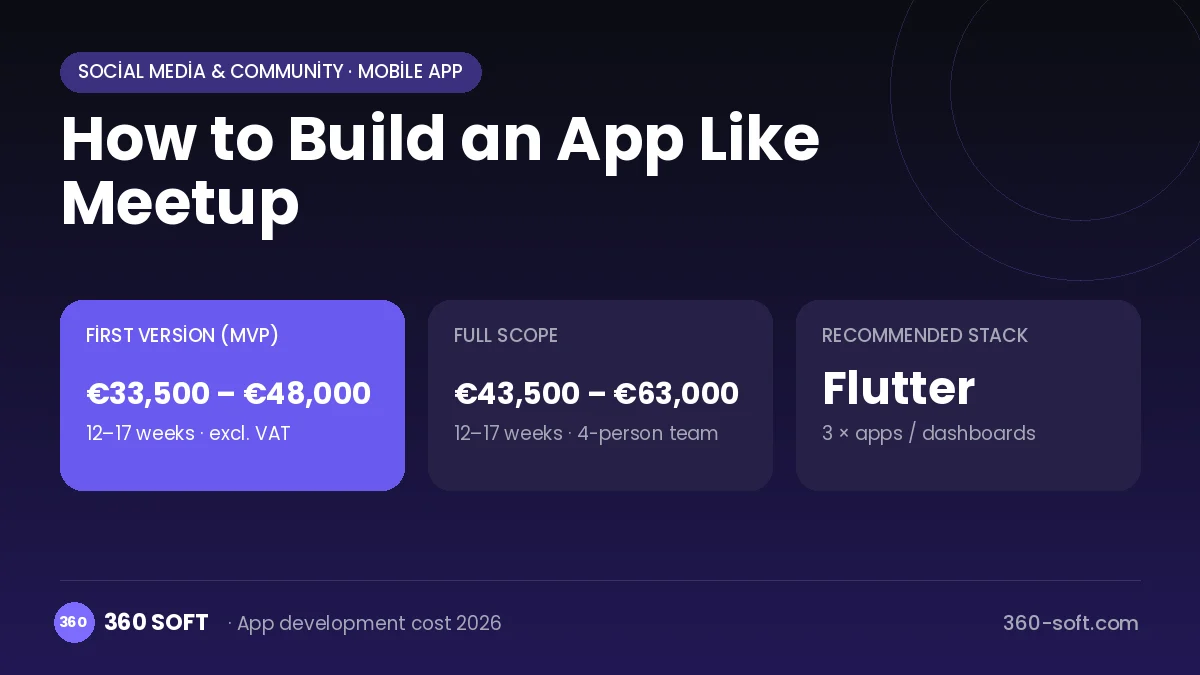
How Meetup works: the core user flow
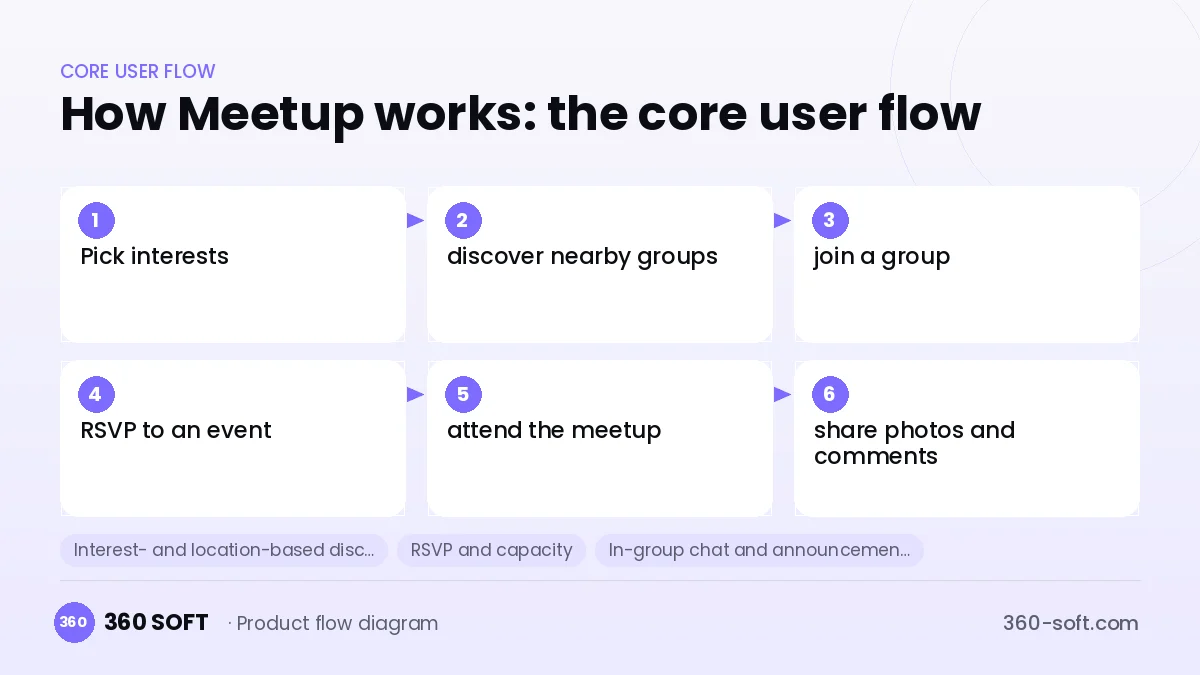
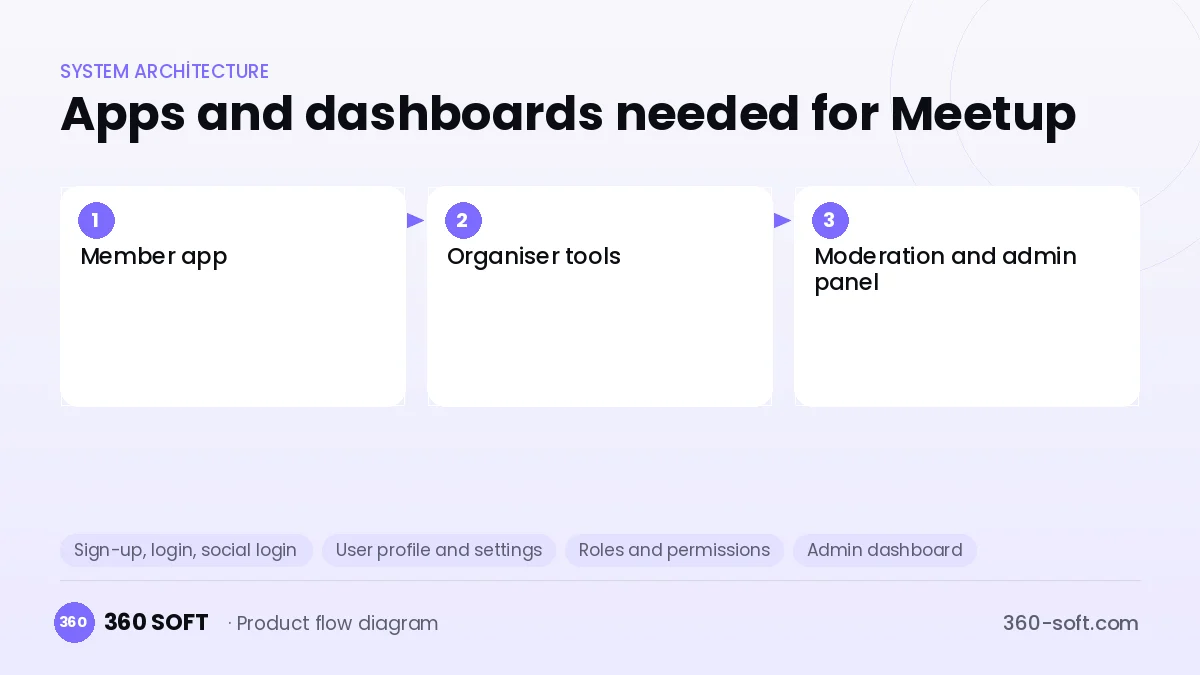
How many apps and dashboards do you need?
Member app
Users discover groups, join, RSVP to events and chat.
Organiser tools
Group owners create events, approve members, send announcements and manage attendance.
Moderation and admin panel
Reports, inappropriate content, fake groups and organiser subscriptions are managed here.
Critical features of a product like Meetup
Interest- and location-based discovery
Active groups and upcoming events are suggested based on the topics the user chooses and their location.
RSVP and capacity
Users reply going / maybe / not going to events, and a waitlist opens when capacity is full.
In-group chat and announcements
Members talk in the group chat, and the organiser delivers important announcements with push notifications.
Membership questions and approval
People who want to join are asked questions set by the organiser, and membership is granted by approval.
Recurring events
Events such as a weekly run or monthly meetup are created in one go as a series.
Safety and moderation
User blocking, reporting, automatic content filtering and age verification provide a safe environment.
What goes into the first version, what comes later
First version (MVP)
- Interest selection and group discovery by location
- Creating and joining groups, and membership approval
- Event creation and RSVP
- Group chat and push notifications
- Reporting, blocking and a moderation panel
Later releases
- Paid events and ticket sales
- Organiser subscription plans
- Online events and video integration
- AI-assisted group and event recommendations
Modules and how the budget is calculated
The budget is calculated with 360 SOFT’s pricing model from the modules below, about 28 screens and the project’s complexity: roughly 166 person-days for the full scope and 127 person-days for the first version. Every module you drop lowers the budget directly.
| Module | Phase |
|---|---|
| Sign-up, login, social login | First version |
| User profile and settings | First version |
| Roles and permissions | First version |
| Admin dashboard | First version |
| Booking / reservations | First version |
| Real-time messaging | First version |
| Push notifications | First version |
| Maps, location, routing | First version |
| Advanced search and filters | First version |
| Subscriptions and recurring billing | First version |
| Online payments (Stripe / PSP) | First version |
| GDPR and security hardening | First version |
| File, photo, video upload | First version |
Hosting, SMS, map APIs, app store accounts and payment-provider fees are separate items. Maintenance and improvements (optional): €550 / month. We send a fixed written price within 24 hours after a free discovery call.
The hard parts
User safety
On a platform where strangers meet in person there is a risk of harassment and fraud; verification, reporting and fast moderation processes are essential.
Finding active organisers
The platform's liveliness depends on organisers who open events regularly; in the first city, community leaders must be won over personally.
Store and content rules
For apps hosting user-generated content, the App Store and Google Play require moderation, blocking and reporting features.
Business model
In this model revenue usually comes from organiser subscriptions: a monthly fee is charged for opening a group and using advanced tools. A premium plan giving members ad-free use and priority access, ticket commissions from paid events and brand sponsorship of community events are additional income sources. Offering private spaces to organisations for their employee communities can also be considered.
Get a free quote for your project
Let us scope it together and send a fixed written quote within 24 hours. NDA on request; you own the source code.
Choosing a company to build an app like Meetup
Most people searching “build an app like meetup” are really looking for a reliable app development company. When comparing quotes, check four things:
- Can you try similar products they have shipped, in the stores or live?
- Are the source code, design files, servers and store accounts transferred to you by contract?
- Do they show a working demo every two weeks, with written scope and acceptance criteria?
- Are maintenance, scaling and GDPR/security costs written into the quote?
Copyright and trademarks
A business model and features are generally not protected on their own, but the Meetup name, logo, interface design, content and source code are. That is why we build a product with similar functionality but your own brand, design and code. This is not legal advice; we recommend a trademark search before launch.
Frequently asked questions
How long does it take to build an app like Meetup?
A first version with groups, events, RSVP, chat and moderation can be ready in a few months. Paid events and subscription modules are added in later phases.
How do I ensure user safety?
You need phone verification, an age limit, blocking and report buttons, and a moderation team that responds quickly. App store rules already require these features.
How many separate apps are needed?
Members and organisers can use the same mobile app with different permissions. In addition, a web panel is needed for moderation and administration.
What should I look for when choosing a community app developer?
Choose a team experienced in real-time chat, notifications and moderation tools. A team that knows the store approval processes will also shorten your time to launch.