Web platformBooking & travelOriginal by trivago N.V.
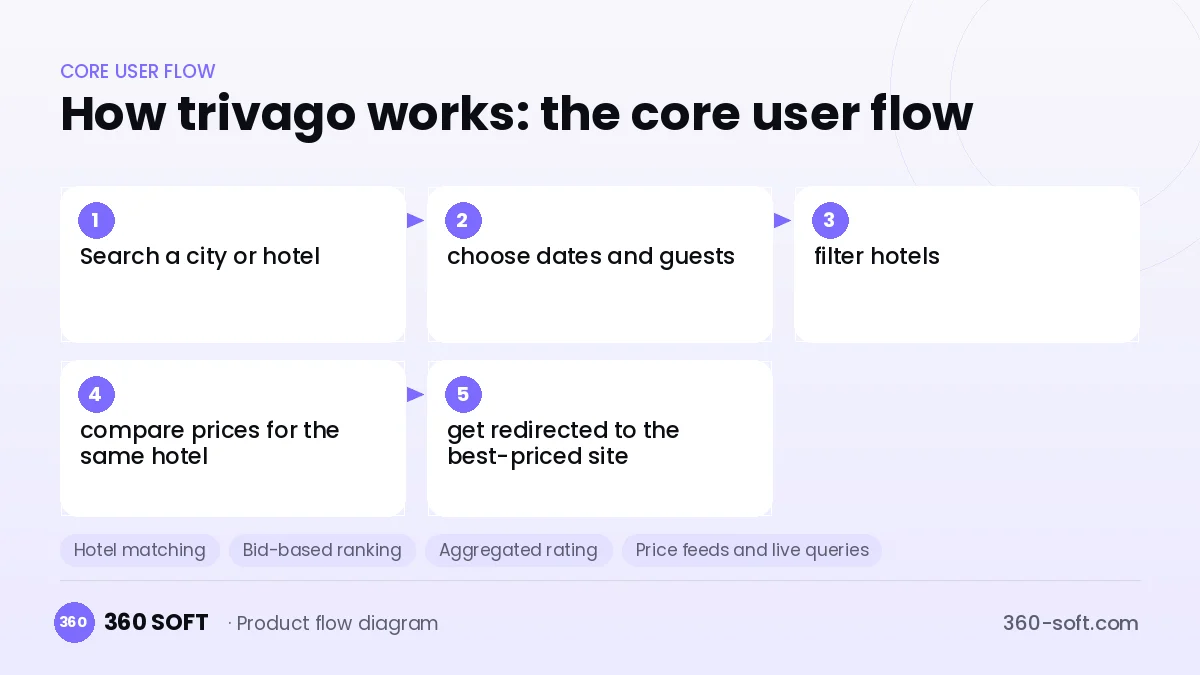
trivago is a hotel metasearch engine that compares the prices of the same hotel across different booking sites in a single list. Users are redirected to the site offering the best price and complete their booking there. What makes this simple promise powerful is accurate hotel matching, up-to-date prices and a fast, clear results screen that does not drown users in detail.
Building something similar requires a data infrastructure that collects price feeds from travel agencies and hotel chains and matches hotels. Merging each hotel into a single record, fetching prices at query time or serving them from cache, a ranking system where advertisers bid and a click billing panel are the core components. SEO and performance marketing are the main engines of growth as well.

How trivago works: the core user flow
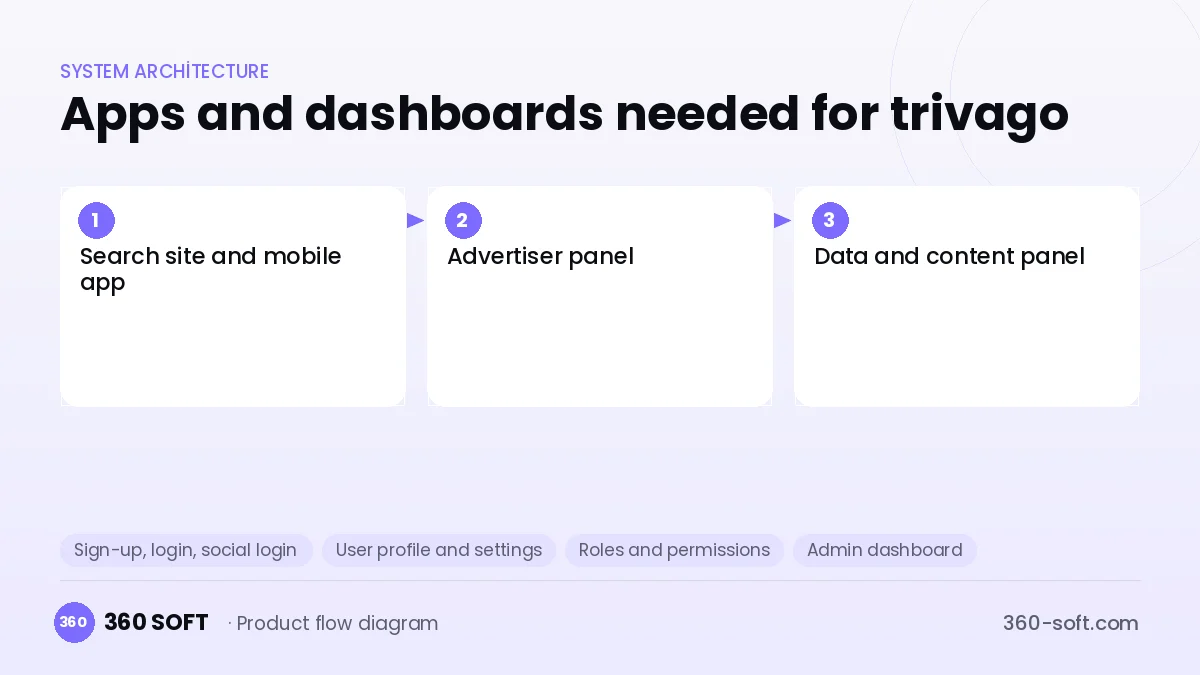
How many apps and dashboards do you need?
Search site and mobile app
The interface where users compare hotels and their prices on different sites.
Advertiser panel
The panel where agencies and hotels manage bids, budgets and click performance.
Data and content panel
The panel for managing hotel matching, content quality, supplier feeds and reports.
Critical features of a product like trivago
Hotel matching
Merges the same hotel from different suppliers into a single record based on name, address and location.
Bid-based ranking
Combines advertisers' cost-per-click bids with price and quality to decide which seller is featured.
Aggregated rating
Turns guest ratings from different sources into a single combined score.
Price feeds and live queries
Receives supplier feeds regularly and runs live price queries at search time when needed.
Location and point-of-interest filters
Filters hotels by proximity to the centre, the beach or an event venue.
Click billing
Counts valid clicks, filters out fake traffic and issues periodic invoices to advertisers.
What goes into the first version, what comes later
First version (MVP)
- Hotel database and feeds from a few suppliers
- Search, filtering and price comparison
- Redirects to seller sites and click tracking
- Advertiser panel and a basic bidding system
- SEO-friendly city and hotel pages
Later releases
- Advanced hotel matching and aggregated ratings
- Mobile app and price alerts
- Quality-score-based auction
- Option for direct hotel bookings
Modules and how the budget is calculated
The budget is calculated with 360 SOFT’s pricing model from the modules below, about 24 screens and the project’s complexity: roughly 152 person-days for the full scope and 106 person-days for the first version. Every module you drop lowers the budget directly.
| Module | Phase |
|---|---|
| Sign-up, login, social login | First version |
| User profile and settings | First version |
| Roles and permissions | First version |
| Admin dashboard | First version |
| Advanced search and filters | First version |
| Maps, location, routing | First version |
| Ratings and reviews | First version |
| Online payments (Stripe / PSP) | First version |
| Reporting and analytics | Later release |
| Multi-language | First version |
| Content management / blog | First version |
| Third-party API integration | First version |
Hosting, SMS, map APIs, app store accounts and payment-provider fees are separate items. Maintenance and improvements (optional): €500 / month. We send a fixed written price within 24 hours after a free discovery call.
The hard parts
Hotel matching quality
Mismatched hotels send users to a different hotel; name, address and coordinate-based matching needs constant improvement.
Price accuracy
If the displayed price differs on the seller's site, trust is lost; accuracy measurement and enforcement are required.
Marketing cost
Acquiring traffic is expensive in this model; measurement that balances ad spend against click revenue is essential.
Business model
Revenue comes almost entirely from advertisers: agencies and hotels pay the fee they bid for every click that sends a user to their site. In some models, a commission per completed booking is charged instead of per click. Paid profile and visibility packages for hotels and data reports can bring in extra revenue.
Get a free quote for your project
Let us scope it together and send a fixed written quote within 24 hours. NDA on request; you own the source code.
Choosing a company to build an app like trivago
Most people searching “website like trivago” are really looking for a reliable app development company. When comparing quotes, check four things:
- Can you try similar products they have shipped, in the stores or live?
- Are the source code, design files, servers and store accounts transferred to you by contract?
- Do they show a working demo every two weeks, with written scope and acceptance criteria?
- Are maintenance, scaling and GDPR/security costs written into the quote?
Copyright and trademarks
A business model and features are generally not protected on their own, but the trivago name, logo, interface design, content and source code are. That is why we build a product with similar functionality but your own brand, design and code. This is not legal advice; we recommend a trademark search before launch.
Frequently asked questions
How long does it take to build a website like trivago?
A first version working with a few supplier feeds can be ready in a few months. Raising hotel matching quality, however, is work that continues after launch.
Where do I get hotel prices from?
You sign partnership agreements with booking sites and hotel chains to receive price feeds or APIs. Large suppliers with affiliate programmes are a good way to start.
Are there copyright or trademark issues?
The hotel comparison model is free to use; the trivago name, logo, design and content may not be used. This information is not legal advice.
Does a niche hotel comparison site make sense?
Yes; niches such as spa hotels, boutique hotels or a specific region let you start with lower marketing costs than the broad market. Niche content is also an advantage for SEO.