Web platformBooking & travelOriginal by KAYAK
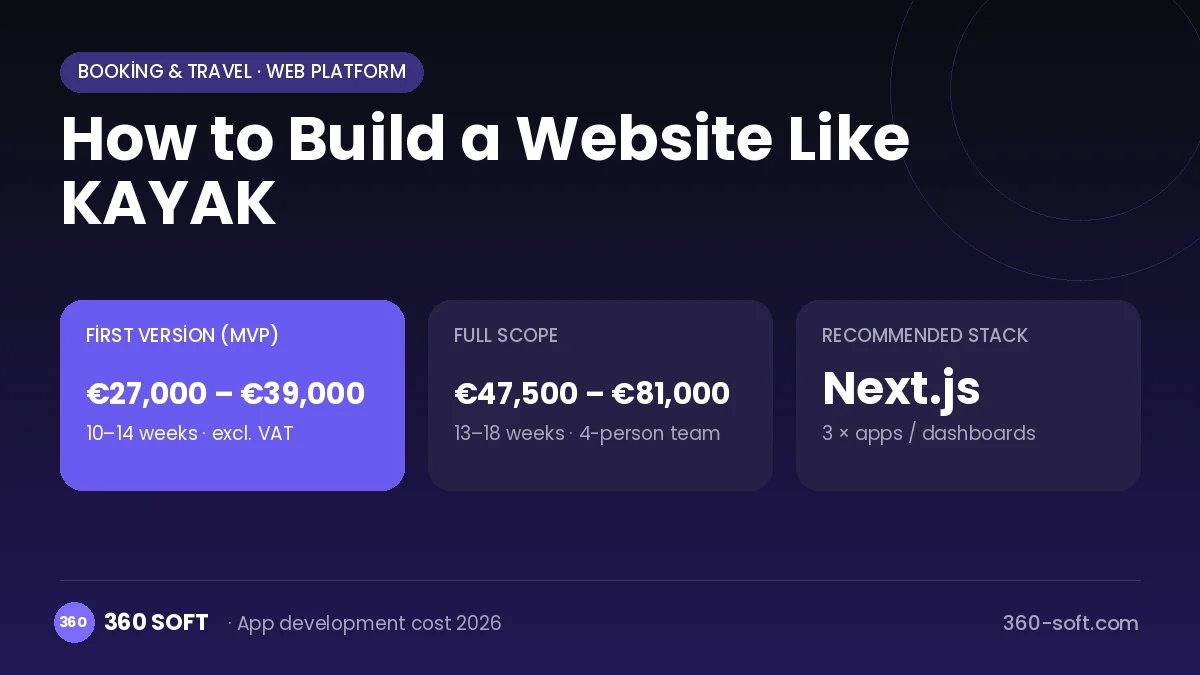
KAYAK is a travel metasearch site that aggregates flight, hotel and car rental prices from hundreds of sources. It helps users decide before sending them off to book: forecasts on whether prices will drop, flexible date suggestions and budget-based destination discovery make that decision easier. Powerful filtering and a clean results screen keep users coming back.
Building something similar requires a multi-vertical price aggregation engine, a referral and click-tracking infrastructure and an analytics layer. Price forecasting requires storing and modelling historical fare data. In addition, a trip planner, user accounts, price alerts, a partner panel and SEO-focused content pages are part of the scope.
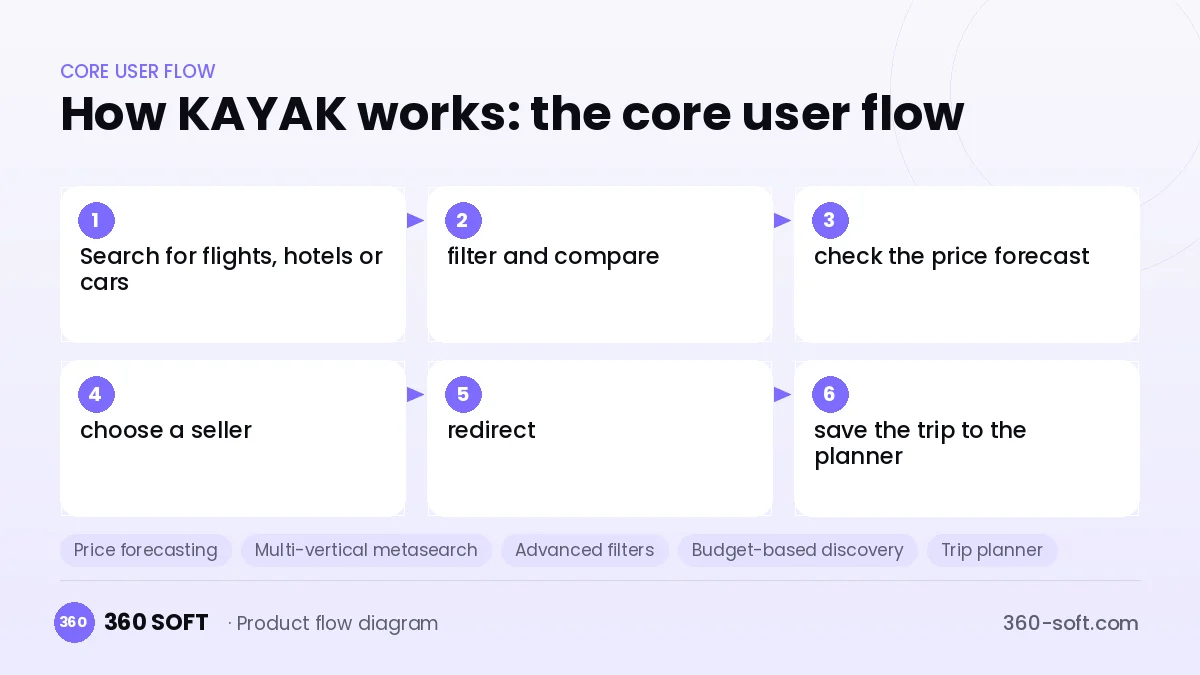
How KAYAK works: the core user flow
How many apps and dashboards do you need?
Search site and mobile app
The interface where users compare travel products, set alerts and are redirected to the seller.
Partner panel
The panel where sellers monitor clicks, conversions and offer quality.
Data and admin panel
The panel for managing supplier settings, price forecasting models, ad placements and revenue reports.

Critical features of a product like KAYAK
Price forecasting
Suggests whether prices are likely to rise or fall based on historical fare data.
Multi-vertical metasearch
Combines flights, hotels and car rentals in the same search and results experience.
Advanced filters
Detailed filters such as layover time, airport, price including baggage, cancellation terms and location.
Budget-based discovery
Shows on a map where you can go within a set budget and date range.
Trip planner
Builds a single itinerary from booking emails or manually added details.
Fee transparency
Shows the total cost comparatively, taking baggage and extra fees into account.
What goes into the first version, what comes later
First version (MVP)
- Flight and hotel metasearch
- Filtering, sorting and seller comparison
- Redirects and click tracking
- User accounts and price alerts
- Partner and admin panels
Later releases
- Price forecasting based on historical data
- Budget-based map discovery
- Car rental vertical
- Trip planner with email import
Modules and how the budget is calculated
The budget is calculated with 360 SOFT’s pricing model from the modules below, about 28 screens and the project’s complexity: roughly 183 person-days for the full scope and 103 person-days for the first version. Every module you drop lowers the budget directly.
| Module | Phase |
|---|---|
| Sign-up, login, social login | First version |
| User profile and settings | First version |
| Admin dashboard | First version |
| Advanced search and filters | First version |
| Maps, location, routing | First version |
| Email / SMS notifications | First version |
| Push notifications | First version |
| AI features (LLM, RAG, recommendations) | Later release |
| Reporting and analytics | Later release |
| Multi-language | First version |
| Content management / blog | First version |
| Third-party API integration | First version |
Hosting, SMS, map APIs, app store accounts and payment-provider fees are separate items. Maintenance and improvements (optional): €600 / month. We send a fixed written price within 24 hours after a free discovery call.
The hard parts
Reliability of the forecasting model
Wrong price forecasts damage user trust; the model must be trained on enough historical data and show a confidence range.
Multi-vertical data model
Flights, hotels and cars have very different data structures; a shared search experience needs a flexible data model.
Traffic acquisition cost
User acquisition is expensive for metasearch sites; SEO, content and a repeat-visit strategy are critical.
Business model
Revenue is based on cost-per-click fees for clicks sent to partner sites and cost-per-acquisition commissions. Sponsored result slots, display ads and destination campaigns make up a significant share. Offering a white-label search engine or data services can also bring in additional revenue on the enterprise side.
Get a free quote for your project
Let us scope it together and send a fixed written quote within 24 hours. NDA on request; you own the source code.
Choosing a company to build an app like KAYAK
Most people searching “website like kayak” are really looking for a reliable app development company. When comparing quotes, check four things:
- Can you try similar products they have shipped, in the stores or live?
- Are the source code, design files, servers and store accounts transferred to you by contract?
- Do they show a working demo every two weeks, with written scope and acceptance criteria?
- Are maintenance, scaling and GDPR/security costs written into the quote?
Copyright and trademarks
A business model and features are generally not protected on their own, but the KAYAK name, logo, interface design, content and source code are. That is why we build a product with similar functionality but your own brand, design and code. This is not legal advice; we recommend a trademark search before launch.
Frequently asked questions
How long does it take to build a website like KAYAK?
A first version starting with flight and hotel search can be ready in a few months. Price forecasting naturally comes later, since enough historical data must be collected first.
Is there a difference between the Skyscanner and KAYAK models?
Both use the metasearch model; the difference lies mostly in the verticals they focus on and in decision-support tools such as discovery and forecasting. For a new venture, starting with a niche market or region is more realistic.
Are there copyright or trademark issues?
The travel metasearch model is free to use; the KAYAK name, logo, design and content may not be copied. This information is not legal advice.
What should I look for in a company that builds a website like KAYAK?
Look for experience with high-traffic search infrastructure, data pipelines and analytics. Who will maintain supplier integrations should be made clear in the contract.