Mobile appBooking & travelOriginal by Türk Hava Yolları A.O.
The Turkish Airlines app brings a vast flight network to passengers of many languages and cultures through a single digital experience. Booking, online check-in, seat and meal selection, the miles programme and flight status tracking all live in the same app. Being a full-service airline adds layers to the experience: cabin classes, connecting flights and airport services.
Building something similar means creating a powerful mobile and web layer connected to the airline's reservation, loyalty and operations systems. Multilingual and multi-currency support, connecting flight search, earning and spending miles, ancillary sales and boarding pass management are the core modules. Accessibility and international data protection rules should be considered from the outset.
How Turkish Airlines works: the core user flow
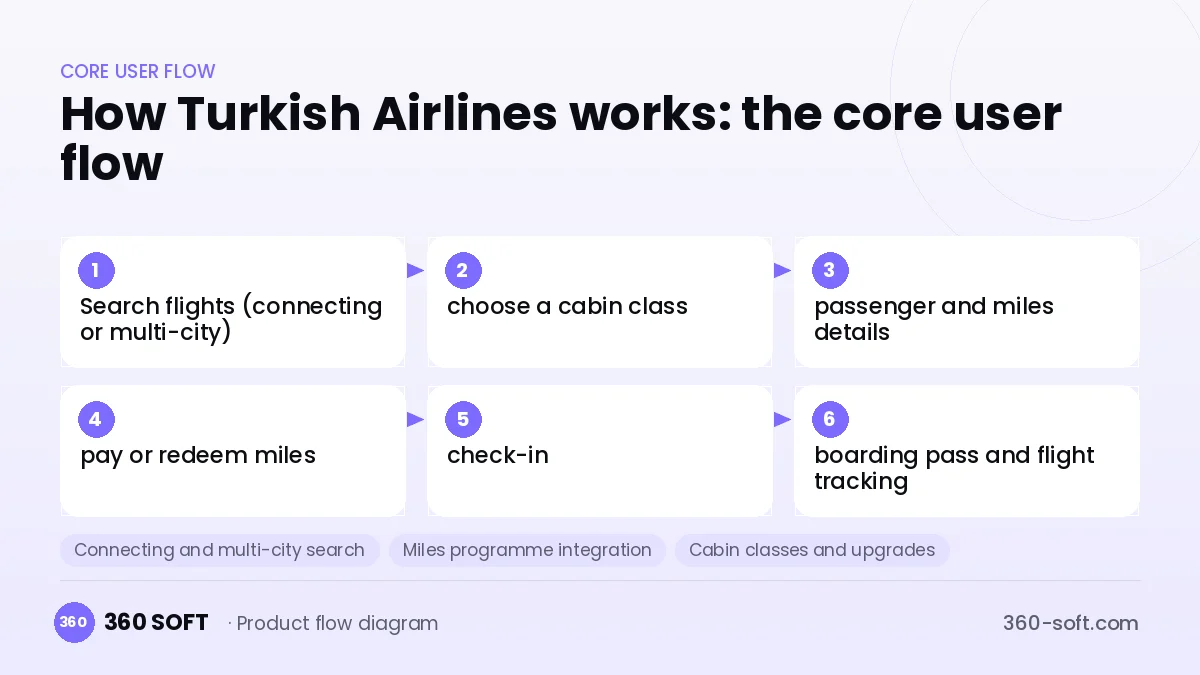
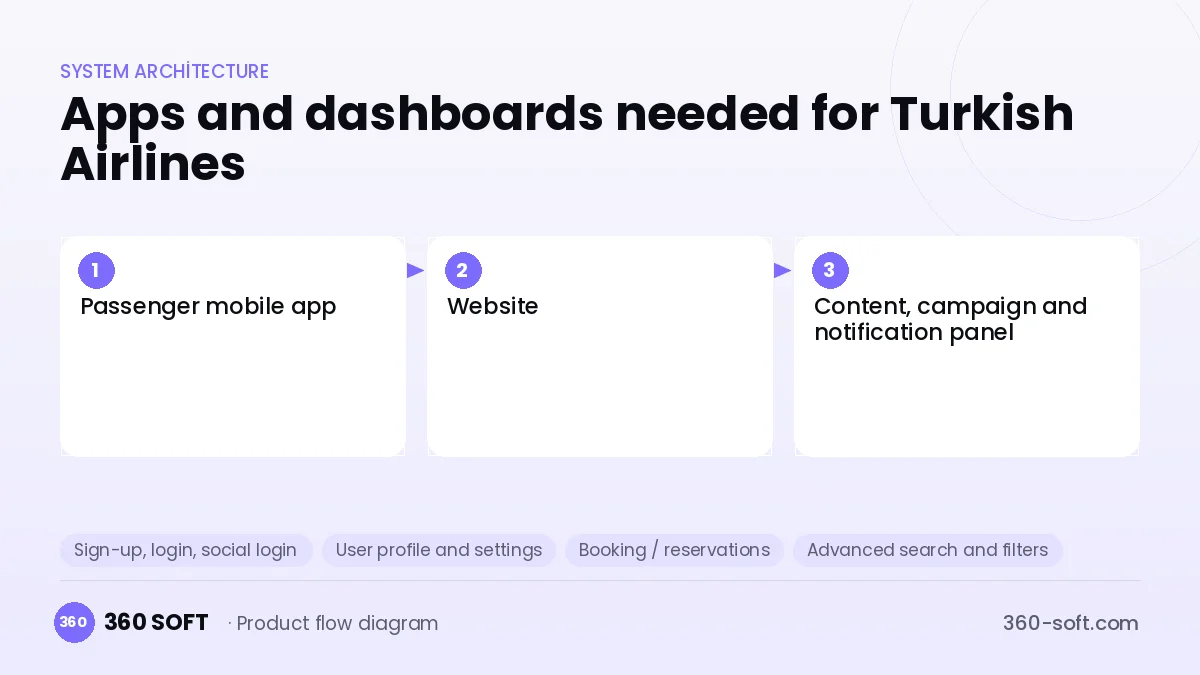
How many apps and dashboards do you need?
Passenger mobile app
Passengers buy tickets, manage their miles account, check in and track their flight.
Website
The site offering multilingual booking, check-in and membership services.
Content, campaign and notification panel
The panel for managing country-specific campaigns, destination content and operational notifications.
Critical features of a product like Turkish Airlines
Connecting and multi-city search
Finds and prices the most sensible connections across a large network based on transfer times.
Miles programme integration
Earning miles from flights and partner spending, booking award tickets and tracking membership tiers.
Cabin classes and upgrades
Comparing classes such as economy and business, with upgrade offers paid in miles or cash.
Multiple languages and currencies
Interface, content and prices presented in the language and currency of each country.
Airport guide
Gate, lounge and service information at the transfer airport, plus time remaining until the flight.
Special assistance requests
Adding requests such as wheelchair assistance, special meals and unaccompanied minors to the booking.
What goes into the first version, what comes later
First version (MVP)
- Flight search, cabin selection and purchase
- Multilingual interface and core currencies
- Booking management and online check-in
- Mobile boarding pass and flight status notifications
- Member login and miles balance view
Later releases
- Award tickets and cabin upgrades with miles
- Airport guide and transfer assistant
- Partner hotel, car and tour sales
- Personalised offers and an AI-powered assistant
Modules and how the budget is calculated
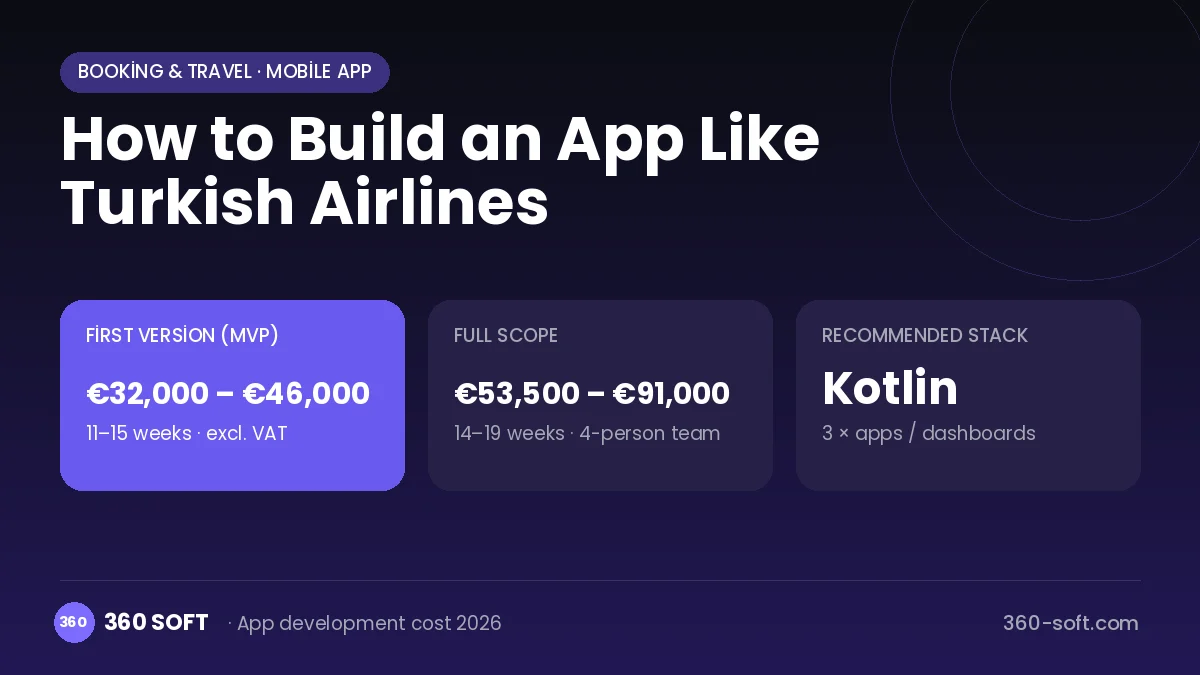
The budget is calculated with 360 SOFT’s pricing model from the modules below, about 38 screens and the project’s complexity: roughly 205 person-days for the full scope and 121 person-days for the first version. Every module you drop lowers the budget directly.
| Module | Phase |
|---|---|
| Sign-up, login, social login | First version |
| User profile and settings | First version |
| Booking / reservations | First version |
| Advanced search and filters | First version |
| Online payments (Stripe / PSP) | First version |
| Push notifications | First version |
| Email / SMS notifications | First version |
| Barcode / RFID / handheld | Later release |
| Content management / blog | First version |
| Multi-language | First version |
| Maps, location, routing | First version |
| Reporting and analytics | Later release |
| GDPR and security hardening | First version |
| Third-party API integration | First version |
Hosting, SMS, map APIs, app store accounts and payment-provider fees are separate items. Maintenance and improvements (optional): €700 / month. We send a fixed written price within 24 hours after a free discovery call.
The hard parts
Complex business rules
Fare classes, codeshare flights and connection rules make it hard to keep the interface simple.
Global scale and accessibility
Low latency in many countries, multiple languages and compliance with accessibility standards are required.
Security and compliance
Payment security, GDPR and other international data protection rules, and passenger rights regulations must all be met.
Business model
The main purpose of an airline app is direct sales; it cuts commissions paid to intermediary channels and keeps passenger data with the airline. Ancillaries such as cabin upgrades, extra baggage, seats, lounge access and insurance increase revenue. Miles programme partnerships, co-branded credit cards and hotel and car partner commissions are also important revenue sources.
Get a free quote for your project
Let us scope it together and send a fixed written quote within 24 hours. NDA on request; you own the source code.
Choosing a company to build an app like Turkish Airlines
Most people searching “build an app like turkish airlines” are really looking for a reliable app development company. When comparing quotes, check four things:
- Can you try similar products they have shipped, in the stores or live?
- Are the source code, design files, servers and store accounts transferred to you by contract?
- Do they show a working demo every two weeks, with written scope and acceptance criteria?
- Are maintenance, scaling and GDPR/security costs written into the quote?
Copyright and trademarks
A business model and features are generally not protected on their own, but the Turkish Airlines name, logo, interface design, content and source code are. That is why we build a product with similar functionality but your own brand, design and code. This is not legal advice; we recommend a trademark search before launch.
Frequently asked questions
How long does it take to build an app like Turkish Airlines?
Because the scope is very broad, a phased approach is needed. A first version focused on booking and check-in can be ready in a few months; the miles programme and airport services are added in later phases.
How many separate applications are needed?
Passengers need iOS and Android apps and a website, plus a content and campaign management panel. Separate internal apps for cabin crew or ground handling may also come up.
Are there copyright or trademark issues?
Airline app features can be implemented freely. The Turkish Airlines name, logo, corporate identity, design and content may not be used; this information is not legal advice.
What should I look for in a company that builds an app like Turkish Airlines?
Look for experience with large-scale enterprise integration, multilingual apps, security testing and high availability. Source code ownership and service level commitments must be clear.