Mobile appVideo, music & mediaOriginal by Apple
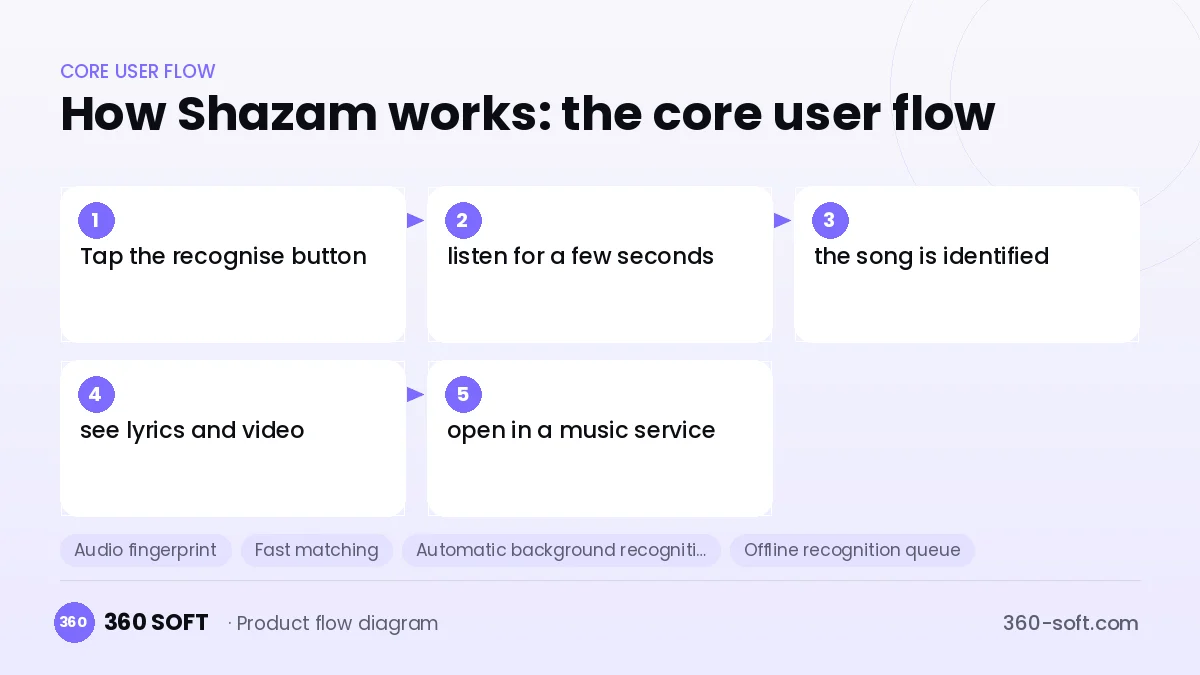
Shazam's magic is recognising a song playing in a cafe or a car within a few seconds. The user presses a button, and the app returns the right result even in a noisy place; that "how did it know?" moment spreads the product by word of mouth. Lyrics, the video clip and a link to open the song in music services carry the user from discovery to listening.
Building something similar, beyond the app itself, the real work is a search server that extracts the audio fingerprints of a large song database and matches a short recording against them within milliseconds. Hash values generated from spectrogram peaks are indexed, and a noise-resistant matching algorithm runs. Licensed data providers are needed for song metadata, lyrics and music service links.

How Shazam works: the core user flow
How many apps and dashboards do you need?
Mobile app
The app for users who identify songs playing around them, keep a recognition history and browse discovery lists.
Recognition and index service
The backend system that generates fingerprints for the song database and matches incoming audio samples.
Admin and data panel
A panel for monitoring catalogue ingestion, match quality, popular recognitions and partnership reports.

Critical features of a product like Shazam
Audio fingerprint
A noise-resistant fingerprint is extracted from the frequency peaks of a short audio recording.
Fast matching
Fingerprint hashes are searched in a large index, and time alignment finds the right song within seconds.
Automatic background recognition
With the user's permission, the app recognises songs playing in the background and adds them to the history.
Offline recognition queue
Recordings taken without internet are stored on the device and recognised once the connection returns.
Recognition trend charts
The most recognised songs are listed by city and country, so rising songs are spotted early.
Music service deep links
A recognised song opens in popular music services or is added to a playlist with one tap.
What goes into the first version, what comes later
First version (MVP)
- iOS and Android recognition app
- Fingerprint generation and a matching server
- Song result page and recognition history
- Redirect links to music services
- Catalogue ingestion panel
Later releases
- Automatic background recognition
- An offline recognition queue
- City-based trend charts
- Lyrics and concert information integration
Modules and how the budget is calculated
The budget is calculated with 360 SOFT’s pricing model from the modules below, about 18 screens and the project’s complexity: roughly 170 person-days for the full scope and 98 person-days for the first version. Every module you drop lowers the budget directly.
| Module | Phase |
|---|---|
| Sign-up, login, social login | First version |
| User profile and settings | First version |
| Product / content catalogue | First version |
| Advanced search and filters | First version |
| File, photo, video upload | First version |
| AI features (LLM, RAG, recommendations) | Later release |
| Offline mode and sync | First version |
| Push notifications | First version |
| Third-party API integration | First version |
| Reporting and analytics | Later release |
| Admin dashboard | First version |
Hosting, SMS, map APIs, app store accounts and payment-provider fees are separate items. Maintenance and improvements (optional): €600 / month. We send a fixed written price within 24 hours after a free discovery call.
The hard parts
Noise robustness
To match correctly amid crowds, wind and speech, the algorithm has to be tested against many real-world recordings.
Index scale
The fingerprints of a large catalogue form a huge index, and the architecture must be built carefully for both fast search and low cost.
Reference audio source
Extracting fingerprints needs access to the songs themselves, which must be obtained through licensed channels.
Business model
The app is usually free; revenue comes from affiliate commissions for sending recognised songs to music services and digital stores, from advertising and from concert ticket referrals. Trend reports drawn from recognition data can be sold to labels and brands as a data product, and a recognition API can be offered to other apps for a fee.
Get a free quote for your project
Let us scope it together and send a fixed written quote within 24 hours. NDA on request; you own the source code.
Choosing a company to build an app like Shazam
Most people searching “build an app like shazam” are really looking for a reliable app development company. When comparing quotes, check four things:
- Can you try similar products they have shipped, in the stores or live?
- Are the source code, design files, servers and store accounts transferred to you by contract?
- Do they show a working demo every two weeks, with written scope and acceptance criteria?
- Are maintenance, scaling and GDPR/security costs written into the quote?
Copyright and trademarks
A business model and features are generally not protected on their own, but the Shazam name, logo, interface design, content and source code are. That is why we build a product with similar functionality but your own brand, design and code. This is not legal advice; we recommend a trademark search before launch.
Frequently asked questions
How long does it take to build an app like Shazam?
The app interface comes together in relatively little time; most of the time goes into developing the fingerprinting algorithm and testing it in real environments. Using a ready-made recognition API shortens it considerably.
A ready-made recognition service or a custom algorithm?
For a fast market launch, licensed music recognition APIs make sense. When you grow in scale or want to differentiate, you can move to a custom fingerprint engine.
Are there copyright or trademark issues?
The music recognition business model and its features are generally free to use, but the name, logo, design, content and code cannot be copied. Algorithms can be patented and song data requires licences; this information is not legal advice.
What should I look for when choosing a company to build an app like Shazam?
Look for real experience in signal processing, audio analysis and large-scale search indexes. Be sure to ask how they run noisy-environment tests.