Web platformBooking & travelOriginal by Eventbrite
What sets Eventbrite apart is that, more than for big concerts, anyone can open their own registration and ticket page for workshops, conferences, seminars, networking meetups and community events. Organisers publish an event without technical knowledge, take free or paid registrations and manage the attendee list. Discovery pages, in turn, help new attendees find these events.
To build something similar you need a self-service event builder, customisable registration forms, free and paid ticket types, attendee emails, a check-in app and an organiser payout system. For online events, video conference link integration, recurring event series and an organiser follow feature are also important parts of the model. The less hassle the organiser has, the more loyal they stay to the platform.
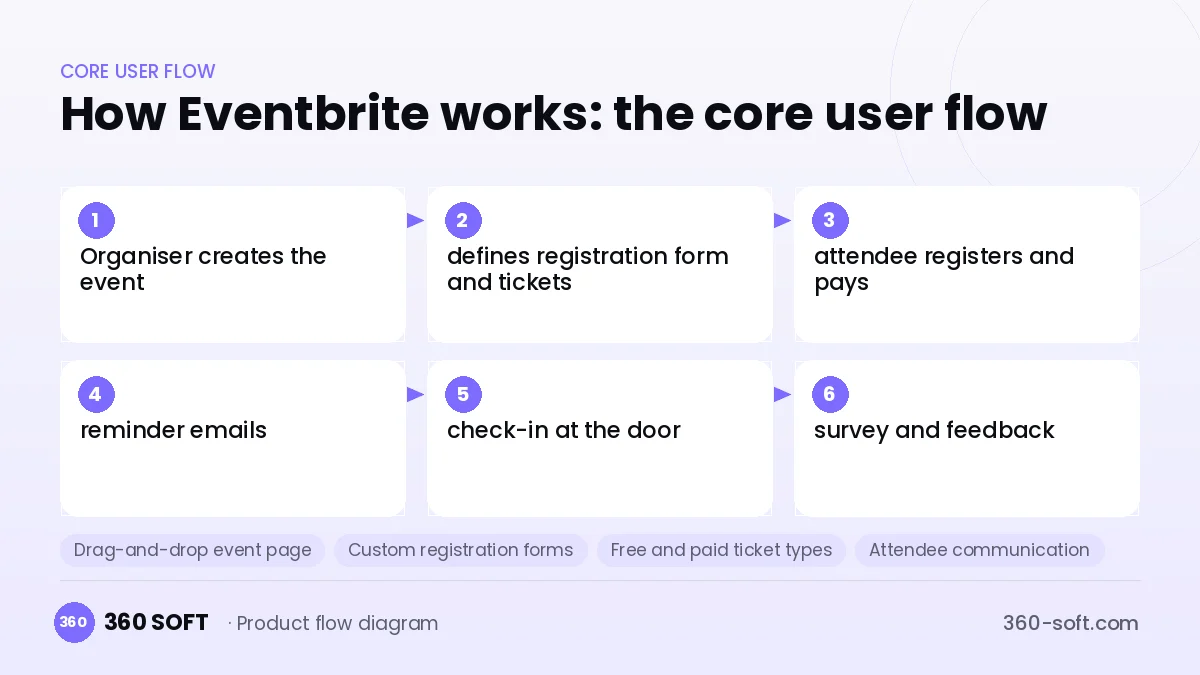
How Eventbrite works: the core user flow
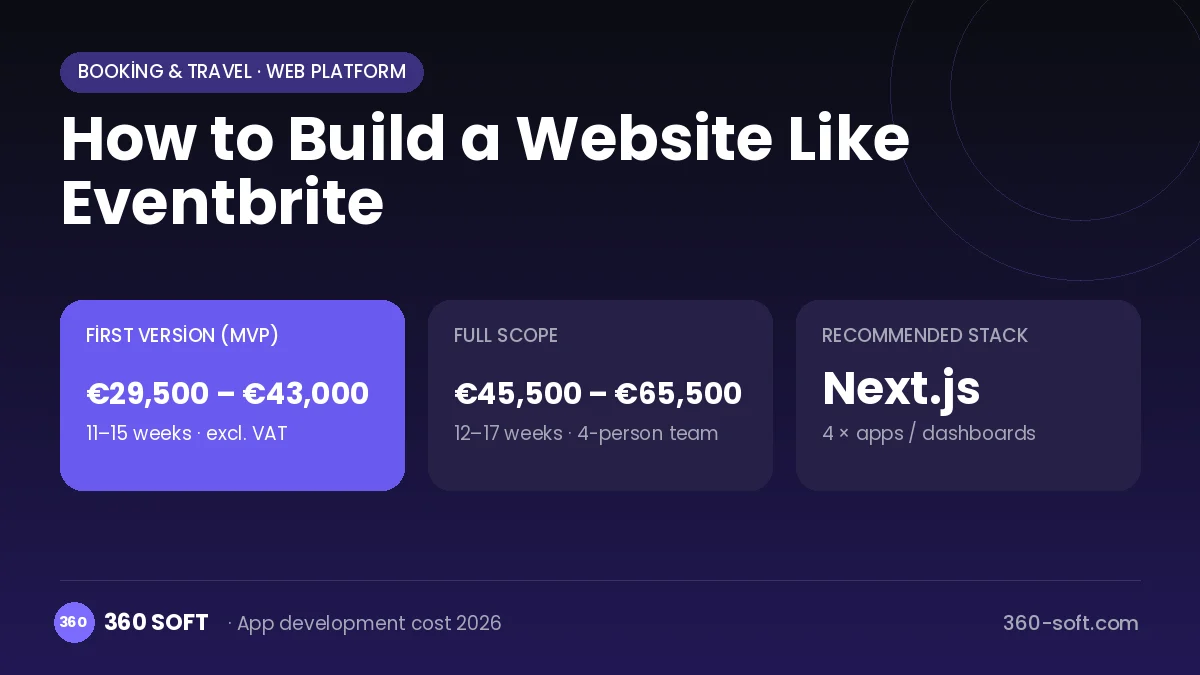
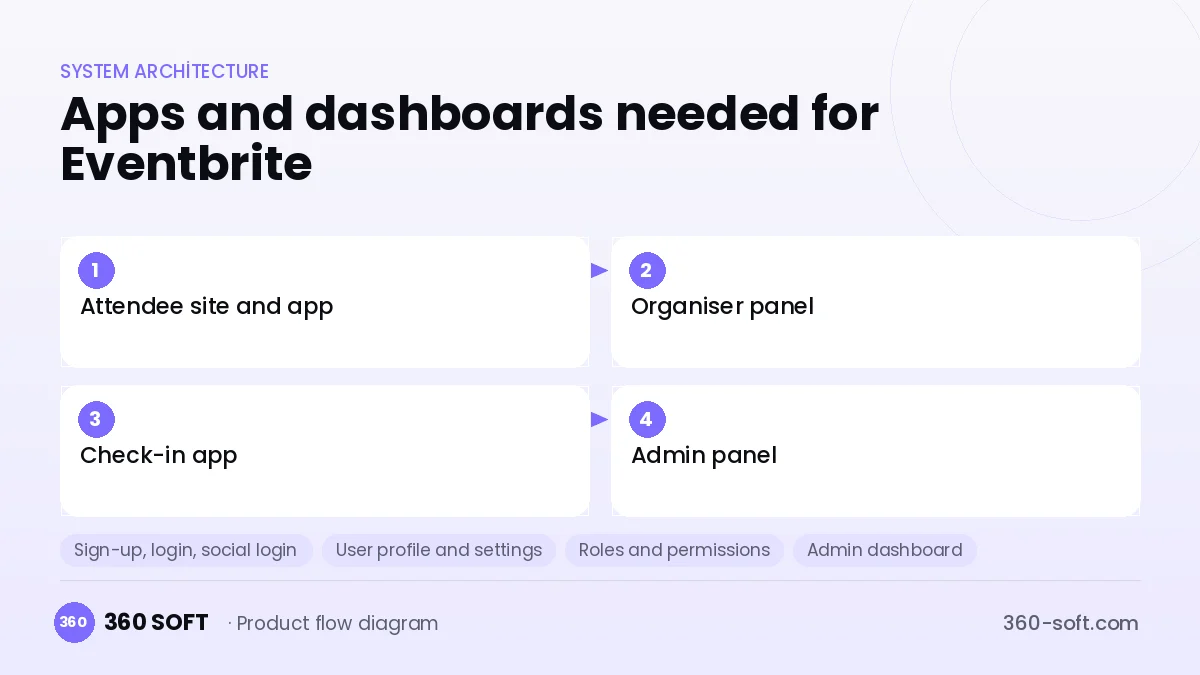
How many apps and dashboards do you need?
Attendee site and app
Users discover events, register, buy tickets and access event information.
Organiser panel
Organisers manage events, forms, ticket types, emails and the attendee list.
Check-in app
The event team checks attendees in by QR or name search and prints name badges.
Admin panel
Organiser verification, commissions, payouts and content moderation are handled here.
Critical features of a product like Eventbrite
Drag-and-drop event page
The organiser edits the cover image, speakers, schedule and FAQ sections without code.
Custom registration forms
Fields such as company, job title and dietary preference are added, and different questions can be asked per ticket type.
Free and paid ticket types
Ticket types such as early bird, student, group and VIP are defined with quotas and date ranges.
Attendee communication
Confirmation, reminder and post-event thank-you emails are scheduled automatically, and bulk announcements can be sent.
Online event support
The video conference link is shown only to registered attendees at the event time.
Check-in and name badges
QR codes are scanned with the mobile app, name badges can optionally be printed, and live attendance is monitored.
What goes into the first version, what comes later
First version (MVP)
- Self-service event creation and publishing
- Free and paid registration, online payment
- Custom registration form and attendee list export
- Automatic confirmation and reminder emails
- Check-in app with QR codes
Later releases
- Event discovery pages and personal recommendations
- Recurring event series and organiser following
- Badge printing and corporate event packages
- Integration with CRM and marketing tools
Modules and how the budget is calculated
The budget is calculated with 360 SOFT’s pricing model from the modules below, about 30 screens and the project’s complexity: roughly 174 person-days for the full scope and 113 person-days for the first version. Every module you drop lowers the budget directly.
| Module | Phase |
|---|---|
| Sign-up, login, social login | First version |
| User profile and settings | First version |
| Roles and permissions | First version |
| Admin dashboard | First version |
| Online payments (Stripe / PSP) | First version |
| Subscriptions and recurring billing | First version |
| Booking / reservations | First version |
| Advanced search and filters | First version |
| Barcode / RFID / handheld | Later release |
| Email / SMS notifications | First version |
| Content management / blog | First version |
| Reporting and analytics | First version |
| Marketplace integration (Amazon, etc.) | Later release |
Hosting, SMS, map APIs, app store accounts and payment-provider fees are separate items. Maintenance and improvements (optional): €600 / month. We send a fixed written price within 24 hours after a free discovery call.
The hard parts
Balancing flexibility and simplicity
Organisers come with very different needs; the panel must offer many options without becoming complicated.
Payouts and refunds
When an event is cancelled or postponed, bulk refunds and payout corrections must be processed without errors.
Spam and fake events
On an open platform, fraudulent events can be created; organiser verification and content moderation are needed.
Business model
Free events are usually kept free, while paid tickets carry a fixed fee per ticket plus a percentage commission. Subscription plans with advanced marketing, a custom domain and white-labelling can be offered to organisers. Prominence on discovery pages and rental of check-in hardware for corporate conferences bring additional income.
Get a free quote for your project
Let us scope it together and send a fixed written quote within 24 hours. NDA on request; you own the source code.
Choosing a company to build an app like Eventbrite
Most people searching “website like eventbrite” are really looking for a reliable app development company. When comparing quotes, check four things:
- Can you try similar products they have shipped, in the stores or live?
- Are the source code, design files, servers and store accounts transferred to you by contract?
- Do they show a working demo every two weeks, with written scope and acceptance criteria?
- Are maintenance, scaling and GDPR/security costs written into the quote?
Copyright and trademarks
A business model and features are generally not protected on their own, but the Eventbrite name, logo, interface design, content and source code are. That is why we build a product with similar functionality but your own brand, design and code. This is not legal advice; we recommend a trademark search before launch.
Frequently asked questions
How long does it take to build a website like Eventbrite?
A first version with event creation, registration, payment and check-in can be ready within a few months. Discovery pages and subscription plans are added in later phases.
How many separate panels are needed?
You need the attendee site, an organiser panel, a check-in app and an admin panel. The check-in side can start as a simple mobile app.
Ready-made script or custom software?
Ready-made registration tools may be enough for the events of a single organisation. For an open, multi-organiser platform with commissions, custom software is a better fit.
Will there be copyright or trademark problems?
The business model and features of an event registration platform are free to use; the name, logo, design, content and code cannot be copied. This is not legal advice.