Mobile appFintech & paymentsOriginal by PayPal
What made PayPal widespread is that it removed the worry of sharing card details with every site when shopping online. The buyer pays with an email and password on a single account, and the seller never sees the card data. Buyer and seller protection programmes, dispute resolution on problem transactions and acceptance of international payments build trust on both sides, especially in cross-border e-commerce. That trust turned the platform into a payment method accepted on millions of sites.
Building something similar means building a two-sided payment network: a user wallet, a payment button and API for merchants, a dispute and protection process, chargeback management and a risk and fraud engine. A payment and e-money institution licence from the regulator is needed for this service; building on licensed infrastructure is the more realistic start. Without a network effect, the product creates no value, so merchant acquisition is central to the strategy.
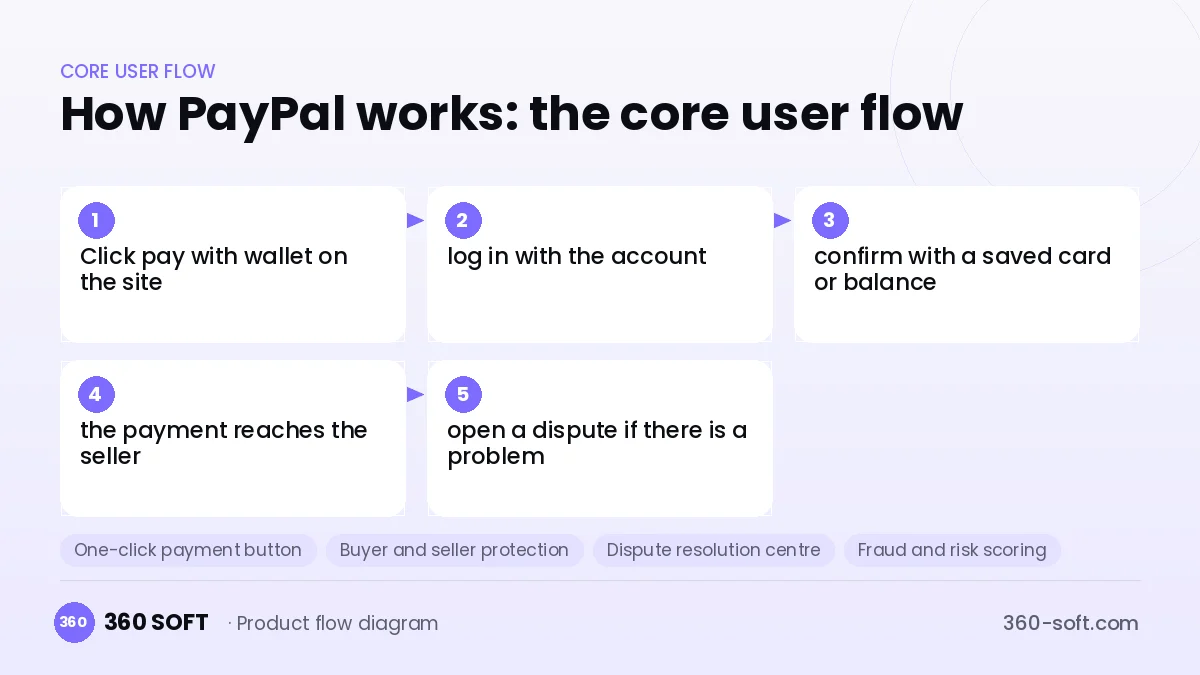
How PayPal works: the core user flow
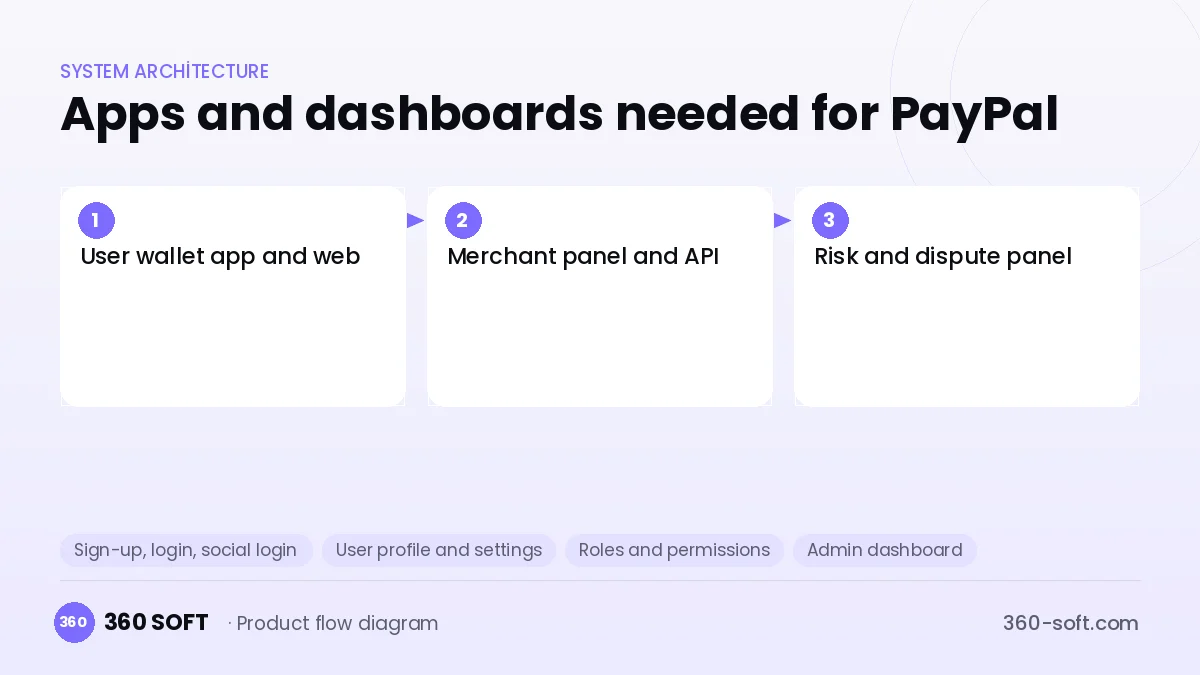
How many apps and dashboards do you need?
User wallet app and web
Buyers manage cards and balance, pay online, send money and open disputes.
Merchant panel and API
Sellers integrate the payment button and manage collections, refunds and disputes.
Risk and dispute panel
The team reviews suspicious transactions, decides protection claims and manages account restrictions.
Critical features of a product like PayPal
One-click payment button
Merchants add the button with a ready SDK, and the buyer signs in to their account in a pop-up window and confirms the payment.
Buyer and seller protection
Buyers can claim for items that never arrive or do not match the description; sellers who meet the conditions are also protected against unfair claims.
Dispute resolution centre
The parties message each other and upload documents; if no agreement is reached, the claim escalates to the risk team and is resolved with deadline tracking.
Fraud and risk scoring
Every payment is scored instantly using device fingerprint, behaviour and transaction history, and risky ones are put through extra verification.
Send money to a friend
Person-to-person transfers go by email or phone number, and the recipient creates an account to withdraw the money.
Multi-currency collection
Sellers accept payments in different currencies, hold a balance or convert automatically to the local currency.
What goes into the first version, what comes later
First version (MVP)
- User accounts, card saving and eKYC
- A payment button and a basic API for merchants
- Collection and settlement on licensed infrastructure
- Refunds and dispute filing
- Risk and operations panel
Later releases
- Buyer and seller protection programme rules
- Person-to-person transfers
- Multi-currency collection and currency conversion
- Subscription payments and buy-now-pay-later options
Modules and how the budget is calculated
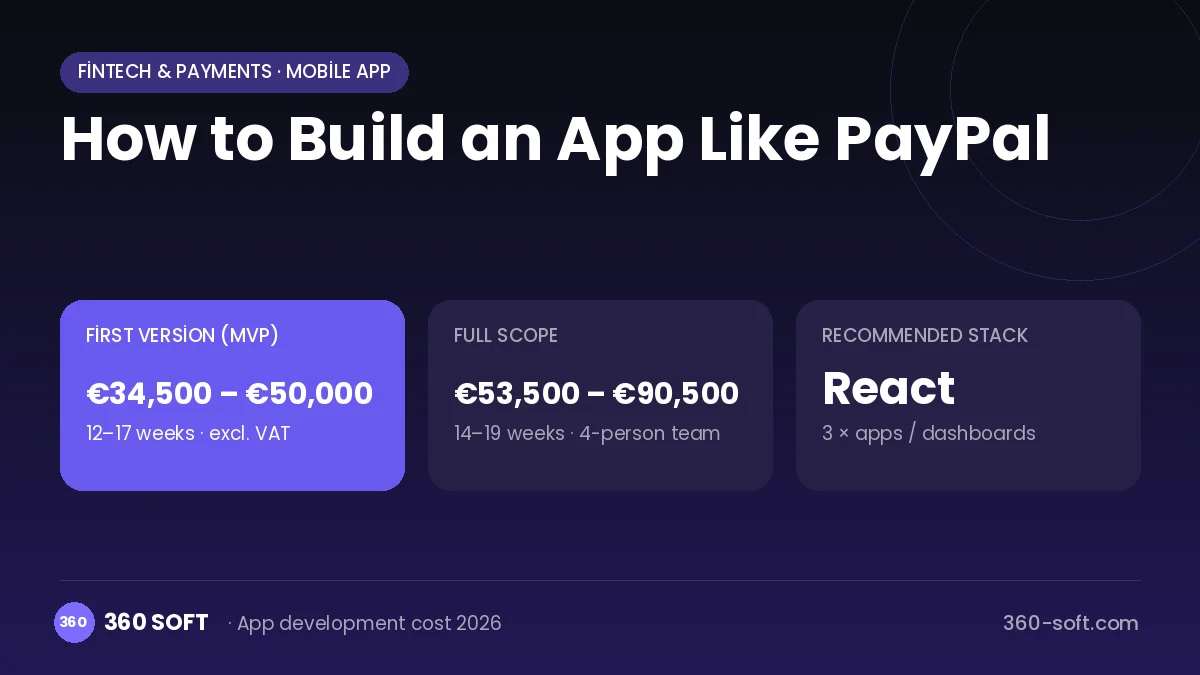
The budget is calculated with 360 SOFT’s pricing model from the modules below, about 36 screens and the project’s complexity: roughly 205 person-days for the full scope and 132 person-days for the first version. Every module you drop lowers the budget directly.
| Module | Phase |
|---|---|
| Sign-up, login, social login | First version |
| User profile and settings | First version |
| Roles and permissions | First version |
| Admin dashboard | First version |
| Online payments (Stripe / PSP) | First version |
| Subscriptions and recurring billing | First version |
| Email / SMS notifications | First version |
| Push notifications | First version |
| Real-time messaging | First version |
| Reporting and analytics | Later release |
| Multi-language | First version |
| GDPR and security hardening | First version |
| Third-party API integration | First version |
Hosting, SMS, map APIs, app store accounts and payment-provider fees are separate items. Maintenance and improvements (optional): €700 / month. We send a fixed written price within 24 hours after a free discovery call.
The hard parts
Starting the network effect
Merchants do not come without buyers and buyers do not come without merchants; a partnership with a specific sector or marketplace is essential in the early phase.
Cost of the protection programme
Buyer protection builds trust, but unfair claims and fraud can turn into losses; the rule set and risk score must be balanced.
Licensing and cross-border compliance
A payment institution licence, AML obligations and sanctions screening on foreign transactions must be part of the software architecture.
Business model
The main revenue is the collection commission charged to merchants, made up of a percentage and a fixed fee per transaction. Cross-border fees and currency conversion margins, value-added services such as fast settlement, subscription management and invoicing for merchants, and funding fees on person-to-person transfers can be added to the model. Basic use stays free for individuals.
Get a free quote for your project
Let us scope it together and send a fixed written quote within 24 hours. NDA on request; you own the source code.
Choosing a company to build an app like PayPal
Most people searching “build an app like paypal” are really looking for a reliable app development company. When comparing quotes, check four things:
- Can you try similar products they have shipped, in the stores or live?
- Are the source code, design files, servers and store accounts transferred to you by contract?
- Do they show a working demo every two weeks, with written scope and acceptance criteria?
- Are maintenance, scaling and GDPR/security costs written into the quote?
Copyright and trademarks
A business model and features are generally not protected on their own, but the PayPal name, logo, interface design, content and source code are. That is why we build a product with similar functionality but your own brand, design and code. This is not legal advice; we recommend a trademark search before launch.
Frequently asked questions
How long does it take to build an app like PayPal?
A first release with a wallet, payment button and merchant panel can be ready within months with a licensed infrastructure partner. The protection programme and cross-border features are added in stages.
Is a licence needed?
Collecting payments on someone else's behalf and holding balances is a payment and e-money service that needs a licence from the national regulator. Without one, you can use a licensed payment institution's infrastructure under your own brand.
Will there be copyright or trademark issues?
The online payment business model with a digital wallet is free to use, but the name, logo, button design, interface and code cannot be copied. This is general information, not legal advice.
What should I look for in a company that builds payment systems?
Choose a team experienced in PCI DSS compliance, risk engines and developer-friendly API design. The quality of SDK documentation and the test environment directly affects merchant acquisition.