Mobile appHealth, fitness & wellness
For people with chronic conditions or several daily medicines, the biggest problem is not the drug itself but remembering to take it at the right time. Medication reminder apps notify every dose on schedule, record taken or skipped doses and warn before supplies run out. Family members who want to keep an eye on an elderly relative's medication remotely are among the most loyal users.
Building something similar starts with a mobile app that works reliably: a scheduling engine that models complex dose plans (every other day, tapering doses, on an empty stomach), local notifications that never get missed even when the phone is off or silent, and offline operation are essential. The backend holds a medicine name database, family member pairing, missed-dose alerts and an adherence report that can be shown to a doctor.
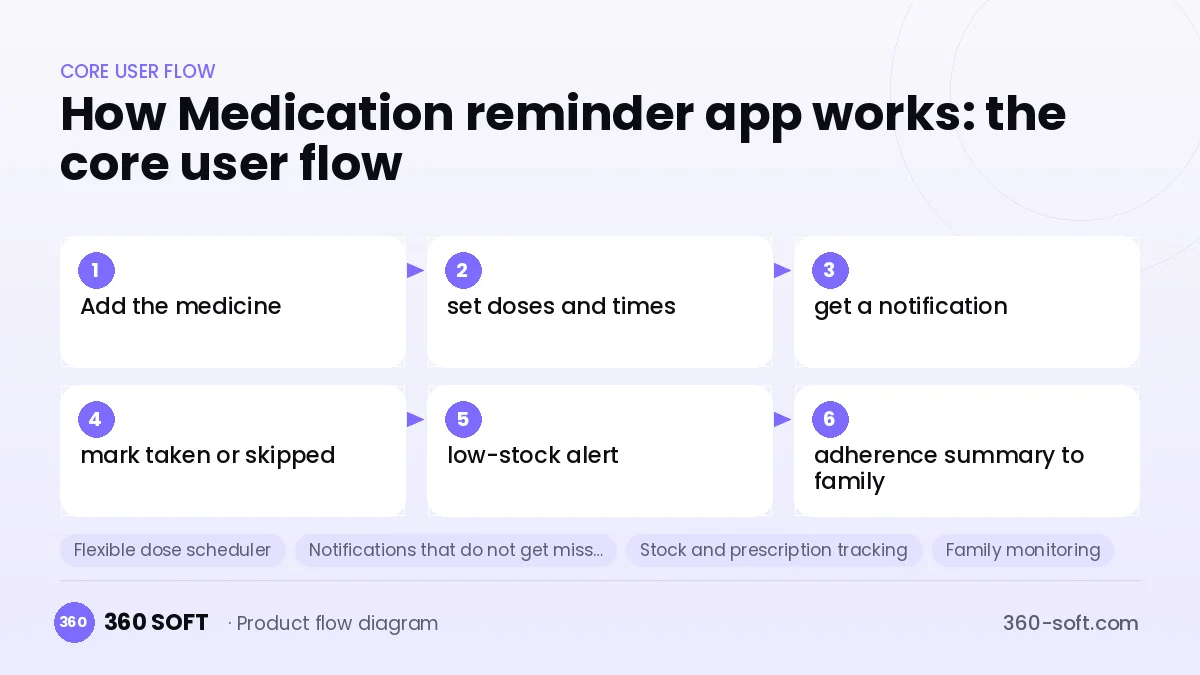
How Medication reminder app works: the core user flow
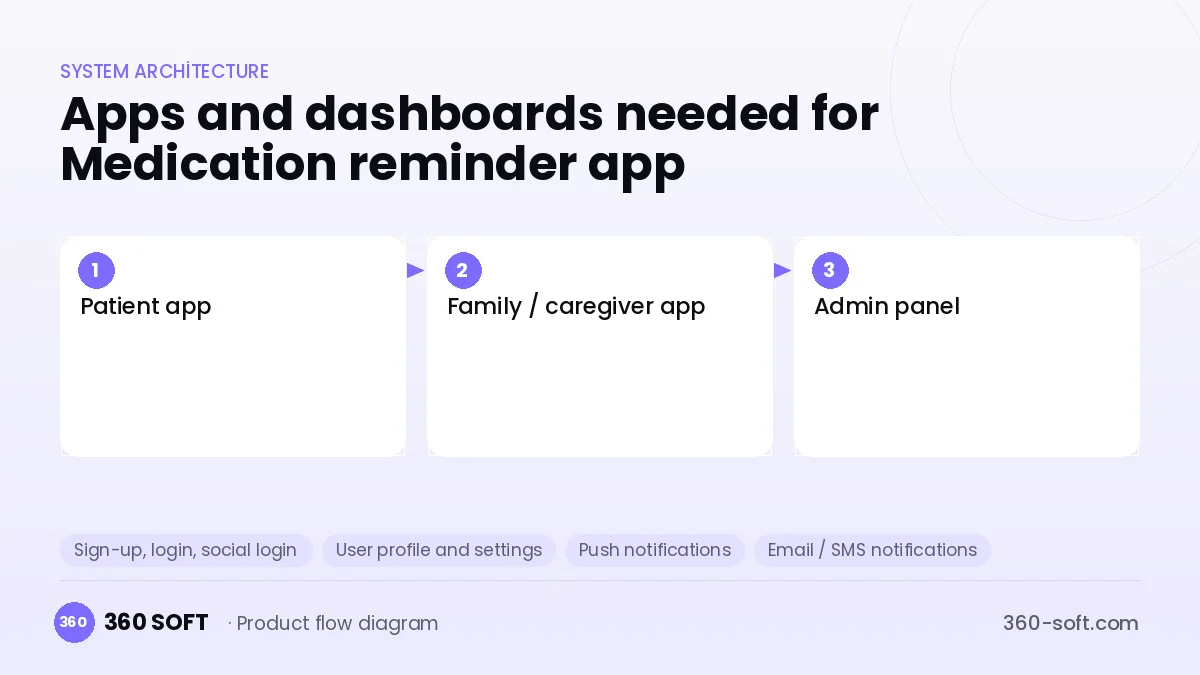
How many apps and dashboards do you need?
Patient app
The user's mobile app for entering medicines and dose plans, receiving reminders and logging doses.
Family / caregiver app
A view where a family member or caregiver remotely monitors the patient's doses and is alerted to missed ones.
Admin panel
An internal panel for the medicine database, notification templates, subscriptions and support requests.
Critical features of a product like Medication reminder app
Flexible dose scheduler
Medical plans such as every day, specific days, every other day, course length and gradually reduced doses are defined on a single screen.
Notifications that do not get missed
Local notifications, repeat reminders and an alarm sound for critical medicines; schedules survive even if the phone restarts.
Stock and prescription tracking
The pill count in the box falls with each dose, and a few days before it runs out the app prompts a prescription renewal and a pharmacy visit.
Family monitoring
When the patient allows it, a chosen family member sees the dose history and gets an instant alert for a missed dose.
Adherence report
Weekly and monthly adherence percentages, skipped doses and notes can be shared with a doctor as a PDF.
Medicine name search
Quick search by brand name and active ingredient, with images and package details to prevent mix-ups.
What goes into the first version, what comes later
First version (MVP)
- Adding medicines with a flexible dose schedule
- Reliable local notifications and snooze
- Taken / skipped dose history
- Stock counter and running-out alert
- Offline operation and cloud backup
Later releases
- Monitoring shared with a family member or caregiver
- PDF adherence report for the doctor
- Log for readings such as blood pressure and glucose
- Voice assistant and smartwatch notifications
Modules and how the budget is calculated
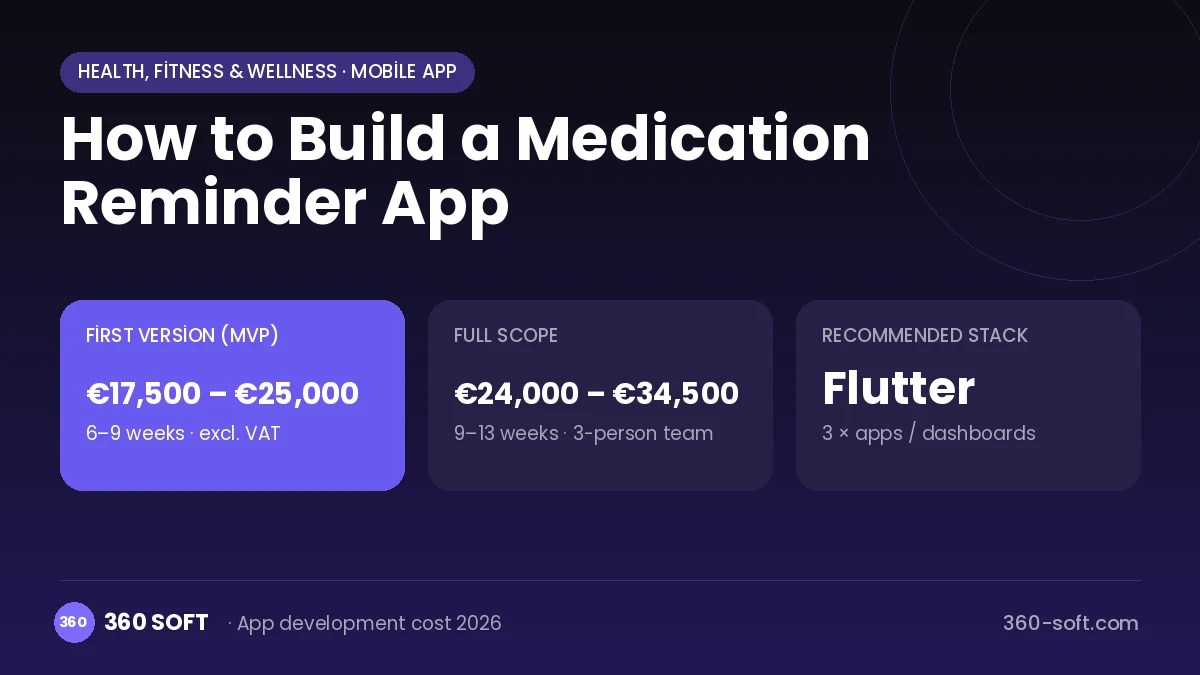
The budget is calculated with 360 SOFT’s pricing model from the modules below, about 16 screens and the project’s complexity: roughly 91 person-days for the full scope and 66 person-days for the first version. Every module you drop lowers the budget directly.
| Module | Phase |
|---|---|
| Sign-up, login, social login | First version |
| User profile and settings | First version |
| Push notifications | First version |
| Email / SMS notifications | First version |
| Offline mode and sync | Later release |
| Advanced search and filters | First version |
| Reporting and analytics | Later release |
| Subscriptions and recurring billing | First version |
| Roles and permissions | First version |
| GDPR and security hardening | First version |
Hosting, SMS, map APIs, app store accounts and payment-provider fees are separate items. Maintenance and improvements (optional): €300 / month. We send a fixed written price within 24 hours after a free discovery call.
The hard parts
Operating system restrictions
Battery saving on Android devices and iOS notification limits can delay alarms, so each device family needs separate testing.
Medical liability
The app must not recommend doses, only remind the plan the user entered, and warning texts and scope must be defined clearly.
Accessibility
Without large text, a simple flow, voice commands and high contrast for older users, the product will not reach its target audience.
Business model
Basic reminders can be free, while family monitoring, unlimited medicines, reports and backup are bundled into a premium subscription. A multi-patient institutional dashboard licence for care homes and home-care companies is a separate revenue line. Because medicine advertising is restricted by regulation, subscriptions and B2B should be preferred over an ad model.
Get a free quote for your project
Let us scope it together and send a fixed written quote within 24 hours. NDA on request; you own the source code.
Choosing a company to build an app like Medication reminder app
Most people searching “build a medication reminder app” are really looking for a reliable app development company. When comparing quotes, check four things:
- Can you try similar products they have shipped, in the stores or live?
- Are the source code, design files, servers and store accounts transferred to you by contract?
- Do they show a working demo every two weeks, with written scope and acceptance criteria?
- Are maintenance, scaling and GDPR/security costs written into the quote?
Copyright and trademarks
A business model and features are generally not protected on their own, but the Medication reminder app name, logo, interface design, content and source code are. That is why we build a product with similar functionality but your own brand, design and code. This is not legal advice; we recommend a trademark search before launch.
Frequently asked questions
How long does it take to build a medication reminder app?
A first version with dose plans, notifications and history can be ready in a relatively short time. Allow extra time for testing to prove that notifications fire reliably on different devices.
What should we watch out for with health data?
Medication and condition information is special-category personal data under GDPR. Explicit consent, encrypted storage, an appropriate hosting region and sharing permissions should be planned from the start.
Ready-made template or custom software?
Templates exist for simple reminders, but for a product that needs complex dose plans, family monitoring and dependable notifications, custom development is the safer choice.
What should I look for in an app development company for a medication reminder app?
Ask for proven experience with background notifications and offline sync, and request usability tests that were run with older users.