Mobile appHealth, fitness & wellness
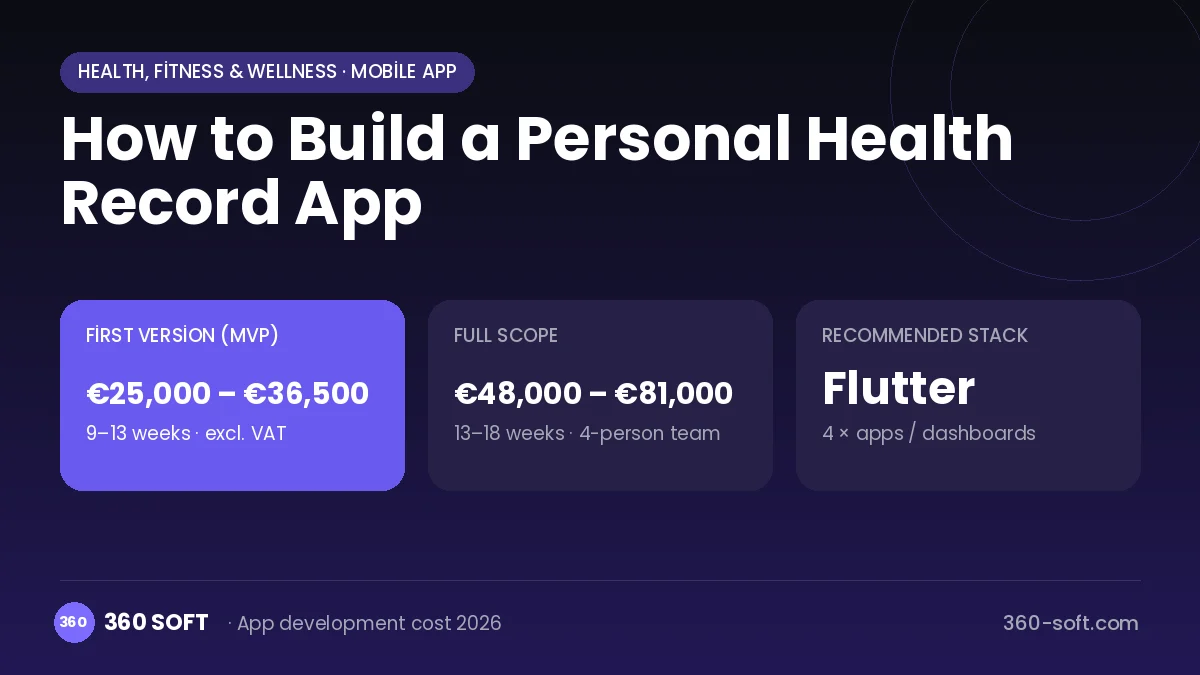
Personal health record apps like e-Nabiz, Turkey's national health record service, gather lab results, prescriptions, vaccinations and reports scattered across hospitals and laboratories in one place. Patients carry their history in their pocket and can share it with a new doctor in seconds. What makes the product valuable is data that is complete, current and trustworthy, along with patients keeping control over their own data.
Building something similar takes a patient mobile app, a clinician viewing interface, an integration layer that collects data from institutions and a back end with strict access control. Lab results, imaging reports and PDF documents are converted into standard formats. Security components such as encryption, access logging, consent management and emergency sharing are as important as the product itself.
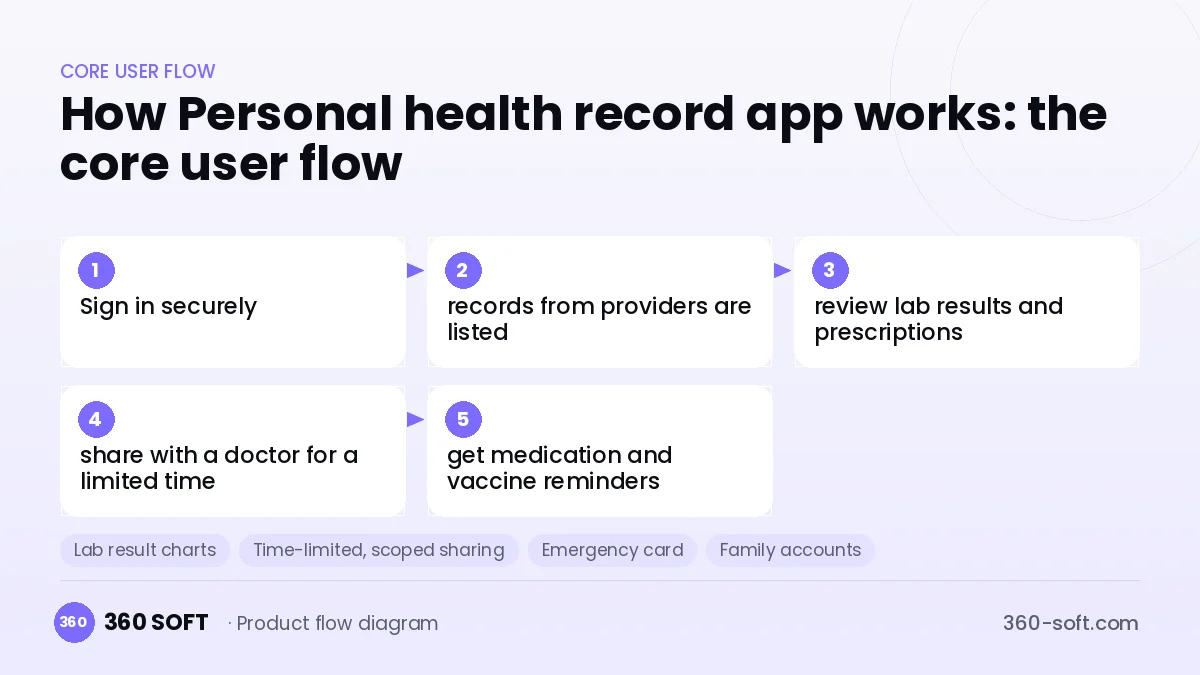
How Personal health record app works: the core user flow
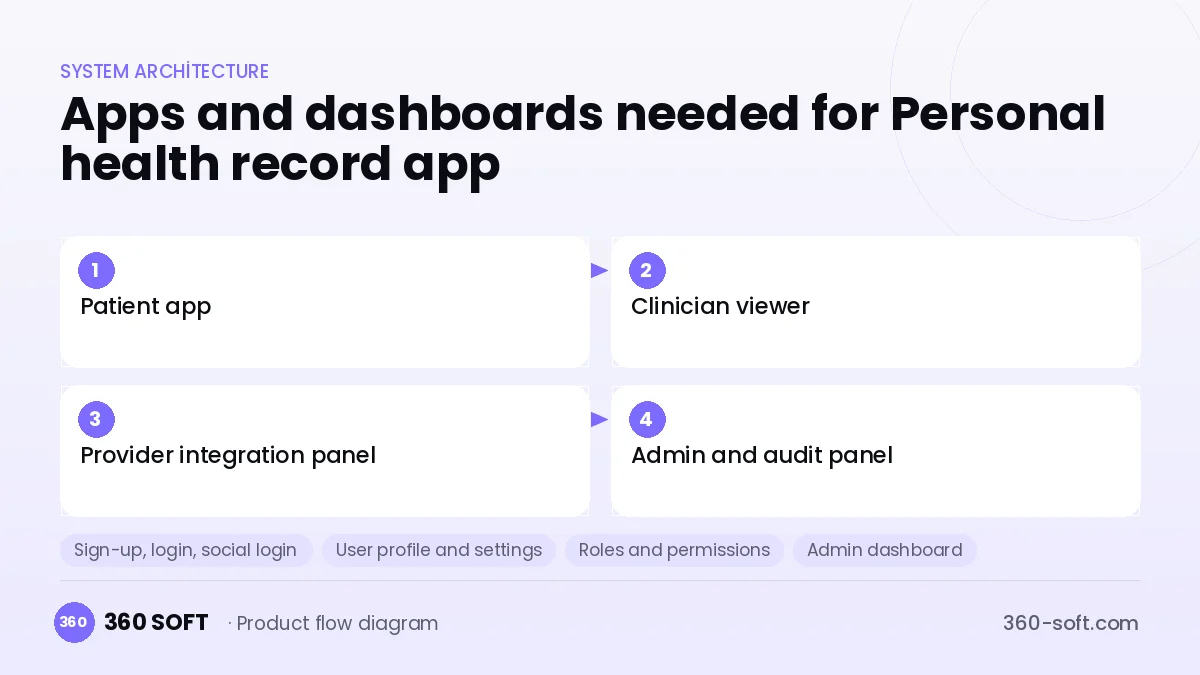
How many apps and dashboards do you need?
Patient app
The app where a person views lab results, prescriptions, vaccinations, allergies and reports and manages sharing permissions.
Clinician viewer
The doctor interface for reading the records a patient has permitted during a consultation.
Provider integration panel
The technical panel that monitors data feeds from hospitals and labs and resolves errors and matching problems.
Admin and audit panel
The administrator panel that tracks access logs, consent processes and security events.
Critical features of a product like Personal health record app
Lab result charts
Results such as blood values are charted over time, and values outside the reference range are flagged.
Time-limited, scoped sharing
The patient shares specific records with a specific doctor for a set period, and access closes when it ends.
Emergency card
Blood type, allergies, chronic conditions and emergency contacts are kept on a card reachable from the lock screen.
Family accounts
Parents can manage their children's records and carers can manage those of elderly relatives, within granted permissions.
Document upload and OCR
Users photograph and upload paper reports, and text recognition extracts dates and values.
Access log
Who accessed the record, when and for what purpose is shown transparently to the patient.
What goes into the first version, what comes later
First version (MVP)
- Secure sign-in and two-factor authentication
- Viewing lab, prescription and vaccination records
- Document upload and categorisation
- Time-limited sharing link for doctors
- Medication and vaccine reminders
Later releases
- Standards-based (FHIR) data integration with providers
- Lab trend analysis and interpretation support
- Importing wearable device data
- Family and carer accounts
Modules and how the budget is calculated
The budget is calculated with 360 SOFT’s pricing model from the modules below, about 26 screens and the project’s complexity: roughly 183 person-days for the full scope and 96 person-days for the first version. Every module you drop lowers the budget directly.
| Module | Phase |
|---|---|
| Sign-up, login, social login | First version |
| User profile and settings | First version |
| Roles and permissions | First version |
| Admin dashboard | First version |
| GDPR and security hardening | First version |
| File, photo, video upload | First version |
| Push notifications | First version |
| Email / SMS notifications | First version |
| Third-party API integration | First version |
| Reporting and analytics | Later release |
| AI features (LLM, RAG, recommendations) | Later release |
| Offline mode and sync | Later release |
Hosting, SMS, map APIs, app store accounts and payment-provider fees are separate items. Maintenance and improvements (optional): €600 / month. We send a fixed written price within 24 hours after a free discovery call.
The hard parts
Access to data sources
Institutions need a legal basis, a contract and a technical standard to share data, so writing the app alone is not enough.
Special-category data security
Health data is the most sensitive kind under GDPR, so encryption, in-region hosting and audit logging are mandatory.
Data standardisation
Different labs send the same test under different names and units, which must be resolved with mapping tables.
Business model
Systems offered by the public sector are free; as a private product, revenue generally comes from institutions. Private hospital groups and insurers pay a licence for a branded app for their own patients. On the consumer side, a premium subscription with advanced analysis, family accounts and unlimited document storage is conceivable; health data must never be used for advertising.
Get a free quote for your project
Let us scope it together and send a fixed written quote within 24 hours. NDA on request; you own the source code.
Choosing a company to build an app like Personal health record app
Most people searching “build a personal health record app” are really looking for a reliable app development company. When comparing quotes, check four things:
- Can you try similar products they have shipped, in the stores or live?
- Are the source code, design files, servers and store accounts transferred to you by contract?
- Do they show a working demo every two weeks, with written scope and acceptance criteria?
- Are maintenance, scaling and GDPR/security costs written into the quote?
Copyright and trademarks
A business model and features are generally not protected on their own, but the Personal health record app name, logo, interface design, content and source code are. That is why we build a product with similar functionality but your own brand, design and code. This is not legal advice; we recommend a trademark search before launch.
Frequently asked questions
How long does it take to build a personal health record app?
A first version with document upload, record viewing and sharing can be ready in a few months. Provider integrations should be planned separately, depending on how ready each data source is.
How do you get access to hospital data?
Data can only be obtained through an agreement with the institution, a legal basis and standard interfaces. Starting with documents users upload themselves is a practical way in.
Will there be copyright or trademark issues?
The idea of a personal health record and its features are free to use, but the name, logo, design and content of an official system cannot be used, and you must not give the impression of being a public body. This is not legal advice.
What should I look for when choosing a company to build a health app?
Ask about experience with health data standards, security testing and GDPR-compliant architecture. A penetration test and a data retention policy should be in the proposal.