Mobile appHealth, fitness & wellnessOriginal by ClassPass
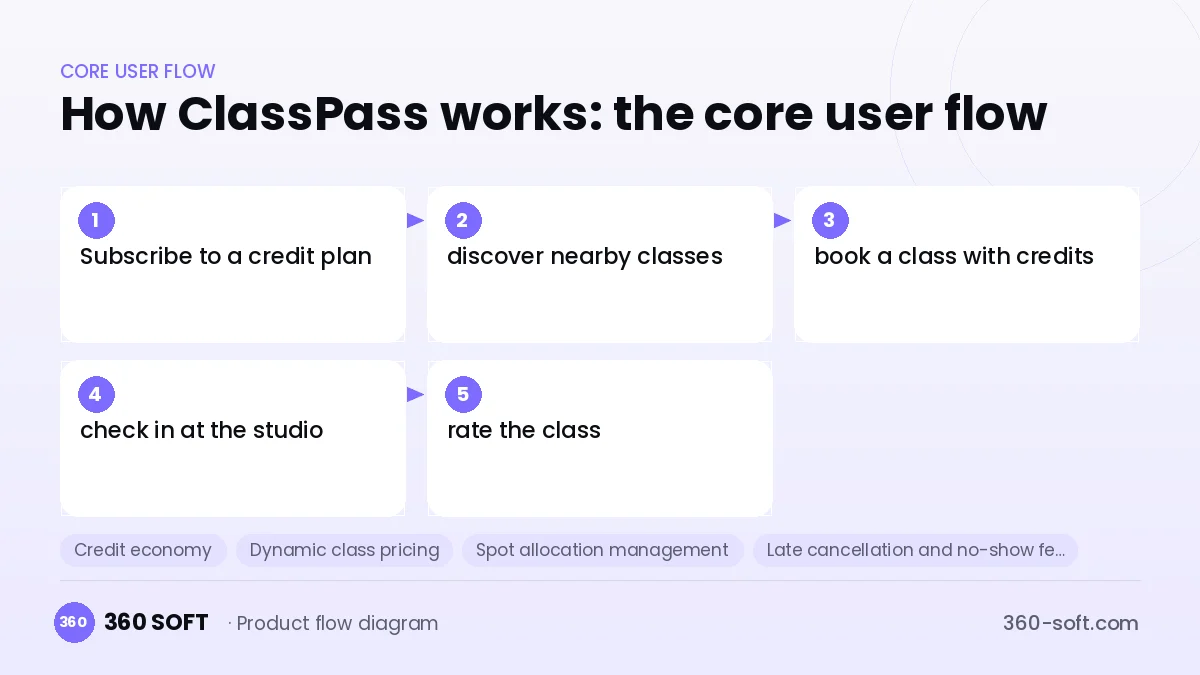
ClassPass lets users who do not want to commit to a single gym try different studios, from yoga and pilates to boxing and spinning, on one membership. Users buy monthly credits and spend them to book the classes they want. Studios earn extra income by selling spots that would otherwise stay empty to new customers, so both sides win.
Building something similar takes a user app, a studio panel and a back end that runs the credit economy. The real challenge is less technical than the pricing engine: a class's credit value changes with time of day, occupancy and area. Integration with studios' own booking software, monthly payout reconciliation, studio contracts and a field sales team that signs new partners are central to operations.
How ClassPass works: the core user flow
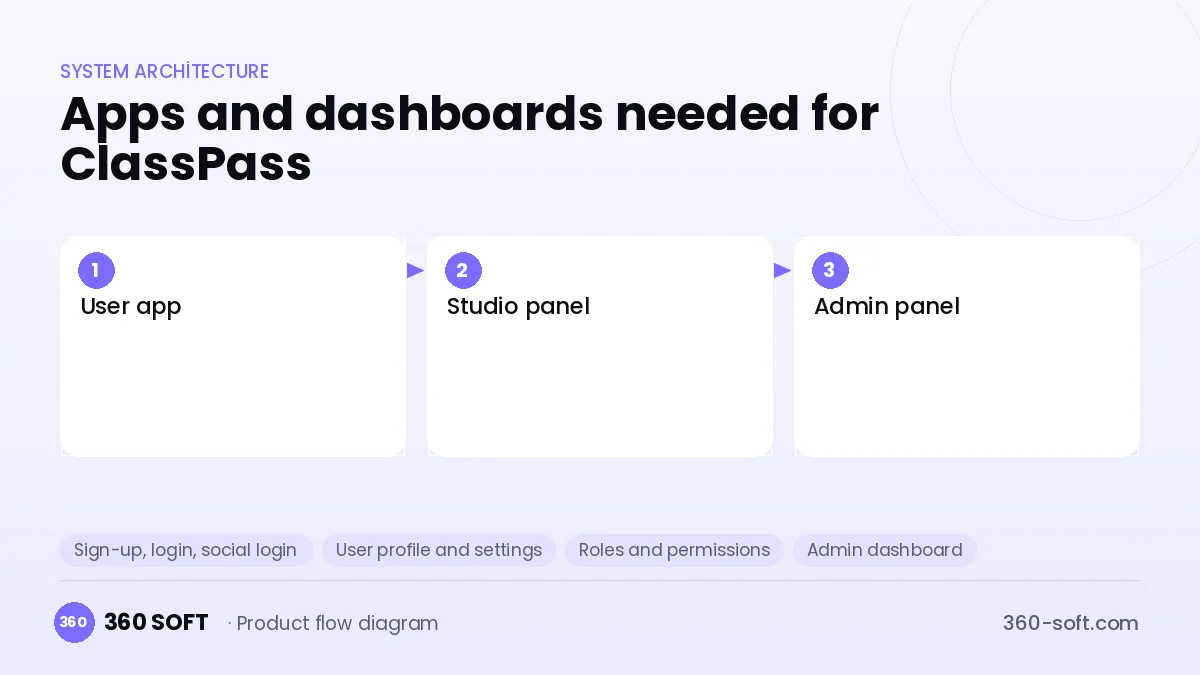
How many apps and dashboards do you need?
User app
The app for finding classes and studios, booking with credits and managing the subscription.
Studio panel
The web panel where a studio sees its class schedule, the spots opened to the platform, attendee lists and earnings.
Admin panel
The internal panel that manages credit prices, studio contracts, payments and user support.
Critical features of a product like ClassPass
Credit economy
Credits granted with a monthly plan are spent at different values depending on a class's popularity and time, and unused credits roll over at a limited rate.
Dynamic class pricing
Classes with high occupancy cost more credits and quiet slots cost fewer, which balances studio revenue.
Spot allocation management
The studio decides how many spots to open to the platform for each class, and the class closes automatically once they are taken.
Late cancellation and no-show fees
Credits or money are deducted from users who cancel after the cut-off or fail to attend.
Studio software integration
Class schedules and bookings are synced over API with management software such as Mindbody.
Personal recommendations
New classes and studios are suggested based on the user's past classes, preferred times and location.
What goes into the first version, what comes later
First version (MVP)
- Monthly subscription with credit packs
- Class discovery by map and list
- Credit-based class booking and cancellation
- Studio panel: schedule and attendee list
- Studio payout report
Later releases
- Dynamic credit pricing algorithm
- API integration with studio software
- Corporate employee memberships
- Live and on-demand online classes
Modules and how the budget is calculated
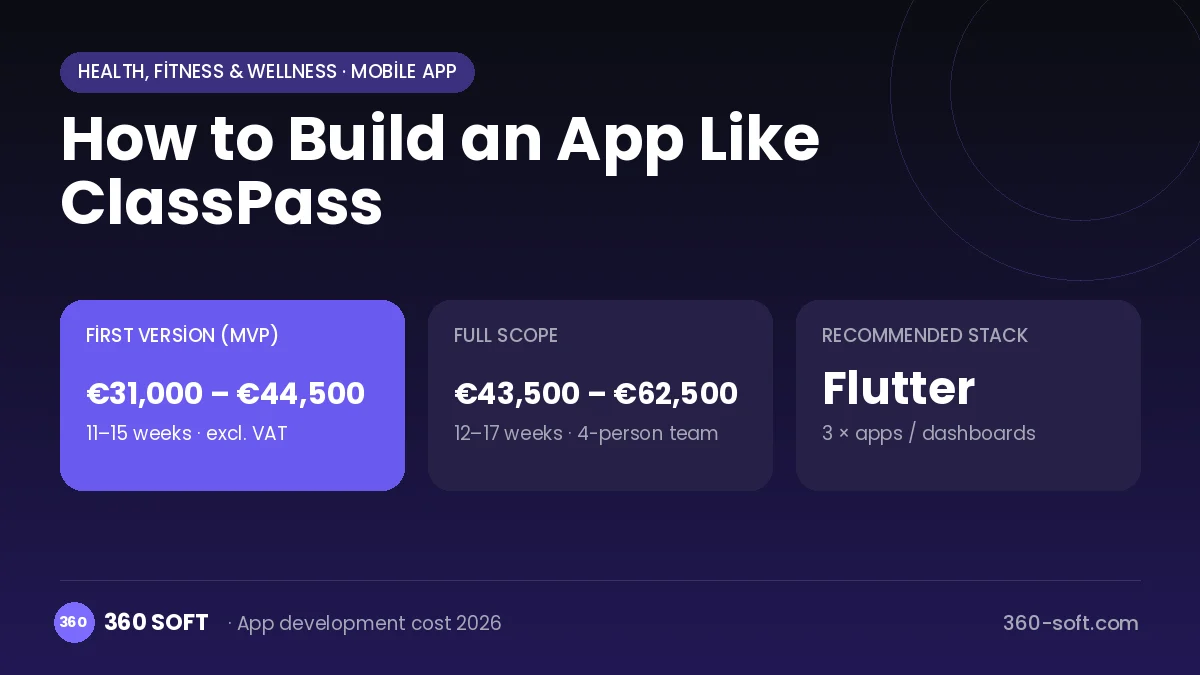
The budget is calculated with 360 SOFT’s pricing model from the modules below, about 28 screens and the project’s complexity: roughly 166 person-days for the full scope and 117 person-days for the first version. Every module you drop lowers the budget directly.
| Module | Phase |
|---|---|
| Sign-up, login, social login | First version |
| User profile and settings | First version |
| Roles and permissions | First version |
| Admin dashboard | First version |
| Subscriptions and recurring billing | First version |
| Online payments (Stripe / PSP) | First version |
| Booking / reservations | First version |
| Advanced search and filters | First version |
| Maps, location, routing | First version |
| Ratings and reviews | First version |
| Push notifications | First version |
| Reporting and analytics | Later release |
| Third-party API integration | First version |
Hosting, SMS, map APIs, app store accounts and payment-provider fees are separate items. Maintenance and improvements (optional): €550 / month. We send a fixed written price within 24 hours after a free discovery call.
The hard parts
Balancing credit value
Finding a credit price that is attractive to users and profitable for studios takes constant data analysis and tuning.
Building a studio network
The app creates no value without enough studios in enough variety, so a field sales team and contract management are essential.
Schedule sync
If changes in a studio's own system do not reach the platform immediately, a user may turn up to a cancelled class.
Business model
The main revenue is the monthly credit subscription, with the platform earning the difference between what users pay and what it pays studios per class. Extra credit sales, late cancellation fees and corporate wellness packages sold to companies form a second revenue line. Selling promotion and featured-placement campaigns to studios is also possible, while margin depends directly on the share of unused credits.
Get a free quote for your project
Let us scope it together and send a fixed written quote within 24 hours. NDA on request; you own the source code.
Choosing a company to build an app like ClassPass
Most people searching “build an app like classpass” are really looking for a reliable app development company. When comparing quotes, check four things:
- Can you try similar products they have shipped, in the stores or live?
- Are the source code, design files, servers and store accounts transferred to you by contract?
- Do they show a working demo every two weeks, with written scope and acceptance criteria?
- Are maintenance, scaling and GDPR/security costs written into the quote?
Copyright and trademarks
A business model and features are generally not protected on their own, but the ClassPass name, logo, interface design, content and source code are. That is why we build a product with similar functionality but your own brand, design and code. This is not legal advice; we recommend a trademark search before launch.
Frequently asked questions
How long does it take to build an app like ClassPass?
A first version with subscriptions, class discovery and booking is usually completed in a few months. Dynamic pricing and integrations are added as data accumulates.
How do you make deals with studios?
Typically a fixed or tiered payment per class is agreed for the studio's empty spots. This commercial model needs to be settled before launch as much as the technical side does.
Will there be copyright or trademark issues?
The multi-studio membership business model and its features are generally free to use, but the name, logo, design, content and code cannot be copied. This is not legal advice.
What should I look for when choosing a company to build an app like ClassPass?
Look at their experience with subscription and credit accounting, booking systems and third-party API integrations.